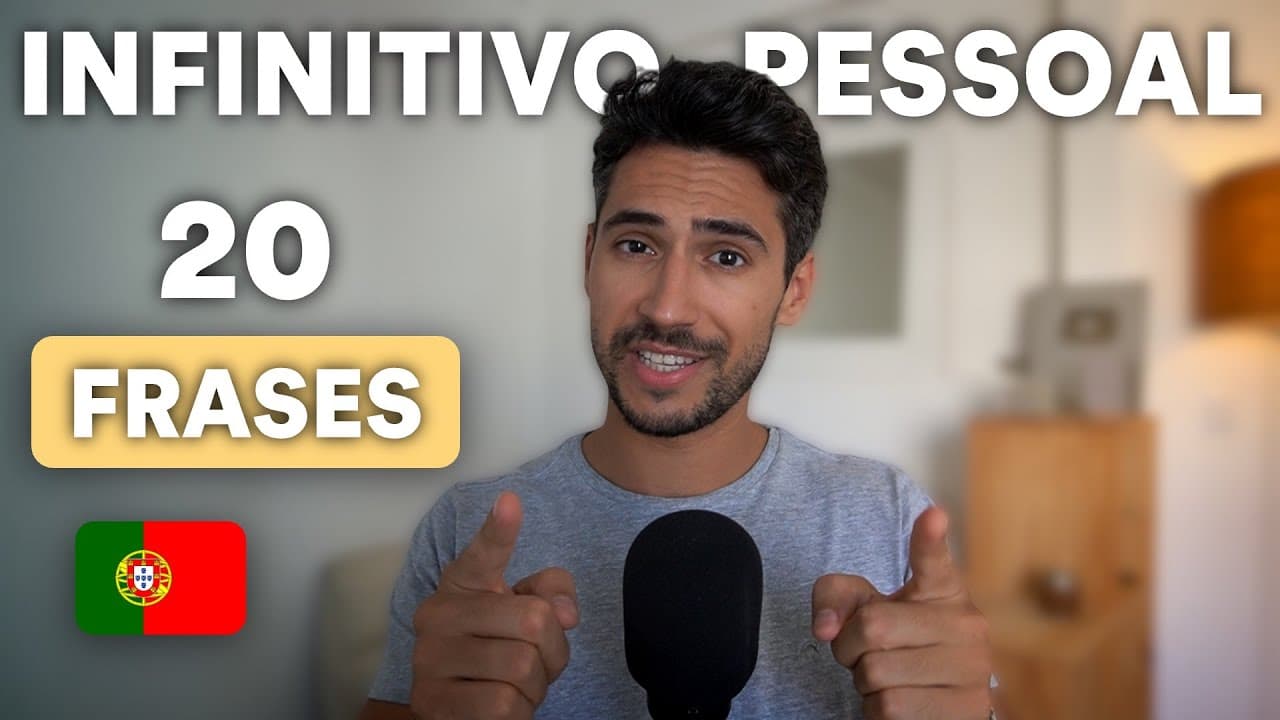
20 FRASES para APRENDERMOS o Infinitivo Pessoal
TL;DR
Learn to use and conjugate the Portuguese personal infinitive.
Transcript
The infinitive! That tense we take for granted, because basically it's the verb itself. It's just a word, like machen in German or hacer in Spanish, or in the case of English we add to + verb: to do. There are even languages that make things simpler and don't even have an infinitive, like Japanese or Arabic. And then there's Portuguese, where ... Read More
Key Insights
- The Portuguese personal infinitive is a unique verb form where the infinitive is conjugated based on the subject, unlike in many other languages.
- Conjugating the personal infinitive involves adding specific endings: -es, -mos, and -em, depending on the subject pronoun.
- The personal infinitive is used in impersonal sentences, often with the structure 'ser + adjective + infinitive', to express general advice or opinions.
- Another use of the personal infinitive is after prepositions or prepositional phrases, where the verb must be conjugated if a personal pronoun can be inserted between the preposition and the verb.
- A common mistake in writing the personal infinitive is adding a hyphen when using the '-mos' ending, which should only occur in specific pronoun combinations.
- The lesson provides 20 example sentences to practice and internalize the use of the personal infinitive, enhancing fluency in Portuguese.
- Resources such as a free PDF with exercises and a summary of the lesson are available to reinforce learning and practice at home.
- Supporters on Patreon can influence future lesson topics and access exclusive content to further improve their Portuguese skills.
Install to Summarize YouTube Videos and Get Transcripts
Explore YouTube Video Summarizer or Get YouTube Transcript Extractor
Questions & Answers
Q: What is the personal infinitive in Portuguese?
The personal infinitive in Portuguese is a form of the infinitive verb that is conjugated according to the subject pronoun. Unlike the regular infinitive, which remains unchanged, the personal infinitive takes specific endings (-es, -mos, -em) depending on the subject, allowing for a more precise expression of actions related to different subjects.
Q: When do you use the personal infinitive?
The personal infinitive is used in two main situations: impersonal sentences and after prepositions or prepositional phrases. In impersonal sentences, it follows the structure 'ser + adjective + infinitive' to express general advice or opinions. After prepositions, the verb is conjugated if a personal pronoun can be inserted between the preposition and the verb.
Q: How do you conjugate verbs in the personal infinitive?
To conjugate verbs in the personal infinitive, specific endings are added to the infinitive form based on the subject pronoun. The endings are -es for 'you', -mos for 'we', and -em for 'you/they'. For example, the verb 'fazer' becomes 'fazeres', 'fazermos', and 'fazerem' for 'you', 'we', and 'they', respectively.
Q: What is a common mistake when using the personal infinitive?
A common mistake when using the personal infinitive is incorrectly adding a hyphen when conjugating verbs with the '-mos' ending. This hyphen should only be used when combining the indirect complement personal pronoun in the first person singular with the definite article 'os'. Otherwise, the hyphen is unnecessary and incorrect.
Q: What resources are available to help learn the personal infinitive?
Leonardo offers a free downloadable PDF that includes a summary of the lesson and exercises to practice the personal infinitive. Additionally, learners can access various resources on his website and support him on Patreon for exclusive content and the opportunity to influence future lesson topics.
Q: What are impersonal sentences, and how do they use the personal infinitive?
Impersonal sentences use the structure 'ser + adjective + infinitive' to express general advice or opinions. In these sentences, the personal infinitive is used to convey actions that are important or necessary, such as 'It is important to learn the personal infinitive'. The verb in the infinitive is conjugated according to the subject.
Q: How do prepositions affect the use of the personal infinitive?
Prepositions affect the use of the personal infinitive by requiring the verb to be conjugated if a personal pronoun can be placed between the preposition and the verb. This means that not all verbs following prepositions are conjugated in the personal infinitive, only those where the pronoun insertion is possible.
Q: How can learners practice the personal infinitive?
Learners can practice the personal infinitive by repeating example sentences provided in the lesson, which helps internalize the conjugation logic. Additionally, they can use the exercises in the downloadable PDF to reinforce their understanding and apply the personal infinitive in various contexts, enhancing their fluency in Portuguese.
Summary & Key Takeaways
-
The video explains the concept of the Portuguese personal infinitive, a conjugated form of the infinitive verb used in specific grammatical situations. It covers how to conjugate verbs in this form and when to apply it in sentences.
-
Leonardo provides practical examples and exercises to help learners understand and use the personal infinitive naturally. The lesson includes sentences for repetition to aid memorization and application in everyday communication.
-
Additional resources, such as a downloadable PDF and Patreon support, offer learners more opportunities to practice and engage with the content, enhancing their understanding of the Portuguese language.
Read in Other Languages (beta)
Share This Summary 📚
Summarize YouTube Videos and Get Video Transcripts with 1-Click
Try YouTube Summary with ChatGPT & Claude or YouTube Transcript Generator
Explore More Summaries from Portuguese With Leo 📚





Summarize YouTube Videos and Get Video Transcripts with 1-Click
Try YouTube Summary with ChatGPT & Claude or YouTube Transcript Generator