How Does DSpark Speed Up AI Model Generation?
TL;DR
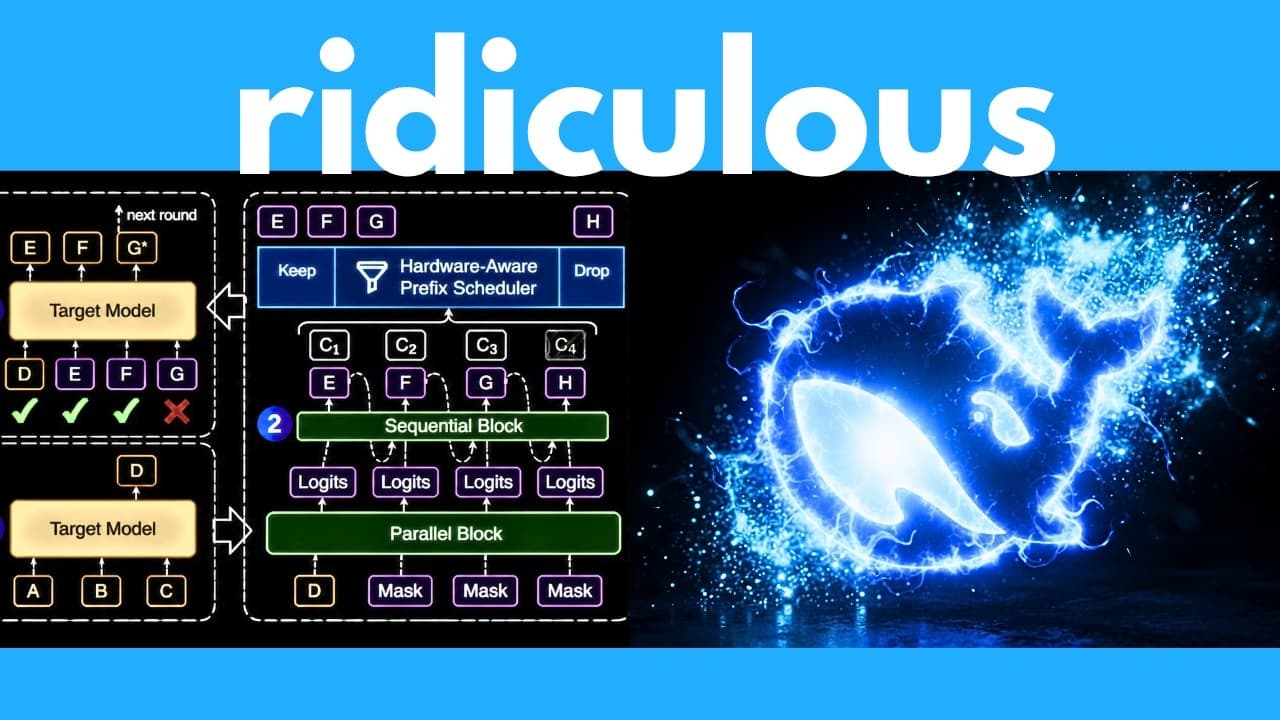
DSpark claims to increase AI output capacity by more than 600% and reduce generation time by over 80% without lowering output quality. It improves speculative decoding by addressing the central tradeoff between slow, accurate autoregressive drafting and fast, error-prone parallel drafting, while leaving the large model responsible for every final token decision.
Transcript
If you've been working with AI models, especially with agents that are doing some really challenging or long tasks, they take quite a while to process and generate your answer. It sometimes takes a painfully long time to wait for it to generate a response or finish a task. But what if that weight basically disappeared? What if instead of watching a... Read More
Key Insights
- Autoregressive generation is a sequential process in which an AI model produces one token at a time. Each new token depends on the preceding context, so longer answers inherently require more generation steps and take more time to complete.
- Memory retrieval is described as the main generation bottleneck rather than neural-network computation. The GPU processes each available batch quickly, but it must repeatedly wait while saved contextual values and token relationships are fetched before calculating the next output.
- Speculative decoding is a lossless acceleration technique that uses a smaller model to draft several tokens ahead. A larger model then checks those proposed tokens simultaneously, taking advantage of the GPU's ability to perform substantial amounts of work in parallel.
- Rejection sampling is the verification mechanism used when a speculative draft diverges from the large model. Tokens are examined from left to right, and the first rejected token causes that token and all subsequent draft tokens to be discarded.
- The large model is the final authority in speculative decoding. The smaller model only proposes text, while the larger model determines what is accepted, allowing generation to become faster without intentionally substituting the smaller model's lower-quality output.
- Autoregressive drafters are relatively accurate because every proposed token can depend on earlier tokens in the draft. Their disadvantage is sequential execution, which means producing a longer speculative block also requires more time and limits the achievable acceleration.
- Parallel drafters are fast because they predict an entire block of tokens in one pass. However, simultaneous predictions cannot naturally build on one another, causing later positions in the proposed block to become progressively less reliable as draft length increases.
- Suffix decay is the deterioration of later token predictions in a parallel draft. DeepSeek's DSpark is presented as a system designed to overcome the conflict between this parallel-drafting weakness and the slower execution of sequential autoregressive drafting.
Install to Summarize YouTube Videos and Get Transcripts
Explore YouTube Video Summarizer or Get YouTube Transcript Extractor
Questions & Answers
Q: Why does AI text generation slow down on long answers?
AI text generation slows down because autoregressive models produce only one token at a time. Before generating each token, the model must consider the text already produced and fetch saved contextual relationships from memory. The GPU handles the resulting neural-network computation quickly, but it repeatedly waits for those values, and the next step cannot begin until the previous token is confirmed.
Q: What is speculative decoding in AI models?
Speculative decoding is a method for accelerating generation by pairing a fast, smaller drafting model with a larger model. The smaller model proposes several tokens in advance, and the large model verifies those proposals together in parallel. Accepted tokens are added to the response, while an incorrect token and the draft after it are rejected before drafting resumes.
Q: How can speculative decoding preserve output quality?
Speculative decoding can preserve output quality because the small drafting model does not make the final decision. It only suggests possible tokens. The large model checks those suggestions and accepts only the tokens that align with its own decisions. Consequently, the smaller model helps the larger model write faster without replacing the larger model as the source of the final output.
Q: How does rejection sampling work during speculative decoding?
Rejection sampling checks a speculative draft from left to right against the larger model's decisions. Correctly aligned tokens are accepted. When the first mismatch appears, that token and every proposed token following it are rejected. The smaller model then begins drafting again from the accepted position, and this cycle repeats until the response has been generated.
Q: What is the difference between autoregressive and parallel drafters?
An autoregressive drafter predicts tokens sequentially, allowing each new prediction to use the earlier draft tokens as context. This improves reliability but makes long drafts slower. A parallel drafter predicts an entire block in one pass, using GPU parallelism more efficiently. Its weakness is that later predictions cannot naturally depend on earlier predictions, increasing errors toward the end.
Q: What is suffix decay in parallel token drafting?
Suffix decay is the tendency for predictions near the end of a parallel draft to become less reliable. Because all positions are predicted simultaneously, later tokens cannot build naturally on the precise tokens selected at earlier positions. The transcript illustrates this with valid phrases being mixed into incorrect combinations, and explains that the problem worsens as the drafted block becomes longer.
Q: What performance improvements does DSpark claim?
DSpark is claimed to increase AI model output capacity by more than 600% and speed generation by over 80% without sacrificing quality. The video presents these results as a response to the usual tradeoff between speed and accuracy in speculative decoding. It attributes the improvement to engineering that develops the parallel-drafting approach while addressing its reliability limitations.
Q: Why does DeepSeek focus heavily on model efficiency?
DeepSeek is described as a small Chinese laboratory with about 20 times fewer employees than OpenAI and without access to the top Nvidia GPUs. These resource and compute constraints prevent it from relying simply on increasingly large models. According to the transcript, this situation encourages the team to pursue efficient designs, publish technical details, and improve performance through engineering rather than brute-force scale.
Summary & Key Takeaways
-
AI text generation is slow because an autoregressive model produces one token at a time and repeatedly fetches stored contextual relationships from memory. GPUs can process neural-network calculations quickly, but they often sit idle while waiting for the information required to calculate and confirm the next token in sequence.
-
Speculative decoding assigns a smaller, faster model to draft several tokens before the large model evaluates them together. The large model accepts matching tokens and rejects the first incorrect token plus everything after it. Because the large model retains final authority, this acceleration method can preserve the original model's output quality.
-
Existing drafting methods create a difficult tradeoff. Autoregressive drafters build text sequentially and produce more reliable guesses, but their drafts take longer to create. Parallel drafters generate whole blocks efficiently, yet later predictions deteriorate through suffix decay. DSpark is presented as DeepSeek's approach to resolving these conflicting weaknesses.
Read in Other Languages (beta)
Share This Summary 📚
Summarize YouTube Videos and Get Video Transcripts with 1-Click
Try YouTube Summary with ChatGPT & Claude or YouTube Transcript Generator
Explore More Summaries from AI Search 📚





Summarize YouTube Videos and Get Video Transcripts with 1-Click
Try YouTube Summary with ChatGPT & Claude or YouTube Transcript Generator