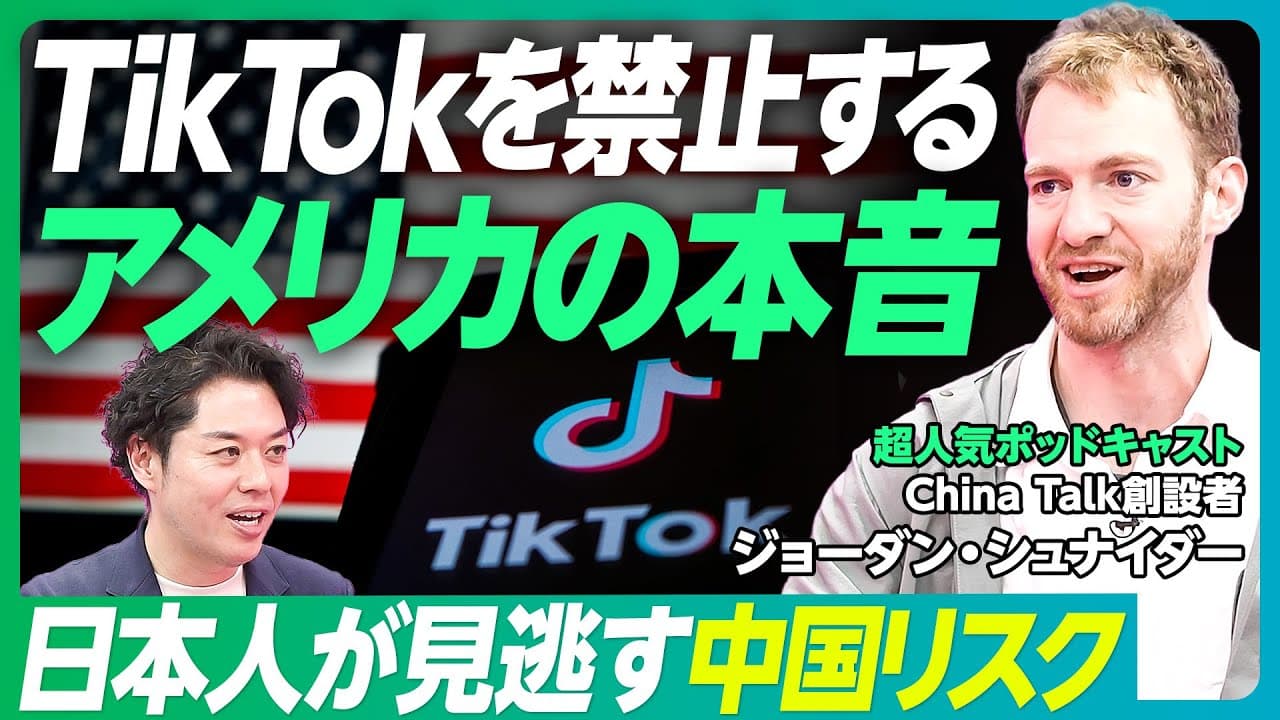
【TikTok禁止 米国人の本音】中国政府への情報漏えい懸念して法が成立/China Talk創設者ジョーダン・シュナイダー/日本人が気づかない米中戦/表現の自由論【PIVOT GLOBAL】
TL;DR
The US may ban TikTok due to security concerns with China.
Transcript
why is us trying to ban Tik Tok so you know the story of Tik Tok it started of course musically it was this like you know lipsyncing app and then all of a sudden it was you know it's very it now has 100 million daus in America which is kind of unbelievable I think a lot of people have the concern that once an app goes from uh you know gets to that ... Read More
Key Insights
- TikTok's massive user base in the US raises concerns about potential influence on public opinion and national security.
- The US-China relationship has evolved from cooperation to competition, especially under Xi Jinping's leadership.
- China's economic rise and assertive policies have led to a reassessment of its role in global politics by the US.
- The US political landscape could drastically change if Trump is re-elected, affecting international relations.
- TikTok's influence is compared to Soviet control over media during the Cold War, highlighting security risks.
- The debate over TikTok includes issues of national security versus freedom of expression.
- China's technological advancements and military investments have increased its confidence on the global stage.
- Japan faces a dilemma whether to follow the US lead on banning TikTok or chart its own course.
Install to Summarize YouTube Videos and Get Transcripts
Explore YouTube Video Summarizer or Get YouTube Transcript Extractor
Questions & Answers
Q: Why is the US considering banning TikTok?
The US is considering banning TikTok due to concerns that its Chinese ownership could allow the Chinese government to influence American public opinion and access sensitive data. The app's large user base and its role as a primary news source for young Americans make it a potential tool for information manipulation.
Q: How has the US-China relationship evolved over the years?
The US-China relationship has evolved from cooperation and economic integration to strategic competition. Initially, the US believed that engaging with China would lead to liberalization and democratization. However, under Xi Jinping's leadership, China has become more assertive, challenging the existing international order and prompting the US to reassess its approach.
Q: What impact could Trump's re-election have on US foreign policy?
If Trump is re-elected, US foreign policy could become more unpredictable, with potential shifts in alliances and a less consistent approach to international relations. Trump's previous term saw significant changes in trade policies and diplomatic relations, and his re-election could further strain US-China relations and affect alliances with countries like Japan and South Korea.
Q: What are the main arguments for and against banning TikTok?
Proponents of banning TikTok argue that it poses a national security risk due to its Chinese ownership and potential for influencing public opinion. Opponents argue that a ban could infringe on freedom of expression and affect creators who rely on the platform. The debate balances security concerns with the impact on digital communication and expression.
Q: How has China's global role changed under Xi Jinping?
Under Xi Jinping, China has become more assertive on the global stage, investing in military capabilities and pursuing aggressive foreign policies. This shift has led to increased tensions with the US and other countries, as China seeks to reshape the international order to reflect its interests and expand its influence globally.
Q: Why is TikTok's influence compared to Cold War media control?
TikTok's influence is compared to Cold War media control because of its potential to shape public opinion and disseminate information. During the Cold War, media control was a strategic tool for influencing populations. Similarly, TikTok's algorithm could be manipulated to favor certain narratives, making it a strategic concern for national security.
Q: What challenges does Japan face regarding TikTok?
Japan faces the challenge of deciding whether to align with the US in banning TikTok or to adopt its own approach. This decision involves balancing national security concerns with the potential impact on digital communication and its relationship with China. Japan must consider the implications of either choice on its international standing and domestic policy.
Q: How does the US view China's potential to reshape the global order?
The US views China as the only country capable of challenging the current international order due to its economic power and assertive policies. However, recent developments suggest that China's influence may not be as dominant as feared, with the US and other democracies regaining confidence in their global leadership roles.
Summary & Key Takeaways
-
The discussion highlights the potential ban of TikTok in the US due to concerns about Chinese influence and data security. TikTok's large user base and its role in shaping public opinion are central to these concerns.
-
The US-China relationship has shifted from economic integration to strategic competition, especially with China's growing global influence and assertive international policies under Xi Jinping.
-
The potential re-election of Trump could lead to significant changes in US domestic and foreign policy, affecting alliances and the approach towards China.
Read in Other Languages (beta)
Share This Summary 📚
Summarize YouTube Videos and Get Video Transcripts with 1-Click
Try YouTube Summary with ChatGPT & Claude or YouTube Transcript Generator
Explore More Summaries from PIVOT 公式チャンネル 📚





Summarize YouTube Videos and Get Video Transcripts with 1-Click
Try YouTube Summary with ChatGPT & Claude or YouTube Transcript Generator