How Does NVIDIA DGX Spark Cut AI Cloud Costs?
TL;DR
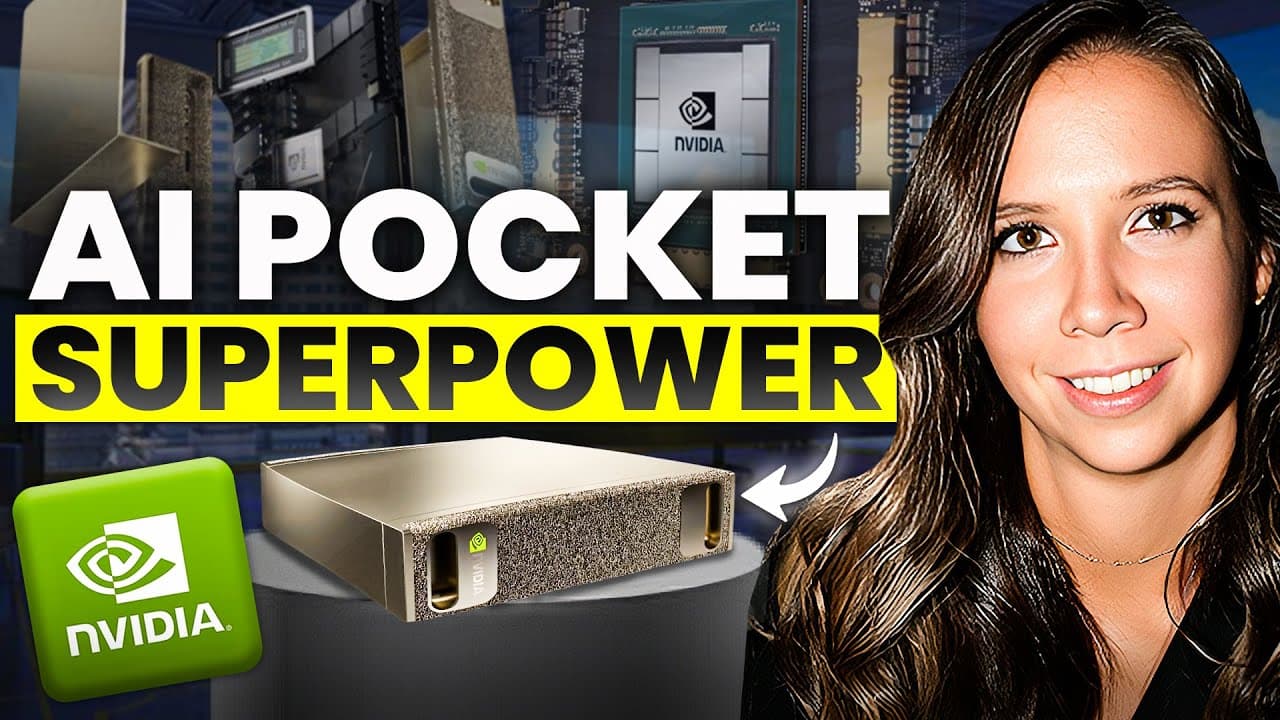
NVIDIA’s DGX Spark brings one petaflop of AI performance and 128 GB of unified memory to a 5.9-inch desktop system costing $3,999. It can fine-tune models up to 70 billion parameters locally, potentially reducing development costs by 70–90%, while cloud infrastructure remains necessary for massive training runs, unpredictable workloads, and production inference at scale.
Transcript
Nine years and everything just changed. In 2016, Jensen Hang handd delivered the first DGX1 supercomput to a little startup called Open AI. That machine weighed 134 lbs, consumed 3,200 watts per and cost $129,000 on a zone. It helped train the AI that became Chat GPT. On October 13th, 2025, Jensen walked through SpaceX Starbase hours before Starshi... Read More
Key Insights
- DGX Spark is a $3,999 desktop AI system offering one petaflop of performance, 128 GB of unified memory, and a 5.9-inch cube form factor. Its CPU and GPU share memory, which is presented as eliminating memory-transfer bottlenecks during local AI development.
- The system can fine-tune models containing up to 70 billion parameters locally and run inference on models containing up to 200 billion parameters. Clustering two units is presented as a way to handle models containing as many as 405 billion parameters.
- A hybrid workflow is the central recommendation: develop and prototype locally, use cloud resources for large-scale training when required, and deploy to either edge or cloud infrastructure according to the use case. The estimated savings from this model are 70–90%.
- DGX Spark can improve data privacy by allowing healthcare, finance, and other sensitive workloads to remain on premises during development. Local processing avoids sending protected information to cloud services and reduces the need to construct an expensive private-cloud environment.
- The economics depend on current cloud spending. A solo developer spending $500–$800 monthly is projected to break even in five to six months, while a three-engineer startup spending $3,000–$5,000 monthly could recover the cost of three units in three to four months.
- Local compute can remove cloud quotas and shared-cluster queues that delay experiments. The video argues that developers may iterate two to three times faster, while researchers may publish 30–50% faster because they can run experiments whenever needed.
- DGX Spark does not eliminate the need for cloud infrastructure. Training models above 100 billion parameters from scratch, serving millions of production requests, handling unpredictable burst workloads, and supporting worldwide geographic distribution are identified as workloads that still favor cloud systems.
- Technical skill remains a meaningful barrier even after hardware becomes more affordable. Effective use requires Python, Linux familiarity, knowledge of model architectures, and experience with PyTorch or TensorFlow. Better compute also cannot replace execution, product-market fit, or go-to-market strategy.
Install to Summarize YouTube Videos and Get Transcripts
Explore YouTube Video Summarizer or Get YouTube Transcript Extractor
Questions & Answers
Q: What are the main specifications of NVIDIA DGX Spark?
NVIDIA DGX Spark is described as a 5.9-inch cube delivering one petaflop of AI performance through a system with 128 GB of unified memory shared by the CPU and GPU. It draws 240 watts through USB-C and costs $3,999. The system can fine-tune models up to 70 billion parameters locally and run inference on models up to 200 billion parameters.
Q: What AI models can DGX Spark run or fine-tune locally?
DGX Spark can fine-tune models containing as many as 70 billion parameters without relying on cloud infrastructure. It can also run inference on models containing up to 200 billion parameters. According to the transcript, two clustered systems can handle models with up to 405 billion parameters, giving developers a path to larger workloads through a paired configuration.
Q: How quickly can DGX Spark pay for itself?
The break-even period depends on existing cloud expenses. The general estimate is two to three months for users spending more than $1,500–$2,000 per month on cloud GPUs. A solo developer spending $500–$800 monthly may need five to six months, while a startup spending $3,000–$5,000 monthly could recover the cost of three systems in three to four months.
Q: How should AI developers combine DGX Spark with cloud computing?
AI developers should use DGX Spark for local coding, prototyping, model fine-tuning, private-data processing, and repeated experiments. Cloud systems should be reserved for final training at scale, production inference, unpredictable demand, or workloads exceeding the local system’s capacity. This hybrid strategy is estimated to cut costs by 70–90% while retaining cloud scalability when it is genuinely required.
Q: Can DGX Spark completely replace cloud GPU services?
DGX Spark cannot completely replace cloud GPU services. The transcript identifies several workloads that still require cloud infrastructure, including training models above 100 billion parameters from scratch, serving millions of production requests, absorbing unpredictable bursts, and distributing services worldwide. Its primary role is to move routine development and suitable private workloads onto local hardware, reducing unnecessary recurring cloud usage.
Q: How can startups benefit from using DGX Spark?
Startups can replace a large portion of recurring development compute costs with a one-time hardware purchase. A three-engineer team is modeled as spending $12,000 for three systems instead of $3,000–$5,000 each month on cloud services, with break-even in three to four months. The resulting savings may extend runway by eight to twelve months while supporting local MVP development.
Q: Why is DGX Spark useful for privacy-sensitive AI research?
DGX Spark allows researchers to run models and experiments locally, so medical, financial, or other regulated data does not need to leave the premises during development. The transcript cites healthcare research as a practical use case and argues that local processing reduces compliance complications. Researchers can also avoid shared clusters and cloud queues, enabling faster and more predictable experimentation.
Q: What skills are required to use DGX Spark effectively?
DGX Spark does not make someone an AI expert automatically. Users still need Python programming ability, familiarity with Linux, knowledge of model architectures, and experience with frameworks such as PyTorch or TensorFlow. The hardware lowers the financial barrier to advanced compute, but time, effort, technical judgment, product execution, product-market fit, and go-to-market strategy remain essential.
Summary & Key Takeaways
-
DGX Spark packages one petaflop of performance, 128 GB of unified memory, and support for fine-tuning models up to 70 billion parameters into a 5.9-inch cube. Priced at $3,999 and drawing 240 watts, it makes substantial local AI development accessible without traditional data-center hardware budgets or continuous cloud access.
-
The recommended operating model is hybrid: develop, prototype, fine-tune, and process sensitive data locally, then use cloud resources for large training jobs or production deployment. The video estimates that this approach can reduce compute costs by 70–90%, remove quota delays, accelerate experimentation, and preserve startup runway or research budgets.
-
DGX Spark does not replace technical expertise or every cloud workload. Users still need skills in Python, Linux, model architectures, and frameworks such as PyTorch or TensorFlow. Cloud services remain appropriate for training massive models from scratch, serving millions of requests, handling unpredictable bursts, and distributing inference across worldwide locations.
Read in Other Languages (beta)
Share This Summary 📚
Summarize YouTube Videos and Get Video Transcripts with 1-Click
Try YouTube Summary with ChatGPT & Claude or YouTube Transcript Generator
Explore More Summaries from Julia McCoy 📚






Summarize YouTube Videos and Get Video Transcripts with 1-Click
Try YouTube Summary with ChatGPT & Claude or YouTube Transcript Generator