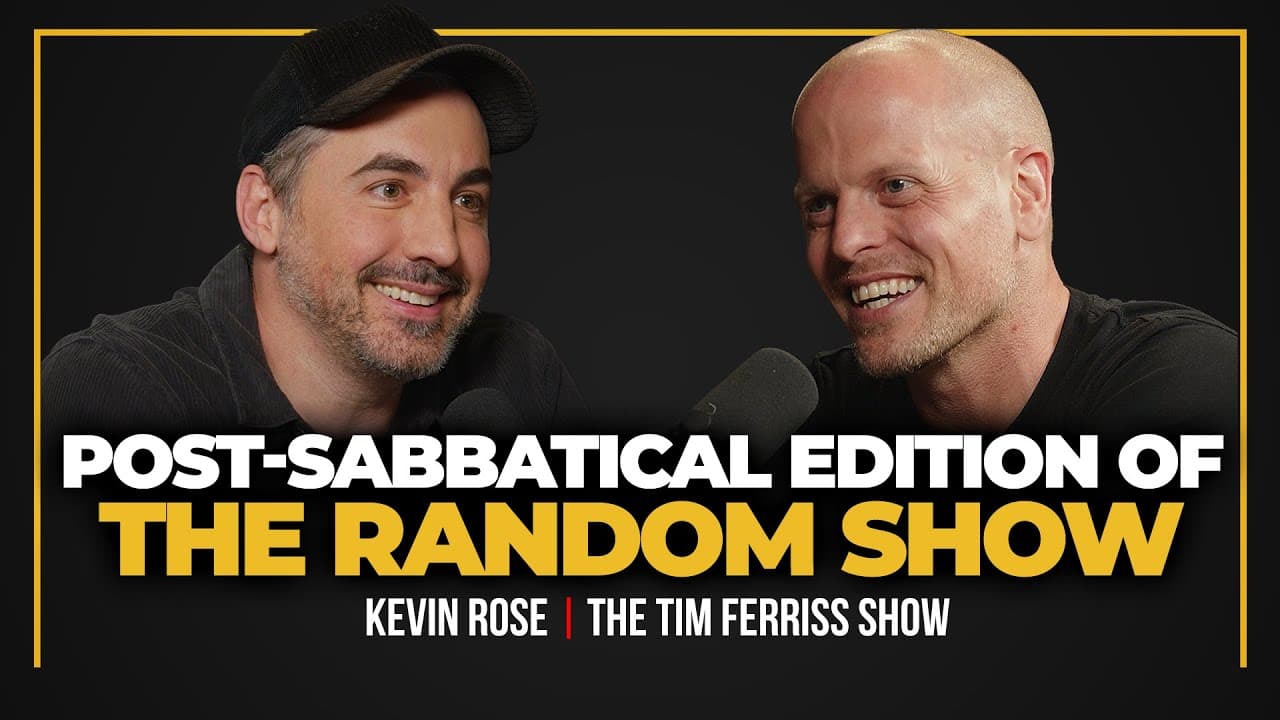
Tim Ferriss’s Sabbatical, Kevin Rose Tries a Medium, Fitness Tools, and More — The Tim Ferriss Show
TL;DR
Tim Ferriss and Kevin Rose discuss creativity, mental health, and unique experiences including ketamine therapy.
Transcript
Kevin Rose: I put this in my mouth and this is going to wrap around both sides. Tim Ferriss: How are you going to rinse that? Kevin Rose: I don't know. Tim Ferriss: All right, let's see it. Let's see it. This is going to be good. Kevin Rose: I couldn't stop it. Tim Ferriss: Holy shit. Kevin Rose: I know what you're thinking. Tim Ferriss: You ... Read More
Key Insights
- 🏃 The importance of taking time off for deep creative work can enhance productivity in the long run.
- 🧑⚕️ Ketamine therapy can offer relief for serious mental health struggles but must be approached with caution due to potential for misuse.
- 🛟 Meaningful connections are vital for emotional well-being and can help navigate life's challenges.
- 🥺 Engaging in fulfilling and enriching projects can lead to a higher quality of life and self-esteem.
- 💭 Self-reflection and the ability to observe one's thoughts are essential skills for personal growth and improvement.
- 🛟 Literature can serve as a powerful tool for personal discovery and healing when chosen thoughtfully.
- 🌍 Relationships contribute significantly to personal happiness and can counter feelings of isolation in an increasingly disjointed world.
Install to Summarize YouTube Videos and Get Transcripts
Explore YouTube Video Summarizer or Get YouTube Transcript Extractor
Questions & Answers
Q: What key insights did Tim Ferriss gain from his podcast sabbatical?
Tim Ferriss reflected on the balance of his creative endeavors, recognizing that stepping back from regular podcasting allowed him to delve into his writing without the pressures of immediate content output. He emphasized the idea of undistracted time for deep creative work, inspired by essays like Paul Graham's on attention as a currency.
Q: How did Kevin Rose approach his ketamine therapy, and what was its impact?
Kevin Rose described his ketamine therapy as a transformative experience that alleviated severe emotional burdens. He acknowledged that while the treatment is not for everyone, it can provide crucial relief for those suffering from treatment-resistant depression. Rose also cautioned against recreational use, highlighting the importance of undergoing the therapy in a controlled, clinical environment.
Q: What are the potential dangers Kevin Rose mentioned about recreational ketamine use?
Kevin Rose warned that recreational ketamine use can lead to dependency, especially since the drug has potent dissociative effects. He shared his concern over individuals seeking the drug outside of medical settings, emphasizing the need for legitimate medical supervision to avoid severe consequences associated with misuse.
Q: How does Tim Ferriss view the relationship between productivity and creativity?
Tim Ferriss believes that for true creativity to flourish, individuals must find their optimal state of work. He argues that busy work can detract from meaningful projects, advocating the 'hunter' mentality. He compares hunting for meaningful experiences to ensure fulfillment in life, instead of just chasing small, inconsequential tasks.
Q: What project is Tim currently pursuing, and how does it relate to his reflections?
Tim Ferriss is working on a new book after his podcast sabbatical. He views this project as a means to explore and solidify his thoughts on creativity, productivity, and the importance of connection while allowing himself the undistracted time needed to produce quality content.
Q: How did Tim Ferriss and Kevin Rose discuss the role of human connection in their lives?
They acknowledged the inherent human need for interaction, particularly as Tim finds more fulfillment in personal relationships. They advocated for the importance of nurturing meaningful connections to counteract feelings of isolation, highlighting friendships as essential lifelines in navigating life's complexities.
Q: What book recommendations did Tim Ferriss mention during their conversation?
Tim Ferriss recommended "Blood Meridian" by Cormac McCarthy for its brutal yet beautifully written prose, and "The Well of Being" for its insights into happiness and living radically alive. He also highlighted the importance of sourcing enriching literature that resonates deeply with readers.
Q: What metaphor did Tim Ferriss use to illustrate the importance of choosing life goals?
Tim Ferriss used the metaphor of "hunting antelope versus field mice," exploring how people should focus on substantial, meaningful pursuits rather than getting bogged down in less rewarding tasks. This metaphor emphasizes the importance of directing energy toward goals that provide significant returns over time.
Summary & Key Takeaways
-
In a candid discussion, Tim Ferriss shares insights on balancing podcasting and writing, emphasizing the need for undistracted time for deep work.
-
Kevin Rose recounts his own experience with ketamine therapy, explaining its potential benefits for mental health while acknowledging its risks.
-
They delve into personal anecdotes regarding dating, friendships, and the importance of genuine connections in navigating life’s challenges.
Read in Other Languages (beta)
Share This Summary 📚
Summarize YouTube Videos and Get Video Transcripts with 1-Click
Try YouTube Summary with ChatGPT & Claude or YouTube Transcript Generator
Explore More Summaries from The Tim Ferriss Show 📚



Summarize YouTube Videos and Get Video Transcripts with 1-Click
Try YouTube Summary with ChatGPT & Claude or YouTube Transcript Generator