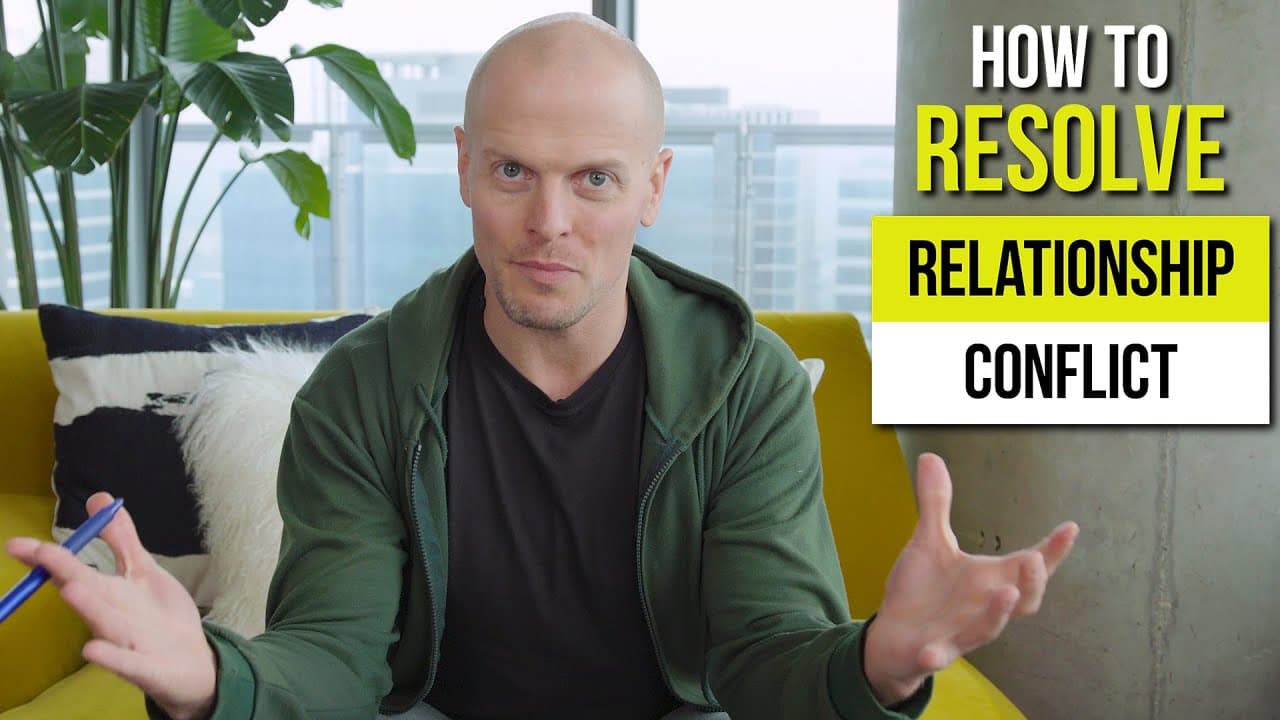
How to Resolve Relationship Conflict | Tim Ferriss
TL;DR
Relationship conflict can be minimized or resolved by building self-awareness first, then discussing concerns in structured batching sessions. Tim Ferriss recommends a daily 10-minute practice with Sam Harris’ Waking Up app, Anthony de Mello’s book “Awareness,” quarterly couples days, and written follow-up on agreed actions. Read on for the specific discussion format he uses with his girlfriend.
Transcript
sometimes I'm asked about how to resolve relationship conflict and I find this amusing and I'm smiling because this has never been a strong suit for me as it relates to intimate relationships I am NOT famous for my patience and have caused innumerable problems in my relationships as a result of that and grew up at least through schooling and coachi... Read More
Key Insights
- 🤳 Self-awareness and recognizing personal patterns and stories are crucial for resolving relationship conflicts.
- 🤳 Using tools like meditation and self-assessment books can greatly contribute to self-improvement.
- 🐶 Candid assessment of sensitivities and pet peeves helps partners communicate feedback effectively.
- 🥳 Setting aside dedicated time for discussions, such as batching sessions or quarterly couples days, can contribute to resolving conflicts.
- 📚 Related book: The 4-Hour Body
- 📚 Related book: The 4-Hour Chef
- 📥 Export your Kindle highlights to Glasp: How to Download Highlights and Notes from Kindle
Install to Summarize YouTube Videos and Get Transcripts
Explore YouTube Video Summarizer or Get YouTube Transcript Extractor
Questions & Answers
Q: How does Tim Ferriss recommend resolving relationship conflict?
Ferriss recommends first becoming aware of your internal states and the stories you create about events. As a couple, he suggests candidly discussing sensitivities and pet peeves, holding weekly or bi-weekly batching sessions, and recording takeaways so both partners can follow up.
Q: Why is self-awareness important during relationship conflict?
Self-awareness helps you notice the stories and recurring loops that shape how you interpret another person’s behavior. For example, consistently casting yourself as the victim can affect how you approach every conflict-resolution discussion.
Q: What self-awareness tools does Tim Ferriss recommend?
Ferriss recommends Sam Harris’ Waking Up app and Anthony de Mello’s book “Awareness.” He says the app offers a logical progression in meditation and self-awareness through a 10-minute daily practice, while the book helps identify personal stories and encourages blunt self-assessment.
Q: What should someone examine before trying to fix a relationship problem?
Ferriss suggests asking whether you genuinely want to fix the problem or are more attached to the drama around it. Recognizing that distinction can help you pause between a stimulus and your response and choose how to act.
Q: What is a relationship batching session?
A batching session is a weekly or bi-weekly period reserved for discussing needs and concerns instead of raising them piecemeal throughout the day. Ferriss finds this timing especially useful because he thrives with structure and predictability.
Q: What discussion format does Tim Ferriss use with his girlfriend?
They first discuss what the other person is doing well and what they love about it. Next, each person identifies what they believe they are doing well, and then they ask for more of what would make them happy instead of focusing on accusations.
Q: Why does timing matter when giving relationship feedback?
Ferriss says receptiveness may depend less on perfect wording than on when feedback is delivered. He prefers concerns to be saved for a designated session rather than introduced repeatedly throughout the day.
Q: How should couples follow up after a conflict-resolution session?
Ferriss recommends writing down the takeaways and homework assignments in a tool such as Evernote or Notes and giving each partner a copy. They can review the notes for several days and use the next session to assess how they handled the agreed assignments.
Summary & Key Takeaways
-
The speaker acknowledges their own challenges in resolving relationship conflicts due to a lack of patience and negative reinforcement during upbringing.
-
They highlight the importance of becoming more aware of internal states and the stories one creates in their head as a first step to minimize or resolve conflicts.
-
Two tools recommended for self-awareness are Sam Harris' waking up app and the book "Awareness" by Anthony de Mello.
Read in Other Languages (beta)
Share This Summary 📚
Summarize YouTube Videos and Get Video Transcripts with 1-Click
Try YouTube Summary with ChatGPT & Claude or YouTube Transcript Generator
Explore More Summaries from Tim Ferriss 📚




Summarize YouTube Videos and Get Video Transcripts with 1-Click
Try YouTube Summary with ChatGPT & Claude or YouTube Transcript Generator