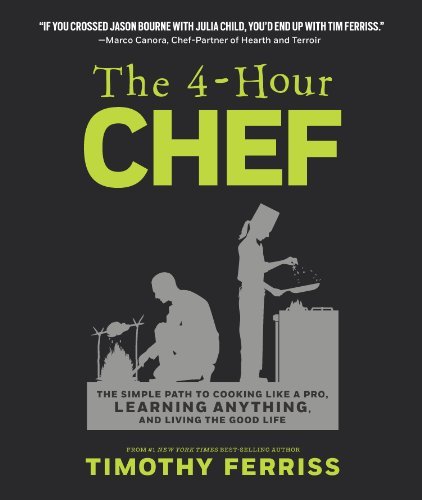
The 4-Hour Chef: The Simple Path to Cooking Like a Pro, Learning Anything, and Living the Good Life
About This Book
The 4-Hour Chef uses cooking as a vehicle to teach Tim Ferriss's larger obsession: how to learn any skill rapidly and reach the top tier of performers in months rather than years. Despite the title, the book is fundamentally about meta-learning — the art of deconstructing a complex domain into its highest-leverage components.
Ferriss's central claim is that what you study matters more than how you study. Just as novice cooks are "subordinate to recipes," learners are subordinate to their materials, so the first job is to find the highest-frequency, most useful material. He argues that the extremes inform the mean — designing for the weakest and the strongest reveals what the average learner needs.
Several recurring principles anchor the book:
- Use positive constraints and clear deadlines (Parkinson's Law) to avoid overwhelm.
- Pursue massive elimination — effective decisions and learning require removing options, not adding them.
- Build momentum through early wins.
- Rely on incentives, not willpower, because "humans are horrible at self-discipline."
The cooking sections demonstrate these ideas in practice: great meals come from picking recipes well, not following them well, and from using the best ingredients simply. Interwoven examples — accelerated language acquisition via the Lord's Prayer and auxiliary verbs, memory palaces, food-pairing databases — show the same deconstruct-and-compress methodology applied across domains.
The practical mantra is ABC: Always Be Compressing — distilling any subject into the smallest set of rules that delivers the largest results. Drawing on figures like Josh Waitzkin and channeling Bruce Lee's "adapt what is useful, reject what is useless," Ferriss positions the kitchen as a training ground for a broader philosophy of self-directed, high-speed learning and a richer life.
Key Takeaways
- 1.What you study matters more than how you study — choosing the highest-frequency material is the first and most important step.
- 2.Examining the extremes (weakest and strongest) reveals what the average learner truly needs; the middle takes care of itself.
- 3.Positive constraints and deadlines (Parkinson's Law) prevent overwhelm and force focus.
- 4.Effective learning and decision-making require massive elimination — removing options, not adding them.
- 5.Follow-through depends on incentives, not willpower, because humans are unreliable at self-discipline.
- 6.Great results come from picking well, not executing perfectly — choose recipes (and materials) well, and early wins build momentum.
- 7.The core operating principle is Always Be Compressing: distill any domain to its essential, high-leverage rules.
Top Highlights
what you study is more important than how you study.
Highlighted by 3 people
In the world of work, a task will swell in complexity to fill the time you allot it,
Highlighted by 3 people
As Bruce Lee said, “Adapt what is useful, reject what is useless, and add what is specifically your own.”
Highlighted by 2 people
“Take risks and
Highlighted by 2 people
What we really need to do, to design, is look at the extremes. The weakest, or the person with arthritis, or the athlete, or the strongest, the fastest person, because if we understand what the extremes are, the middle will take care of itself.” In other words, the extremes inform the mean, but not vice versa.
Highlighted by 2 people · 1 left a note
The top 1% often succeed despite how they train, not because of it. Superior genetics, or a luxurious full-time schedule, make up for a lot.
Highlighted by 2 people
Last, play with foodpairing.be, which is based on the Volatile Compounds in Food (VCF) database. The objective is to start thinking about how to mix and match foods based on similar characteristics.
Highlighted by 2 people
AI Review
Based on Glasp's analysis of highlights from 7 readers, this is a resonant idea-machine that doubles as a learning manifesto, with its meta-learning principles attracting the strongest consensus.
Pros
- +Strong consensus around the "what you study matters more than how" principle
- +Memorable, quotable frameworks like Always Be Compressing and positive constraints
- +Cross-domain examples (cooking, languages, memory) reinforce one coherent method
- +Practical hacks for rapid skill acquisition that readers found actionable
Cons
- −Sprawling structure mixes recipes, learning theory, and lifestyle advice, which can dilute focus
- −Bold claims like reaching the top 5% in weeks may overstate what's realistic for most readers
Glasp AI analysis based on highlights from 7 readers.
Who Should Read This
Ideal for self-directed learners and skill hackers who want a system for acquiring competence fast — whether in cooking, languages, or any new discipline. It suits fans of Tim Ferriss's earlier work, ambitious autodidacts, and anyone fascinated by deconstruction, memory palaces, and productivity constraints. Beginner cooks looking for confidence will find value, but readers expecting a conventional cookbook should know the book is equally about learning theory and lifestyle design.
Frequently Asked Questions
What is The 4-Hour Chef about?
Who is the book for?
What are the key lessons?
Is it really a cookbook?
Is it worth reading?
What does Always Be Compressing mean?
How does the book say you become world-class fast?
How to Apply What You Read
- 1.Identify the highest-frequency material in any skill you want to learn before you start studying it.
- 2.Set tight deadlines and positive constraints to combat Parkinson's Law and force progress.
- 3.Eliminate options aggressively — strip a subject to its essential rules and ignore the rest.
- 4.Design incentives rather than relying on motivation to ensure follow-through.
- 5.Engineer early wins to build momentum when starting something new.
Discussion Questions
- Q1.Do you agree that what you study matters more than how you study? How would that change your own learning habits?
- Q2.How might designing for the extremes rather than the average apply to your work or projects?
- Q3.Where in your life could positive constraints or deadlines improve your output?
- Q4.Is the claim that anyone can become world-class in months realistic, or does it overlook talent and circumstance?
- Q5.How do you balance ruthless elimination of options with the risk of missing valuable approaches?
- Q6.What would it look like to replace willpower with better incentives in a habit you struggle with?
- Q7.How does framing cooking as a learning experiment change the way you'd approach a new kitchen skill?
Recommended Books

Revisit Your Highlights, Deepen Your Understanding
Import your Kindle highlights to review, organize, and share the ideas that matter most to you.
Get the free browser extension