How Do AI Agents Operate and Adapt?
TL;DR
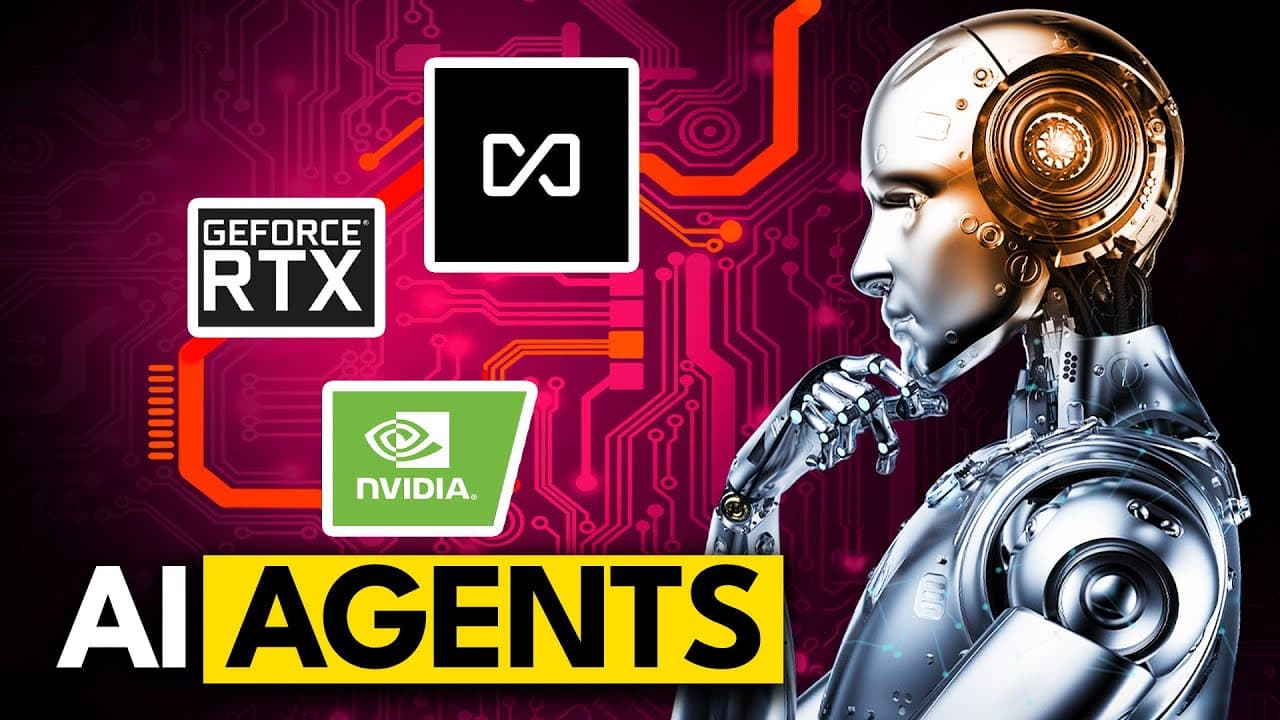
AI agents are autonomous systems that can independently complete tasks, make decisions, and adapt to new information. They utilize core technologies like large language models, memory, and feedback loops to enhance their functionality, allowing for proactive engagement with various tasks. With tools like AnythingLLM on NVIDIA hardware, users can run AI agents locally while maintaining privacy.
Transcript
what exactly are AI agents and why is everybody talking about them well in this video I'm going to break down everything you need to know about AI agents including what they are how they work and why they're so important I'll also discuss how they differ from standard llms and give you an example at the end of the video of h... Read More
Key Insights
- AI agents are systems powered by artificial intelligence that autonomously complete tasks, make decisions, and adapt to new information, acting as proactive tools.
- Unlike standard large language models (LLMs), AI agents can take actions, such as booking flights and hotels, rather than just providing information.
- AI agents have three key properties: autonomy, goal orientation, and environment awareness, allowing them to act independently, focus on outcomes, and respond to external data.
- The core technologies behind AI agents include LLMs for language processing, tool usage for executing tasks, memory for tracking progress, and feedback loops for continuous improvement.
- Decision-making frameworks guide AI agents, using reinforcement learning or rule-based logic to break down goals into actionable tasks and select appropriate tools.
- AI agents use feedback loops to evaluate their actions, adjust strategies, and refine approaches, enhancing their problem-solving capabilities.
- Memory and context management enable AI agents to track their progress, maintain consistency, and adapt to changes, ensuring informed decision-making.
- NVIDIA's hardware, like the GeForce RTX GPU, enhances the performance of AI applications, allowing users to run AI agents locally with tools like AnythingLLM.
Install to Summarize YouTube Videos and Get Transcripts
Explore YouTube Video Summarizer or Get YouTube Transcript Extractor
Questions & Answers
Q: What are the key properties of AI agents?
AI agents have three key properties: autonomy, goal orientation, and environment awareness. Autonomy allows them to act independently within a given scope. Goal orientation means they focus on specific outcomes, such as solving problems or completing tasks. Environment awareness enables them to respond to data or events from their surroundings, both online and physical.
Q: How do AI agents differ from standard LLMs?
AI agents differ from standard LLMs in that they can perform actions rather than just provide information. While LLMs generate language and text, AI agents can execute tasks such as booking flights or making reservations. They are proactive tools that take steps to achieve goals, rather than merely recommending options.
Q: What technologies are involved in the operation of AI agents?
AI agents operate using several key technologies: LLMs for understanding and generating language, tool usage for executing tasks, memory for tracking progress, and feedback loops for continuous improvement. These components are coordinated by a decision-making framework, which guides the agent in achieving specific tasks through reinforcement learning or rule-based logic.
Q: How do feedback loops enhance AI agents' capabilities?
Feedback loops enhance AI agents' capabilities by allowing them to continuously monitor and analyze their behavior. After executing an action, agents evaluate whether it brought them closer to their goal. If not, they adjust their approach dynamically. This process of acting, evaluating, and adjusting enables agents to refine their actions and try different strategies if initial attempts fail.
Q: What role does memory play in AI agents?
Memory plays a crucial role in AI agents by enabling them to track their progress and maintain context. Agents use memory to remember what tasks have been completed, what remains, and any external changes. This allows them to make informed decisions, ensuring consistency and adaptability in their actions, and helps them manage complex tasks efficiently.
Q: How does NVIDIA hardware enhance AI agent performance?
NVIDIA hardware, such as the GeForce RTX GPU, enhances AI agent performance by providing the computational power necessary for running advanced AI models and applications. This hardware allows users to run AI agents locally, ensuring faster processing speeds and greater privacy, as data does not need to be shared with cloud services. Tools like AnythingLLM leverage this hardware to optimize AI functionality.
Q: What is the decision-making framework in AI agents?
The decision-making framework in AI agents is a system that coordinates the various components, such as LLMs, tool usage, memory, and feedback loops, to guide the agent in achieving specific tasks. It can use reinforcement learning or rule-based logic to define goals, break them into actionable tasks, and select appropriate tools and actions. This framework ensures that agents can effectively solve problems and adapt to new challenges.
Q: How can users experiment with AI agents using AnythingLLM?
Users can experiment with AI agents using AnythingLLM by running the application locally on their computer with an NVIDIA GeForce RTX GPU. AnythingLLM allows users to deploy and test various AI agent skills, providing tools for creating, managing, and interacting with AI agents. This setup offers privacy and efficiency, enabling users to explore AI capabilities without relying on cloud services, and supports a wide range of models and functionalities.
Summary & Key Takeaways
-
AI agents are autonomous systems powered by artificial intelligence, capable of completing tasks, making decisions, and adapting to new information. Unlike standard LLMs, they can perform actions such as booking accommodations, making them proactive tools for achieving specific goals.
-
The core components of AI agents include LLMs for language processing, tool usage for task execution, memory for tracking progress, and feedback loops for continuous improvement. These technologies allow agents to act independently, focus on outcomes, and respond to external data.
-
NVIDIA's hardware, such as the GeForce RTX GPU, enhances AI application performance, enabling users to run AI agents locally with tools like AnythingLLM. This provides privacy and efficiency, allowing users to experiment with AI agents without relying on cloud services.
Read in Other Languages (beta)
Share This Summary 📚
Summarize YouTube Videos and Get Video Transcripts with 1-Click
Try YouTube Summary with ChatGPT & Claude or YouTube Transcript Generator
Explore More Summaries from Tech With Tim 📚




Summarize YouTube Videos and Get Video Transcripts with 1-Click
Try YouTube Summary with ChatGPT & Claude or YouTube Transcript Generator