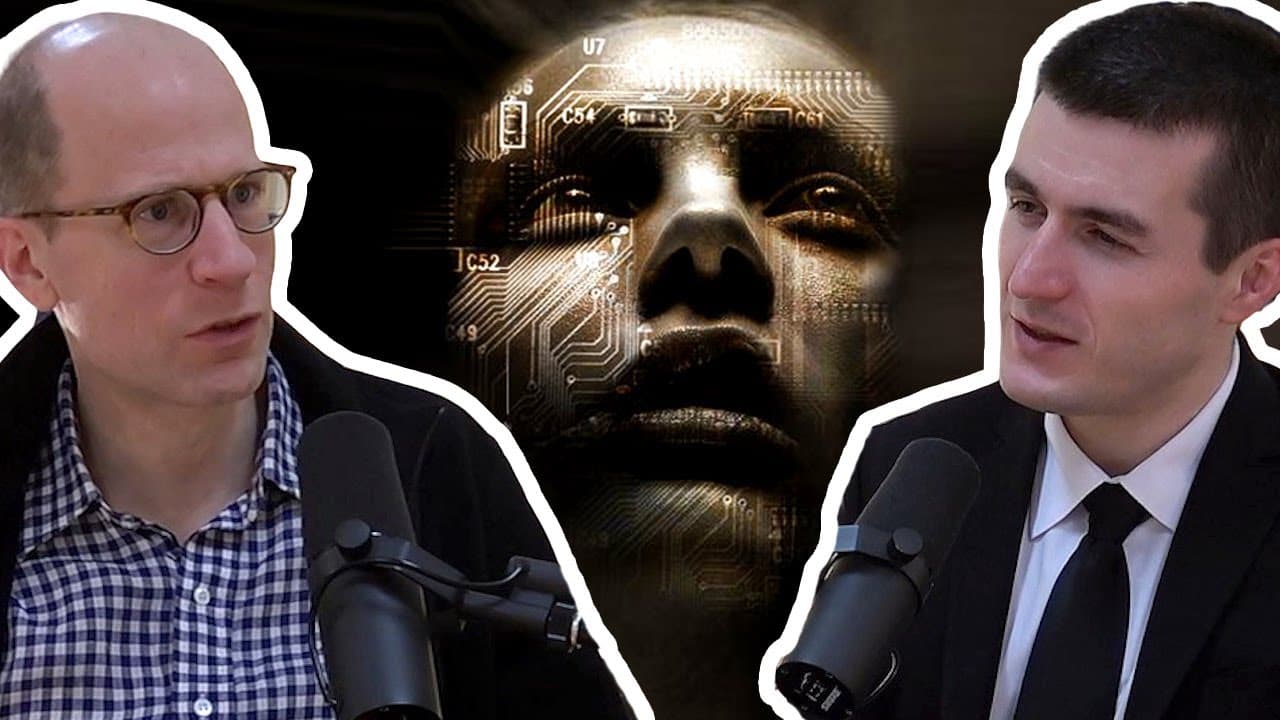
Nick Bostrom: Superintelligence | AI Podcast Clips
TL;DR
Superintelligence is a system with much greater general cognitive capacity than humans, enabling it to learn faster, reason better, and make more effective plans across complex environments. Nick Bostrom explains why it could operate digitally, why alignment matters, and how its benefits could extend from health to economics and foreign policy. Read on to understand both its long-term risks and its broad positive potential.
Transcript
let's talk about superintelligence at least for a little bit and let's start at the basics what tu is intelligence yeah I didn't not to get too stuck with the definitional question I mean I their common sense understand like the ability to solve complex problems to learn from experience to plan to reason some combination of things like that it's co... Read More
Key Insights
- 🤔 Key insight: Intelligence is the ability to solve complex problems, learn from experience, and plan. Superintelligence refers to a higher level of cognitive capacity than humans possess, with the ability to learn faster and achieve goals more effectively in complex environments.
- 🤖 Key insight: Superintelligence does not necessarily have to exist in the physical world. While physical interaction can enhance its capabilities, a digital-only system that can affect the world through text or other means could still be highly intelligent.
- 🌍 Key insight: Concerns about existential threats from superintelligence in the digital world exist because the attack vectors for a digital system are different than those for physical systems. Research groups are developing AI alignment techniques to mitigate these risks.
- 🚀 Key insight: Machine intelligence, including superintelligence, has tremendous positive potential that is often overshadowed by concerns about its negative impact. Developing a granular understanding of potential pitfalls can help avoid them and focus on the upside.
- ⚡️ Key insight: General intelligence has both near-term and long-term implications. Near-term concerns include algorithmic discrimination and advancements in self-driving cars, while long-term considerations involve existential threats and positive impacts on various fields.
- 💡 Key insight: The potential positive impacts of general intelligence are vast and diverse, ranging from improvements in healthcare to more effective decision-making in economics and foreign policy, among other fields. AI is a general-purpose technology with no single "killer app."
- 🔥 Key insight: The concept of an intelligence explosion, where progress in AI becomes extremely rapid, is uncertain. However, it is likely that progress will reach a point where AI has cognitive faculties similar to humans, potentially leading to explosive growth.
- 🌌 Key insight: Once we achieve human-level intelligence, it is unlikely that there will be a ceiling on further progress towards superintelligence. However, the control problem of maintaining alignment with human values becomes crucial.
- 😮 Key insight: The idea of creating a system beyond human intelligence can be both exciting and terrifying. While control over such systems is a concern, efforts are being made to ensure their alignment with human values and mitigate potential risks.
- 🌈 Key insight: A future utopia with superintelligent systems could open up vast possibilities for improved problem-solving and resource utilization. It would likely require a fundamental rethink of values and the ability to achieve multiple value systems simultaneously.
Install to Summarize YouTube Videos and Get Transcripts
Explore YouTube Video Summarizer or Get YouTube Transcript Extractor
Questions & Answers
Q: What is superintelligence according to Nick Bostrom?
Superintelligence is something with much greater general cognitive capacity than humans. It would learn faster, reason better, and create more effective plans for achieving goals across a wide range of complex, challenging environments.
Q: How does Nick Bostrom define intelligence?
Bostrom describes intelligence through abilities such as solving complex problems, learning from experience, planning, and reasoning. He treats it as some combination of these capabilities rather than insisting on a rigid definition.
Q: Does intelligence require consciousness?
Bostrom does not think consciousness is necessarily part of intelligence. He says something could probably be fairly intelligent without being conscious.
Q: Can superintelligence exist only in digital form?
Yes, Bostrom says a digital-only superintelligence is feasible, although its computers and memory would still be physical. Even limited ways of acting, such as producing text on a screen, could give it a strong ability to affect the world.
Q: Why does Nick Bostrom emphasize AI alignment?
Bostrom says researchers need a more detailed understanding of potential pitfalls so they can be avoided if AI succeeds. He notes that since his book Superintelligence appeared in 2014, more research groups have begun developing AI alignment techniques.
Q: How do near-term and long-term AI concerns differ?
Near-term concerns include algorithmic discrimination, self-driving cars, and drones. Long-term discussion concerns the kinds of issues addressed in Superintelligence, although Bostrom says the boundary is blurry and the two contexts can overlap.
Q: What positive effects could aligned superintelligence have?
Bostrom says a friendly, aligned superintelligence could help address problems in health and the economic system. It could also improve investment, trade, and foreign-policy decisions, along with many other areas.
Q: Does artificial general intelligence have one killer application?
Bostrom does not think artificial general intelligence has a single killer application. He describes it as the ultimate general-purpose technology because it could apply across nearly every field where human creativity, intelligence, and problem-solving are useful.
Summary & Key Takeaways
-
Intelligence is the ability to solve complex problems, learn from experience, and reason, while superintelligence refers to a much higher level of general cognitive capacity.
-
Superintelligence has the potential to bring both positive impacts and existential threats to humanity.
-
The development of AI raises concerns about the control and the potential risks associated with superintelligence.
Read in Other Languages (beta)
Share This Summary 📚
Summarize YouTube Videos and Get Video Transcripts with 1-Click
Try YouTube Summary with ChatGPT & Claude or YouTube Transcript Generator
Explore More Summaries from Lex Fridman 📚





Summarize YouTube Videos and Get Video Transcripts with 1-Click
Try YouTube Summary with ChatGPT & Claude or YouTube Transcript Generator