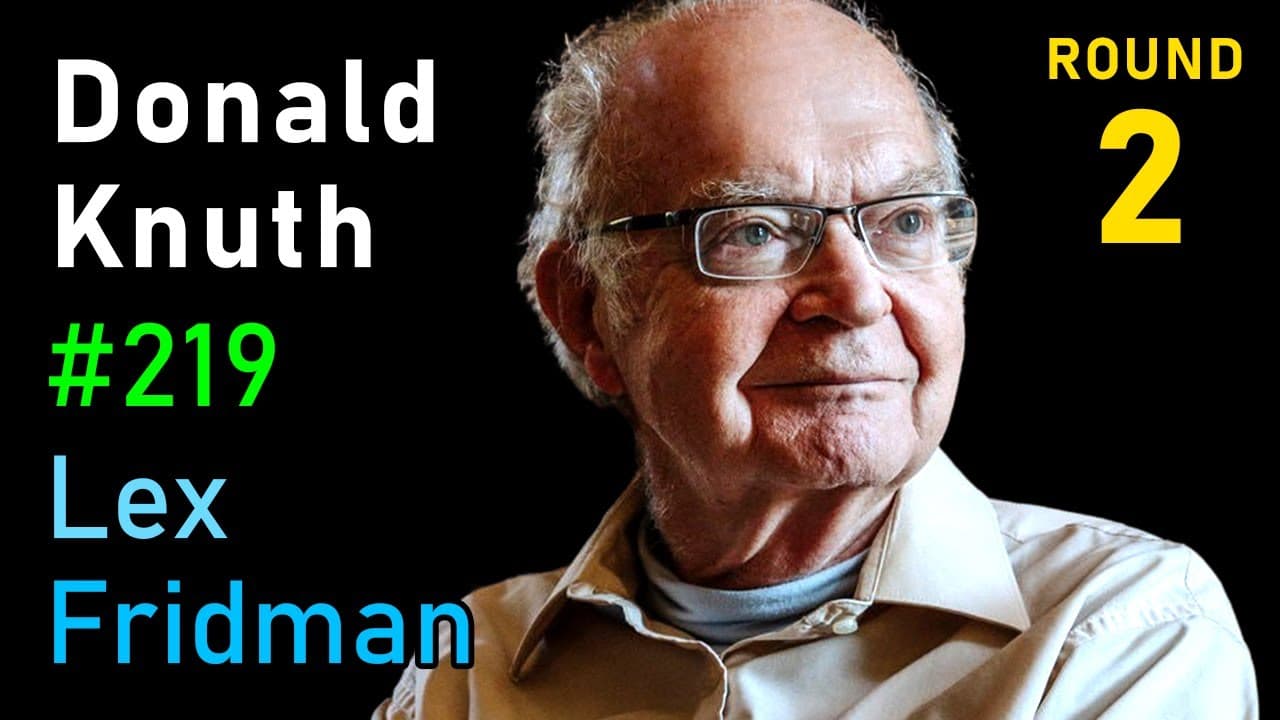
Donald Knuth: Programming, Algorithms, Hard Problems & the Game of Life | Lex Fridman Podcast #219
TL;DR
Donald Knuth's journey in programming began with writing decimal machine code for the IBM 650, leading to insights on the importance of optimizing code effectively. He shares experiences with humor and the impact of early encounters with computer science legends, emphasizing the significance of understanding algorithms and challenges in AI.
Transcript
the following is a conversation with donald knuth his second time on this podcast don is a legendary computer scientist touring award winner father of algorithm analysis author of the art of computer programming creator of tech that led to late tech and one of the kindest and most fascinating human beings i've ever got a chance to talk to i wrote h... Read More
Key Insights
- 🤝 Donald Knuth is a legendary computer scientist, known for his contributions to algorithm analysis, the art of computer programming, and the development of TeX.
- 💡 The first large-scale program Knuth wrote was in decimal machine language in 1957, before he learned about assemblers.
- 🔢 The IBM 650 computer used decimal numbers and had specific instructions for loading and manipulating data.
- 📜 Knuth was inspired by a poorly written manual for the IBM 650, which led him to get involved with programming and writing better manuals.
- 🎮 Knuth's second program was a tic-tac-toe game that used machine learning techniques to improve its gameplay over time.
- 💻 Knuth emphasizes the importance of understanding and optimizing code at the right time and in the right places, rather than premature optimization.
- 😁 Knuth values humor in his work, including his books, the art of computer programming, and uses it to engage readers and make complex topics more enjoyable.
- ❓ Knuth is agnostic about whether human consciousness and the workings of the mind can be fully understood by computation and science, considering the question currently beyond knowledge.
- 🌌 Knuth acknowledges the potential risks of AI and automation, particularly in the face of irrational human decision-making and unintended consequences.
- 💘 Knuth has been happily married to his wife, Jill, for 60 years, emphasizing the importance of compromise and realistic expectations in maintaining a stable marriage.
- 👥 Knuth had interactions with other notable figures in the field, including meeting John Conway, working with Richard Feynman, and being inspired by their work.
Install to Summarize YouTube Videos and Get Transcripts
Explore YouTube Video Summarizer or Get YouTube Transcript Extractor
Questions & Answers
Q: How did Donald Knuth get started in computer programming?
Donald Knuth began his journey in computer programming in the late 1950s, writing his first program in decimal machine language on an IBM 650 computer.
Q: What was the role of optimization in Knuth's programming approach?
Knuth emphasized the importance of optimization but cautioned against premature optimization, highlighting the need to understand the right time and place for optimization in programming.
Q: How did John Conway influence Knuth's work?
Knuth and John Conway had a mutual appreciation and occasionally attended each other's lectures. Conway's groundbreaking work on cellular automata, such as the Game of Life, inspired Knuth and impacted his understanding of computation.
Q: In what ways did Richard Feynman inspire Donald Knuth?
Knuth and Feynman knew each other while at Caltech, and Feynman's approach to physics and solving puzzles influenced Knuth's thinking. They had conversations on various topics, including stable marriages and solving the game of solitaire.
Summary
In this conversation, Lex Friedman talks to Donald Knuth, a legendary computer scientist, about his early experiences in programming, his thoughts on optimization, the beauty of a well-written program, and the limitations of computation and consciousness. Knuth shares his insights into the early days of programming on machines like the IBM 650, the challenges of debugging with decimal machine language, and the concept of optimization in programming. He also discusses his approach to writing and humor in his book "The Art of Computer Programming" and the impact of automation and artificial intelligence on society. Knuth explores the importance of understanding the limitations of optimization and the value of late binding in programming. He also touches on the question of whether there are limits to what a computer can do and if human consciousness and the human mind extend beyond computation.
Questions & Answers
Q: What was the first large-scale program Don wrote and in what language?
Don wrote his first large-scale program in decimal machine language for the IBM 650, a machine that didn't have an assembler at the time. The program was written in the summer of 1957 and was used to factor numbers.
Q: How did Don write a program in machine language without an assembler?
Don looked at the user manuals for the IBM 650 that provided instructions in decimal numbers. He would manually enter the instructions using the console of the machine, inputting addresses and numbers to execute different operations.
Q: Can you explain the process of debugging on the IBM 650?
Debugging on the IBM 650 involved manually entering instructions and using switches to execute one instruction at a time. Don would observe the machine's actions and look for any unexpected behaviors or errors. He mentioned that some common bugs included off-by-one errors and going to the wrong instruction.
Q: What was Don's second program and how did it differ from the first?
Don's second program was a binary to decimal converter, which was simpler and had fewer bugs compared to the factoring program. After that, he wrote a tic-tac-toe program with three different "brains" representing different playing strategies.
Q: How did Don's tic-tac-toe program incorporate machine learning?
Don's third program, the tic-tac-toe program, included a learning brain that improved its playing strategies based on previous games. The learning process involved evaluating different moves and adjusting the values associated with the moves based on game outcomes. The program aimed to learn how to avoid losing rather than trying to win.
Q: How did Don observe differences in programming styles in different programs?
Don mentioned that differences in programming style could be observed by analyzing the code and identifying distinct approaches and thought processes. While certain programming languages may have different conventions or structures, the style and elegance of code can still vary across different programmers.
Q: How does Don define a beautiful program?
Don believes that beauty in a program can be defined in various ways, depending on the intentions and goals of the program. A program can be considered beautiful if it works correctly, is easily understood, employs literate programming, and incorporates elements of wit and humor.
Q: Do humans have a limit when it comes to optimization?
Don believes that humans are prone to premature optimization, often spending a significant amount of time optimizing code that is not critical. He emphasized the importance of understanding the bottlenecks in a program's performance before focusing on optimization. Additionally, he mentioned the danger of optimizing parts of a program that sacrifice flexibility or adaptability.
Q: Can computers achieve the same level of mathematical understanding and consciousness as humans?
Don considers the question of whether computers can achieve the same level of mathematical understanding and consciousness as humans an unanswerable question. He believes that while the workings of the human mind may be within the reach of science, there are limitations to what can be known at present.
Q: What are Don's thoughts on automation and artificial intelligence?
Don expressed both optimism and concern regarding automation and artificial intelligence. He believes that these advancements can be beneficial in fields such as medicine and scientific research but also acknowledges the potential dangers and negative impacts they may have on society. He emphasized the importance of considering the ethical implications of advanced technologies and urged caution in their development and deployment.
Q: What does Don mean by "optimization is the root of all evil" in programming?
Don's statement refers to the tendency for programmers to prioritize optimization prematurely, focusing on making code faster or more efficient without first identifying the real bottlenecks or performance issues. Premature optimization can lead to code that is harder to maintain or modify and may not result in significant performance gains. He advises programmers to prioritize clarity, readability, and flexibility in their code and to optimize only when necessary and based on careful analysis and profiling.
Takeaways
Donald Knuth shares his insights on early programming experiences, the concept of optimization, and the beauty of well-crafted code. He highlights the importance of understanding the limitations of optimization, the value of late binding, and the need to prioritize clarity and readability in code. Knuth also explores the implications of automation and artificial intelligence, advocating for ethical considerations and a cautious approach to their development and implementation. In contemplating the limits of computation and consciousness, Knuth remains open to possibilities but believes that some questions may remain unanswerable for now.
Summary & Key Takeaways
-
Donald Knuth reflects on his early days in computer programming, including his first program written in decimal machine language on an IBM 650 computer.
-
He shares his thoughts on optimization, emphasizing the importance of focusing optimization efforts at the right time and place.
-
Knuth discusses his interactions with computer scientist John Conway and physicist Richard Feynman, both of whom inspired him in different ways.
Read in Other Languages (beta)
Share This Summary 📚
Summarize YouTube Videos and Get Video Transcripts with 1-Click
Try YouTube Summary with ChatGPT & Claude or YouTube Transcript Generator
Explore More Summaries from Lex Fridman Podcast 📚


Summarize YouTube Videos and Get Video Transcripts with 1-Click
Try YouTube Summary with ChatGPT & Claude or YouTube Transcript Generator