How to Distill Pure Anhydrous Ammonia at Home
TL;DR
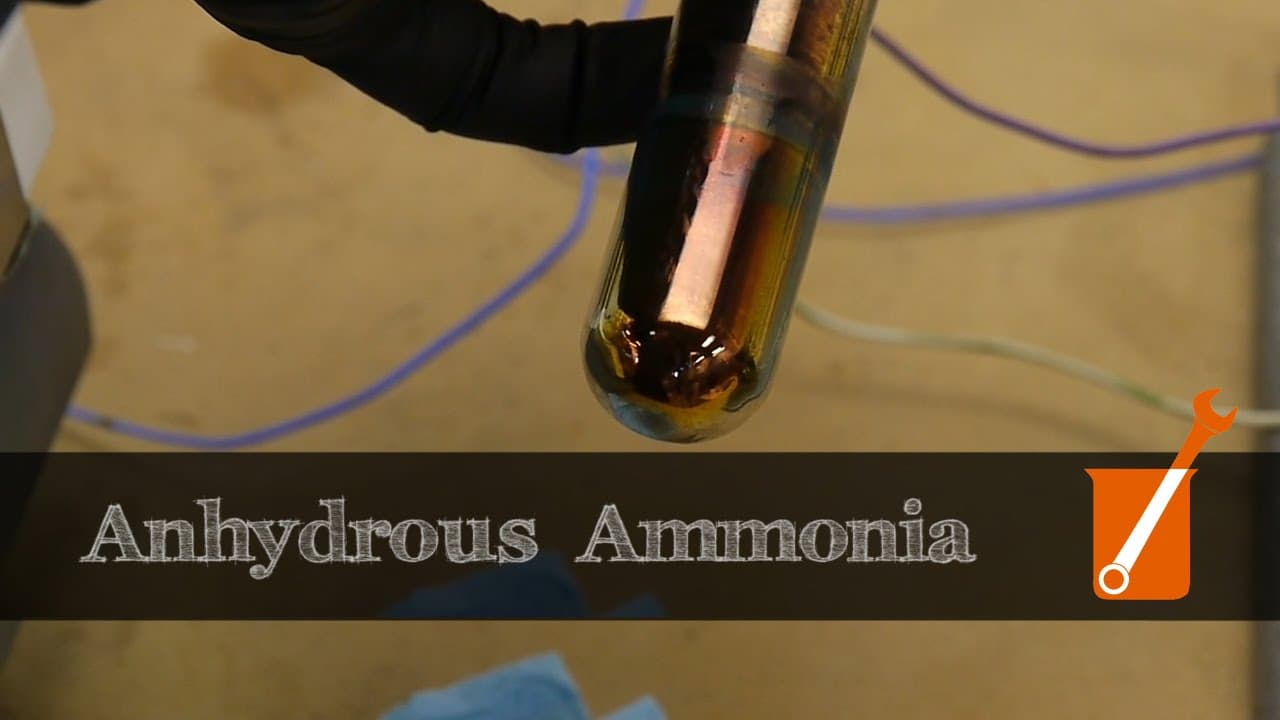
To distill pure anhydrous ammonia, raise the temperature of an ammonia solution to emit gas, then cool it to separate water vapor using a condenser. Finally, use sodium hydroxide as a desiccant to eliminate moisture before compressing or chilling the dry ammonia gas into liquid form for storage in a suitable stainless steel container.
Transcript
when you hear the word ammonia you might think of this blue glass cleaner but actually this is mostly water with ammonia gas dissolved in it but for some future experiments I have planned I need the pure ammonia out of this damn hydrous ammonia meaning ammonia without water so in this video I'm going to talk about how to transform this into an hydr... Read More
Key Insights
- 🫢 Ammonia gas can be separated from water in an ammonia solution by raising the temperature and allowing the gas to evaporate.
- 🫢 Condensers are essential for separating ammonia gas from water vapor during the extraction process.
- 🫢 Sodium hydroxide is an effective desiccant for removing water vapor from ammonia gas before storage.
- 🫢 Anhydrous ammonia gas can be compressed or chilled to convert it into a liquid form for easier storage.
- 🏪 Stainless steel containers are necessary for storing anhydrous ammonia due to its corrosive properties.
- 🤘 The birch reduction reaction can be observed by adding lithium metal to anhydrous ammonia.
- 🫢 Ammonia gas is not highly flammable and can extinguish flames, making it relatively safe to handle.
Install to Summarize YouTube Videos and Get Transcripts
Explore YouTube Video Summarizer or Get YouTube Transcript Extractor
Questions & Answers
Q: Why is it important to remove water vapor from ammonia gas?
Removing water vapor is crucial because water contamination can affect the purity and performance of ammonia in experiments and reactions. It ensures the ammonia is dry and suitable for use.
Q: Can any desiccant be used to remove water vapor from ammonia gas?
No, certain desiccants like calcium chloride or silica gel can react with ammonia gas. Sodium hydroxide (lye) is an effective desiccant for removing water vapor from ammonia gas without causing any adverse reactions.
Q: How is the anhydrous ammonia gas converted into a liquid for storage?
The anhydrous ammonia gas can be compressed using a mechanical compressor or chilled to condense it into a liquid. The video demonstrates the use of a cryogenic freezer to achieve a low enough temperature for the ammonia gas to liquefy.
Q: Is ammonia highly flammable?
Ammonia gas is technically flammable, but it has a high ignition temperature and is difficult to sustain a flame. The video demonstrates that spraying pure ammonia over an alcohol flame extinguishes the flame instead of igniting it.
Summary & Key Takeaways
-
The video demonstrates how to extract anhydrous ammonia from a solution and store it for future experiments.
-
By raising the temperature of the ammonia solution, the gas is emitted, leaving behind pure water.
-
A condenser is used to separate the ammonia gas from water vapor, and a desiccant is used to remove any remaining water.
Read in Other Languages (beta)
Share This Summary 📚
Summarize YouTube Videos and Get Video Transcripts with 1-Click
Try YouTube Summary with ChatGPT & Claude or YouTube Transcript Generator
Explore More Summaries from Applied Science 📚
Summarize YouTube Videos and Get Video Transcripts with 1-Click
Try YouTube Summary with ChatGPT & Claude or YouTube Transcript Generator