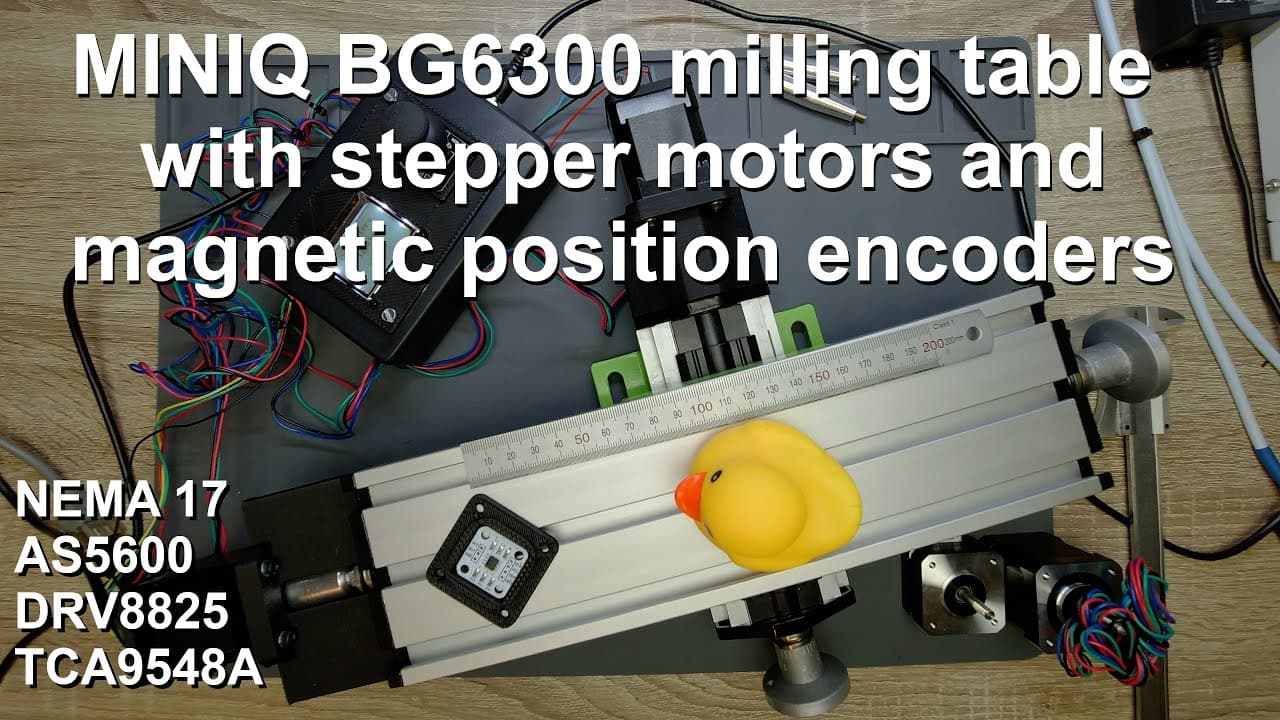
MINIQ BG6300 milling table with stepper motors and magnetic position encoders
TL;DR
The video demonstrates upgrading a milling table by adding stepper motors and encoders for precise control.
Transcript
welcome everyone in this video i'm going to show you another iteration of my milling table so originally i bought the milling table with the fully mechanic mechanism and then i decided to upgrade it by putting stepper motors on both x and y axis and then now i further developed this thing so now i can measure the displacement of both x's via two ma... Read More
Key Insights
- 🦾 The migration from a fully mechanical mechanism to one integrated with stepper motors enhances precision and efficiency in milling tasks.
- 👻 Incorporating magnetic encoders allows for precise measurement of movement, enhancing the machine's functionality.
- 📽️ The project highlights the importance of detailed assembly and calibration to achieve desired operational standards.
- 🎮 Using a controller board such as the STM32 facilitates sophisticated control algorithms and accurate data handling for the motors and encoders.
- 🧑🦼 Microstepping capabilities in the stepper motors improve positioning accuracy, providing finer control over movements.
- 👨💻 The development process involved iterative learning and problem-solving to refine both the physical design and control code.
- 👻 The project emphasizes the significance of real-time data readouts for user feedback, allowing for better operational control.
Install to Summarize YouTube Videos and Get Transcripts
Explore YouTube Video Summarizer or Get YouTube Transcript Extractor
Questions & Answers
Q: What prompted you to upgrade the milling table with stepper motors?
I initially found the mechanical solution lacking in precision and torque. The original mechanism was limited, so I added stepper motors for better control. This upgrade allows for more accurate movements and smoother operation, which is vital for milling tasks.
Q: How are the magnetic encoders integrated into the project?
The magnetic encoders are mounted directly onto the stepper motors, with a diametrically magnetized magnet attached to the motor shaft. This setup allows the encoders to read the rotation of the shaft accurately, providing real-time displacement data for both the x and y axes.
Q: Can you explain the significance of using a multiplexer in your design?
The multiplexer is crucial because it allows multiple encoders, which share the same address, to be connected to a single microcontroller. This setup eliminates communication conflicts, enabling the system to read the positions of both encoders without interference.
Q: What challenges did you face during the assembly of the milling table?
One of the main challenges was ensuring that all components fit well together and that the electrical connections were properly routed. Additionally, achieving the desired precision and functionality with the mechanical parts required careful calibration and adjustments to the code.
Q: How does the coding for the joystick and display work in your system?
The joystick readings are processed in the code to control the movement of the stepper motors by translating the joystick’s position into speed and direction commands. The display provides real-time feedback on the milling table’s position and status, allowing for easy monitoring and adjustments.
Q: What improvements would you consider for future iterations of the milling table?
Future enhancements could include using higher-quality linear guides and lead screws for better precision and smoother operation. Additionally, exploring more advanced control systems with increased automation and feedback from sensors could further enhance the overall performance of the milling table.
Summary & Key Takeaways
-
The creator discusses the various iterations of their milling table project, highlighting enhancements made by integrating stepper motors on both axes.
-
Magnetic encoders are introduced for real-time position measurement, enhancing the milling table's precision and functionality compared to its original design.
-
A detailed walkthrough of the setup, construction, and programming of the system is provided, including code implementation considerations for controlling motors and reading encoder data.
Read in Other Languages (beta)
Share This Summary 📚
Summarize YouTube Videos and Get Video Transcripts with 1-Click
Try YouTube Summary with ChatGPT & Claude or YouTube Transcript Generator
Explore More Summaries from Curious Scientist 📚
![Building a Peltier cooler-based cooling box - First iteration, improvements [Part 2/6] thumbnail](/_next/image?url=https%3A%2F%2Fi.ytimg.com%2Fvi%2F0YlNw0EGnzI%2Fhqdefault.jpg&w=750&q=75)
Summarize YouTube Videos and Get Video Transcripts with 1-Click
Try YouTube Summary with ChatGPT & Claude or YouTube Transcript Generator