How to Build and Master Agentic AI Systems

TL;DR
Start with strong, project-level Python skills, then study machine learning, NLP, deep learning, and generative AI while building agentic applications in parallel. Learn LangGraph first, add LangSmith for tracing and monitoring, then explore Agno and CrewAI, cloud deployment, and Model Context Protocol for standardized communication between language models and external tools.
Transcript
Hello all, my name is Krishna and welcome to my YouTube channel. So guys, recently the talk of the town is all about building agentic AI systems. I've seen many many companies who are building their own AI agents which are automating most of the complex workflows that they have built already and because of that they are able to reduce this specific... Read More
Key Insights
- Strong Python proficiency is the first requirement for building agentic AI systems. Basic syntax is insufficient because practical work involves modular code, classes, object-oriented programming, and the ability to complete end-to-end projects that integrate multiple components.
- Machine learning, natural language processing, deep learning, and generative AI are valuable foundations for agentic development. A learner can begin building with language models immediately, but studying these subjects in parallel improves understanding of underlying mechanisms and preparation for concept-focused interviews.
- LangGraph is the recommended first agentic AI framework because it supports complex workflows and granular modifications. The transcript presents it as more stable than the early LangChain experience, when frequent package-location changes created upgrade problems for applications already deployed in production.
- LangSmith is a companion platform for tracing, debugging, and monitoring applications developed with LangGraph. It gives developers a way to inspect agentic workflows and understand application behavior while building systems such as chatbots and other multi-step, language-model-driven applications.
- Agentic workflows can automate multiple stages of the software development life cycle. The described example moves from business requirements and requirement gathering through coding, unit testing, test-case writing, and documentation, demonstrating how connected agents can address a complex end-to-end goal.
- Agno is described as the renamed Phi Data framework and an easy way to create AI agents. It can support reasoning agents, multimodal agents, and agentic workflows, but the recommended learning order places it after LangGraph to establish a stronger initial understanding.
- CrewAI enables developers to create agents and write communication logic between them. It supports multiple language models mentioned in the transcript and can work with other agent frameworks, while its multi-agent communication pattern helps coordinate agents toward a final goal or complex workflow.
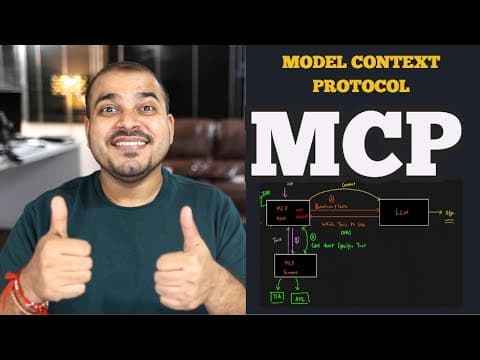
- Model Context Protocol is an open protocol that standardizes how applications provide context to language models. It replaces separate communication code for each external tool or database with a generic protocol intended to give those integrations a common communication method.
Install to Summarize YouTube Videos and Get Transcripts
Explore YouTube Video Summarizer or Get YouTube Transcript Extractor
Questions & Answers
Q: How should I start learning to build agentic AI systems?
Start by developing strong hands-on Python skills, including modular coding, classes, object-oriented programming, and end-to-end project development. Study machine learning, natural language processing, deep learning for NLP, and generative AI as foundations. You can begin building language-model-based agents before finishing every prerequisite, but the roadmap recommends learning those foundational subjects in parallel.
Q: What Python skills are required for agentic AI development?
Agentic AI development requires more than basic Python syntax. The recommended preparation includes practical experience building complete projects, organizing code into modules, working with classes, and applying object-oriented programming. Strong project-level Python knowledge makes agentic system development easier because the work requires coordinating language models, tools, workflows, frameworks, and deployment-related components in one application.
Q: Can I learn agentic AI without machine learning or NLP experience?
Yes, a developer can begin creating agentic systems with language models without first mastering machine learning, natural language processing, or deep learning. However, the roadmap recommends studying these subjects alongside agent development. Foundational knowledge helps explain how the underlying systems work and is particularly useful because interviews may emphasize basic concepts more heavily than direct questions about agentic frameworks.
Q: Why should LangGraph be the first agentic AI framework to learn?
LangGraph is recommended first because it supports complex workflows, allows granular changes within those workflows, and is described as stable enough for serious agentic applications. The transcript contrasts it with early LangChain releases, where frequent changes to modular package locations created upgrade difficulties. Learning LangGraph first also provides a foundation that makes later frameworks easier to understand.
Q: What is LangSmith used for in agentic AI applications?
LangSmith is used for tracing, debugging, and monitoring applications developed with LangGraph and related tools. These capabilities help developers inspect what happens across a multi-step workflow, identify problems, and follow application behavior. It is presented as an important companion platform when building chatbots, agentic systems, and other workflows that coordinate language models across multiple operations.
Q: What can agentic AI automate in software development?
Agentic AI can automate a connected software development life cycle workflow. The example described includes business requirements, requirement gathering, coding, unit testing, writing test cases, and producing documentation. Instead of treating each stage as an isolated task, an agentic framework such as LangGraph can organize the stages into a complex workflow directed toward completing the larger development goal.
Q: What order should I follow when learning agentic AI frameworks?
The recommended order begins with LangChain and LangGraph, with particular emphasis on learning LangGraph for building workflows. LangSmith follows as the platform for tracing, debugging, and monitoring. Next, study Agno, formerly Phi Data, to create reasoning, multimodal, and workflow-based agents more easily. After gaining experience with both, move to CrewAI and multi-agent communication patterns.
Q: What is Model Context Protocol and why is it useful?
Model Context Protocol is an open protocol that standardizes how applications provide context to language models. Before this protocol, a developer might write separate communication code for a language model to use each external tool or database. The protocol introduces a generic communication approach so different tool integrations can use one shared method instead of individually designed connection patterns.
Summary & Key Takeaways
-
The roadmap begins with practical Python proficiency rather than basic syntax alone. Developers should understand modular programming, classes, object-oriented programming, and complete project development. Machine learning, natural language processing, deep learning for NLP, and generative AI provide useful foundations, especially for understanding underlying behavior and answering conceptual questions during technical interviews.
-
LangGraph is presented as the first major framework to study because it supports stable, complex, and granular agentic workflows. LangSmith complements it with application tracing, debugging, and monitoring. The described projects include chatbots and software-development workflows covering requirements, coding, unit testing, test-case creation, and documentation within an automated process.
-
After LangGraph, the recommended sequence continues with Agno, formerly called Phi Data, followed by CrewAI. These frameworks simplify the creation of reasoning, multimodal, and communicating agents. The roadmap also includes deployment on AWS, GCP, or Azure and Model Context Protocol for standardizing connections between language models and external tools or databases.
Read in Other Languages (beta)
Share This Summary 📚
Summarize YouTube Videos and Get Video Transcripts with 1-Click
Try YouTube Summary with ChatGPT & Claude or YouTube Transcript Generator
Explore More Summaries from Krish Naik 📚
Summarize YouTube Videos and Get Video Transcripts with 1-Click
Try YouTube Summary with ChatGPT & Claude or YouTube Transcript Generator