How to Copy a Meta Ads Strategy for Growth
TL;DR
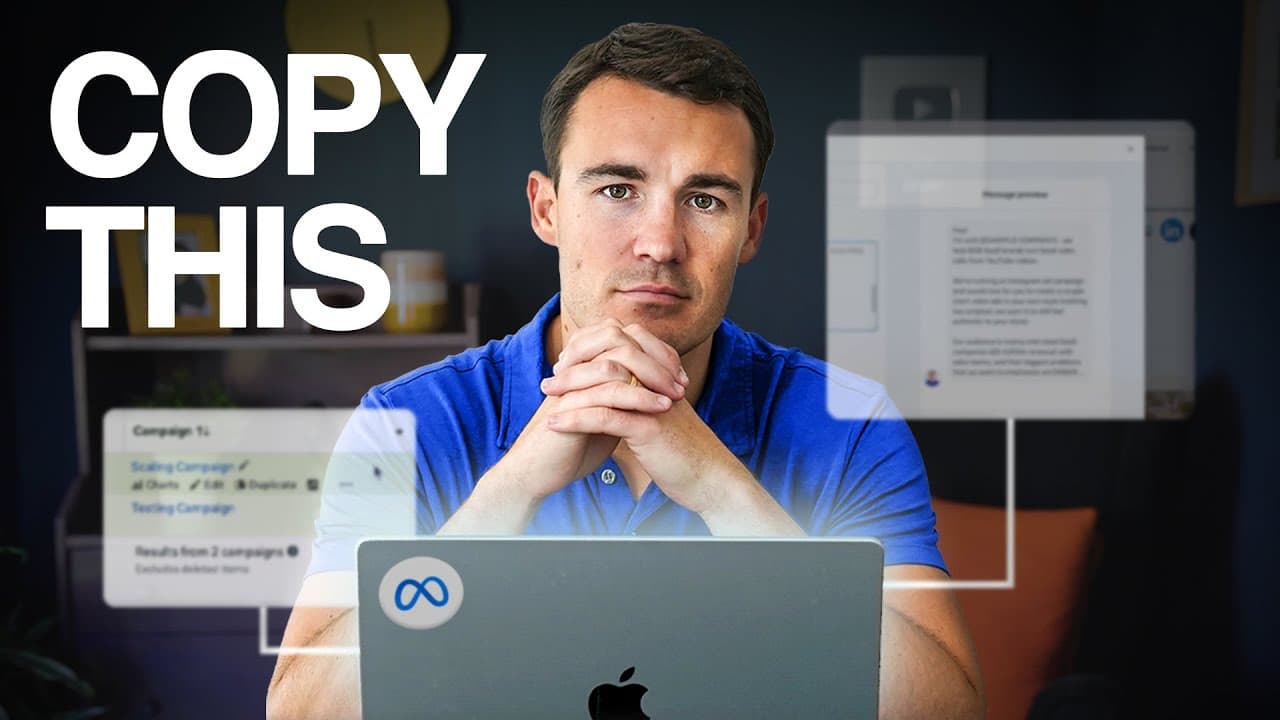
The two campaign structure is key: a scaling campaign to exploit winners and a testing campaign to continually test new creatives. This setup allows data accumulation and creative testing while avoiding fatigue on top performers. If results improve, shift budget toward scaling; if not, invest more in testing to discover new winners.
Transcript
My agency is working on more than 1,200 meta ad accounts right now. We literally have more than 1,200 Facebook ad accounts in our business manager and almost no one on earth has access to that many ad accounts, access to that much testing resource, which has allowed us to test so many different Facebook and Instagram ad strategies. And in this vide... Read More
Key Insights
- A two campaign structure combines a scaling campaign and a testing campaign to maximize both performance and experimentation. The scaling campaign runs winners while the testing campaign continually introduces new creatives to Meta for evaluation.
- A single ad set per campaign is recommended because Meta blends audiences when using suggested audiences, so consolidating data helps Meta optimize more effectively and maintain a stable testing environment.
- Creative testing is essential for longevity; rotating in new ads prevents fatigue of top performers and uncovers potentially better creatives that can later replace current winners.
- Budgeting between campaigns depends on performance; allocate more to scaling when results are strong and pivot to testing when profitability is lacking to discover new winners.
- Influencers and creators can produce ads more efficiently than in-house teams, often delivering high quality content quickly and at lower cost, which can boost ad performance through trusted endorsements.
- Meta’s creator marketplace is a free tool to find space-aligned influencers, enabling direct outreach and campaign setup to control deliverables and timelines.
- Hiring influencers can also provide added exposure for the creators themselves, making the collaboration attractive and scalable for advertisers with growing needs.
- The strategy emphasizes practical structure and testing discipline over chasing a single “perfect” ad, focusing on iterative learning and data-driven optimization.”],
- Q_and_A:[{
- question
- answer
- More videos from this channel:
- More from this channel: Ben Heath
Install to Summarize YouTube Videos and Get Transcripts
Explore YouTube Video Summarizer or Get YouTube Transcript Extractor
Questions & Answers
Q: What is the recommended two-campaign setup and why is it used?
The recommended setup includes a scaling campaign and a testing campaign, each with one adset and targeting both cold and warm audiences. This structure lets you run winners from the scaling campaign while the testing campaign continuously tests new creatives. It prevents top performers from fatiguing because new ads get budget for evaluation, and it accelerates learning by separating optimization objectives between growth and discovery.
Q: How should budget be allocated between scaling and testing campaigns?
Budget allocation should be driven by performance. If results are strong and profitable, allocate a larger share to the scaling campaign to maximize winner revenue, potentially 80 percent. If profitability is weak, shift more budget toward testing to rapidly discover new ads that can outperform current winners, then reallocate once those gains materialize.
Q: Why is there one adset per campaign in this strategy?
One adset per campaign concentrates data, allowing Meta to optimize effectively by blending audience signals within that single set. Separate targeting by location only when necessary, not by interests, to avoid fragmentation that could hinder learning and slow down optimization.
Q: What role do influencers and creators play in this strategy?
Influencers and creators are used to generate ads instead of building them in-house. They bring professional content creation skills and trusted voices that can stop scrolls and improve click-through and conversion rates. Their involvement can accelerate performance while often costing less than traditional ad production.
Q: How can Meta’s creator marketplace be used in this approach?
The creator marketplace is a free tool to find creators whose audiences align with your niche. Advertisers can search, reach out, and specify deliverables to quickly assemble campaigns. This streamlines collaboration and helps you obtain authentic, high-quality content at scale.
Q: What are the benefits of testing new ads in a separate campaign?
Testing new ads in a separate campaign forces Meta to allocate budget to fresh creatives, ensuring new ideas get exposure even when top performers dominate the learning phase. This helps build a bank of ready-to-go ads that can replace underperforming ones later, maintaining long-term performance.
Q: What is the impact of using influencers on ad performance, according to the video?
Using influencers can significantly improve engagement and conversion by leveraging trust and authority within a niche. The content they create resonates more with viewers, reducing scroll fatigue and increasing the likelihood of a click and subsequent conversion, sometimes boosting returns compared to standard non-influencer creatives.
Q: What should beginners take away from this Meta Ads strategy?
Beginners should focus on a simple, scalable structure: two campaigns, one adset each, and a disciplined testing approach. Prioritize data-driven decisions, use influencers to accelerate content quality, and adjust budgets in response to performance. This approach fosters ongoing learning and sustainable growth without overcomplicating campaigns.
Summary & Key Takeaways
-
This video presents a two-campaign approach for Meta Ads with one adset per campaign, designed to consolidate audiences and maximize data collection. It explains why separating scaling from testing helps test new creatives without harming top performers and how budget allocation adapts to performance.
-
The creator emphasizes the value of influencer and creator produced ads, arguing they improve engagement and conversion by leveraging trusted voices. It covers choosing influencers via Meta’s creator marketplace and structuring collaborations to get a win on ad performance.
-
The mentor pitch highlights access to live calls, Q&As, and unlimited support, framing it as a way to accelerate learning and implementation of effective Meta Ads strategies, with emphasis on practical execution and ongoing optimization.
Read in Other Languages (beta)
Share This Summary 📚
Summarize YouTube Videos and Get Video Transcripts with 1-Click
Try YouTube Summary with ChatGPT & Claude or YouTube Transcript Generator
Explore More Summaries from Ben Heath 📚
Summarize YouTube Videos and Get Video Transcripts with 1-Click
Try YouTube Summary with ChatGPT & Claude or YouTube Transcript Generator