Why Is Human Perception a Controlled Hallucination?
TL;DR
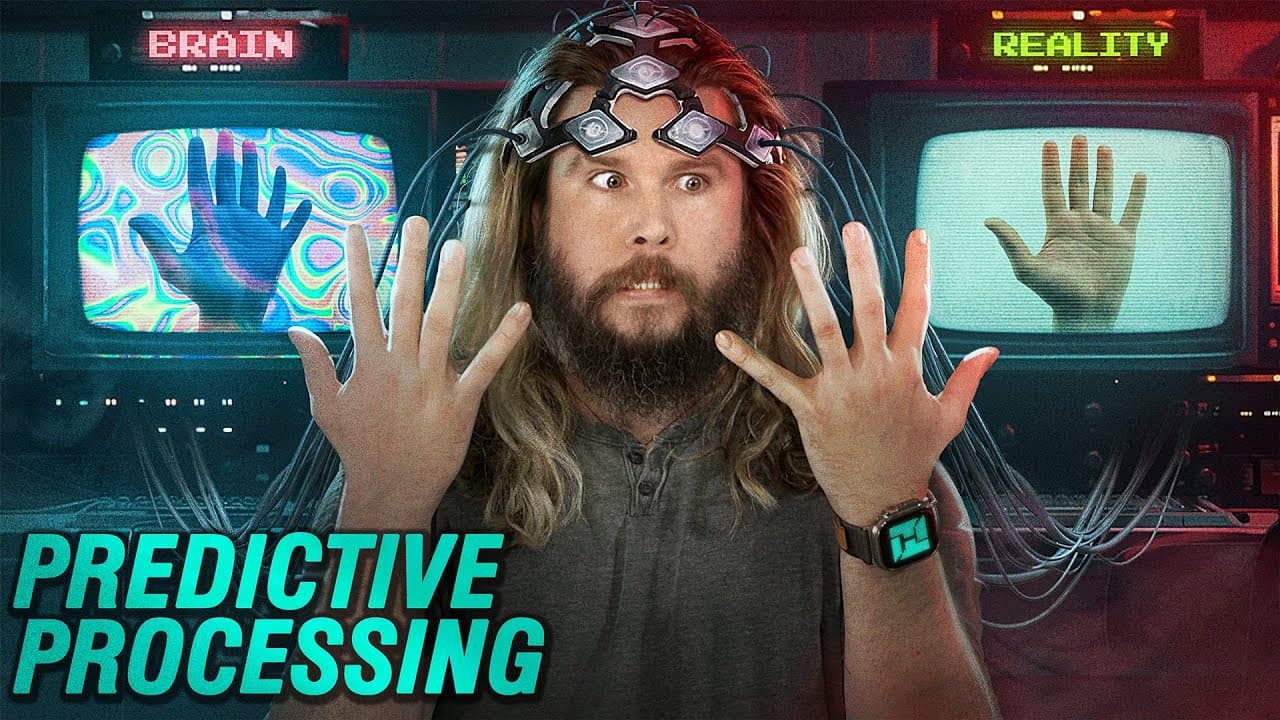
Human perception is essentially a controlled hallucination, as modern neuroscience reveals that our brains construct a mental model of reality based on predictive processing rather than direct sensory input. This means we don’t perceive the world as it truly is; instead, our experiences are shaped by our brain's predictions and interpretations, often filling in gaps and providing a seamless experience.
Transcript
you live in the past it's weird I know I said those words over 10 years ago now just look at what has happened to me I said it because any information that you perceive has to travel some distance and time to get to your senses and then it has to be processed by the brain electrochemically and therefore there is simply no way that you can be living... Read More
Key Insights
- 🧠 Perception involves the brain actively constructing a mental model of the world based on predictions and sensory input.
- 🧠 The brain buffers reality, filling in gaps and creating a seamless experience.
- 🍝 Our perception of reality is shaped by past experiences and expectations.
- 🫵 Predictive processing provides a unifying theory of cognition and challenges the traditional view of direct realism.
- ❓ Evolutionary pressures have favored efficient mental models over exact replicas of external reality.
- ❓ Predictive processing has implications for AI and the study of cognition.
- 🧠 The brain's model of the world only changes when a prediction error occurs, highlighting the brain's reliance on internal models.
Install to Summarize YouTube Videos and Get Transcripts
Explore YouTube Video Summarizer or Get YouTube Transcript Extractor
Questions & Answers
Q: How does the brain create the illusion of simultaneous actions when there is a delay in processing signals?
The brain buffers reality, giving the illusion of simultaneous actions, but in reality, there is a delay in processing electrochemical signals from touch or other sensations.
Q: Why does our brain fill in the gaps in our vision during blinking?
When we blink, we are functionally blind, but our brain fills in the missing visual information based on expectations and past experience.
Q: Does our perception of reality align with the actual world?
No, perception and reality are not the same thing. The brain constructs a mental model of the world, but this model may not accurately reflect the external reality.
Q: How does predictive processing explain the discrepancies between our senses and reality?
Predictive processing suggests that our brain uses models and predictions to construct our perception of the world, updating this model when there are discrepancies between predictions and sensory input.
Summary & Key Takeaways
-
Modern Neuroscience challenges the naive view of human perception, suggesting that we do not perceive the world as it truly is, but rather through a constructed mental model.
-
The brain processes sensory input and makes predictions about the world, often filling in gaps and buffering reality.
-
Predictive processing, a new theory gaining ground in the field, proposes that our entire conscious experience is a controlled hallucination crafted by the brain.
Read in Other Languages (beta)
Share This Summary 📚
Summarize YouTube Videos and Get Video Transcripts with 1-Click
Try YouTube Summary with ChatGPT & Claude or YouTube Transcript Generator
Explore More Summaries from Kyle Hill 📚



![🔴 Viral "Hanger Reflex" Explained! | [OFFICE HOURS] Podcast 090 thumbnail](/_next/image?url=https%3A%2F%2Fi.ytimg.com%2Fvi%2F-GQPNu0erKc%2Fhqdefault.jpg&w=750&q=75)
![What Made MEGALODON So Huge? | [OFFICE HOURS] Podcast #025 thumbnail](/_next/image?url=https%3A%2F%2Fi.ytimg.com%2Fvi%2F2F_zCTfPt-I%2Fhqdefault.jpg&w=750&q=75)

Summarize YouTube Videos and Get Video Transcripts with 1-Click
Try YouTube Summary with ChatGPT & Claude or YouTube Transcript Generator