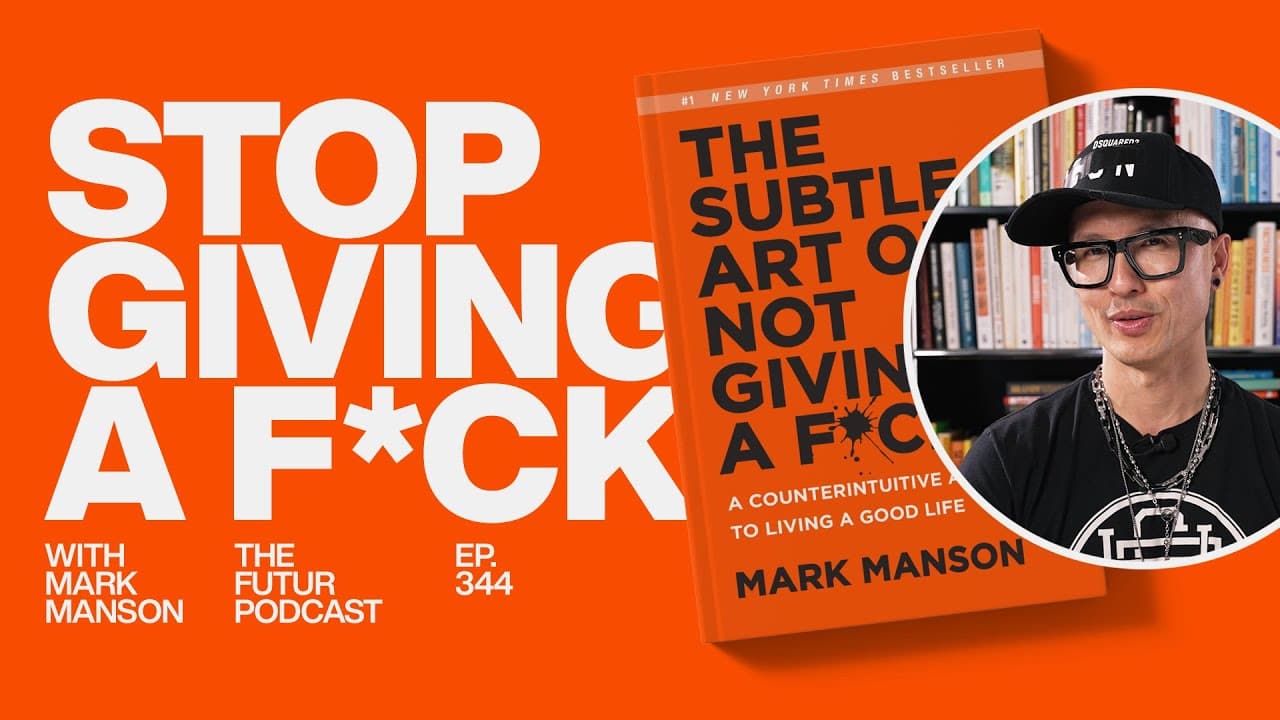
Mark Manson on Choosing Suffering Worth Having
TL;DR
Avoiding suffering becomes its own form of suffering, because resisting an emotion like anxiety or anger amplifies it. Mark Manson argues the better path is to find the struggle that feels meaningful: the hard work you are naturally predisposed to tolerate, paired with a mission that gives the pain purpose. Pain is discomfort; suffering is the story you tell yourself about it.
Transcript
If you've ever wondered when to keep going and when to stop, it comes down to a counterintuitive truth about creativity and suffering. Isn't it weird how sometimes the hardest answer is the most simple one that's right in front of you, but you just don't see it for whatever reason? It was right here in front of my nose for 5 years and I was looking... Read More
Key Insights
- Resisting an emotion amplifies it. Trying to stop feeling anxious makes a person anxious about being anxious, and suppressing anger makes a person angry about being angry, which creates a feedback loop.
- Avoiding all struggle is itself a form of suffering, because constantly censoring and limiting yourself to dodge discomfort is uncomfortable. Manson took from Buddhism that suffering is ever present, so it should be accepted.
- The key to a fulfilling life is choosing suffering that feels worth having: struggle that feels meaningful and adds value, rather than trying to eliminate struggle altogether.
- Worthwhile suffering often comes from tasks you are naturally predisposed to, and people are usually bad at noticing them because they don't feel like sacrifice. Manson calls this the [ __ ] sandwich you don't mind eating.
- Pain and suffering are different. Pain is discomfort or unpleasantness, mental or physical. Suffering is a more existential misery, the narrative you write in your head about the pain, such as asking why you are still doing this.
- Manson left music after realizing he hated the hours of practice that make up most of a musician's life, while a classmate who just played all day did not experience practice as sacrifice.
- Pairing a natural talent with a higher mission sustains a person through ups and downs. For Manson, the mission was fixing a self-help industry he saw as giving bad and counterproductive advice.
- Enjoying your work tends to improve output, because you care more, pay closer attention to detail, put more energy in, and burn out slower. Alignment between daily work and a mission also eases suffering.
Install to Summarize YouTube Videos and Get Transcripts
Explore YouTube Video Summarizer or Get YouTube Transcript Extractor
Questions & Answers
Q: Why does avoiding suffering cause more suffering?
According to Mark Manson, resisting any emotion tends to amplify it. Someone who tries to stop feeling anxious becomes anxious about being anxious, and someone suppressing anger becomes angry about being angry. Trying to eliminate all struggle means constantly censoring and limiting yourself to avoid possible discomfort, and that constant vigilance is itself a form of pain and suffering.
Q: What is the difference between pain and suffering?
Manson defines pain as plain discomfort, something unpleasant, whether mental or physical. Suffering is a more existential misery. It often accompanies pain but does not have to. People who love their jobs still have painful days, yet they are glad to be there. Suffering begins when you build a narrative around the pain, asking why you are here or why you took this job.
Q: How do you find the kind of suffering worth having?
Manson suggests looking for the task most people consider really hard but that you somehow don't mind. He frames it as asking which [ __ ] sandwich you don't mind eating, because that is probably your secret superpower. He also recommends attaching that predisposition to a mission or principle, which gives the inevitable pain meaning and helps sustain you through wins and losses.
Q: Why did Mark Manson quit music school?
Manson was practicing guitar five to six hours a day, developing tendonitis, sore fingers, and burnout, when his teacher told him his problem was not practicing enough. He realized most of being a musician is practicing, a form of suffering he was not predisposed to and found no higher meaning in. A classmate who simply played all day did not see it as sacrifice.
Q: How did Mark Manson realize writing was his natural strength?
After his blog grew, conference attendees cornered him asking how he wrote so much, including articles of 5 to 20 pages published sometimes several times a week. They asked about his routine and warm-ups. He answered that he just wakes up and writes, echoing his music classmate. He saw that rereading and rewriting paragraphs repeatedly, agonizing for most people, was something he naturally enjoyed.
Q: Why does having a mission help sustain hard work?
Manson says that beyond his predisposition to writing, he found a higher mission: he believed the self-help industry gave bad, counterproductive advice that could harm people's mental health, and he wanted to fix it. Attaching that mission to his talent is what sustained him through the ups and downs and the wins and losses of his career over the years.
Q: Does enjoying your work make you more productive?
Yes, according to Manson. If you enjoy your work, your output is probably better because you care more, pay more attention to detail, put more energy into it, and burn out slower. He adds that finding alignment between daily work and a value, principle, or mission also alleviates suffering, so you don't feel you are torturing yourself for a paycheck.
Q: Do you need to become an artist or entrepreneur to find meaningful work?
No. Manson says finding alignment does not require becoming an artist or an entrepreneur. Instead, people should look for some value, principle, or mission that feels aligned with how they spend their days. He also warns that many people go looking for passion as if it were hidden under a rock, treating it as a magical thing waiting to be discovered.
Summary & Key Takeaways
-
Manson explains that avoiding suffering creates more suffering. Resisting emotions like anxiety or anger amplifies them through a feedback loop. Drawing on Buddhism, he argues suffering is ever present, so people should accept it and look for the suffering that feels meaningful and worth having rather than trying to avoid all discomfort.
-
Using his own story, Manson contrasts music school, where five to six hours of daily guitar practice left him burnt out and injured, with blogging, where rewriting long articles felt natural. He concludes that the hard thing you don't mind doing, which most people find agonizing, is likely your secret superpower.
-
Manson separates pain, which is simple discomfort, from suffering, the existential story told about that pain. Combining a natural predisposition with a mission, such as improving self-help advice, sustains effort. Host Chris Do adds that when work feels like breathing, it stops feeling like work, and both agree enjoyment improves output.
Read in Other Languages (beta)
Share This Summary 📚
Summarize YouTube Videos and Get Video Transcripts with 1-Click
Try YouTube Summary with ChatGPT & Claude or YouTube Transcript Generator
Explore More Summaries from The Futur 📚




Summarize YouTube Videos and Get Video Transcripts with 1-Click
Try YouTube Summary with ChatGPT & Claude or YouTube Transcript Generator