Why the US is Struggling to Land on the Moon
TL;DR
US struggles with autonomous lunar landings despite technological advancements.
Transcript
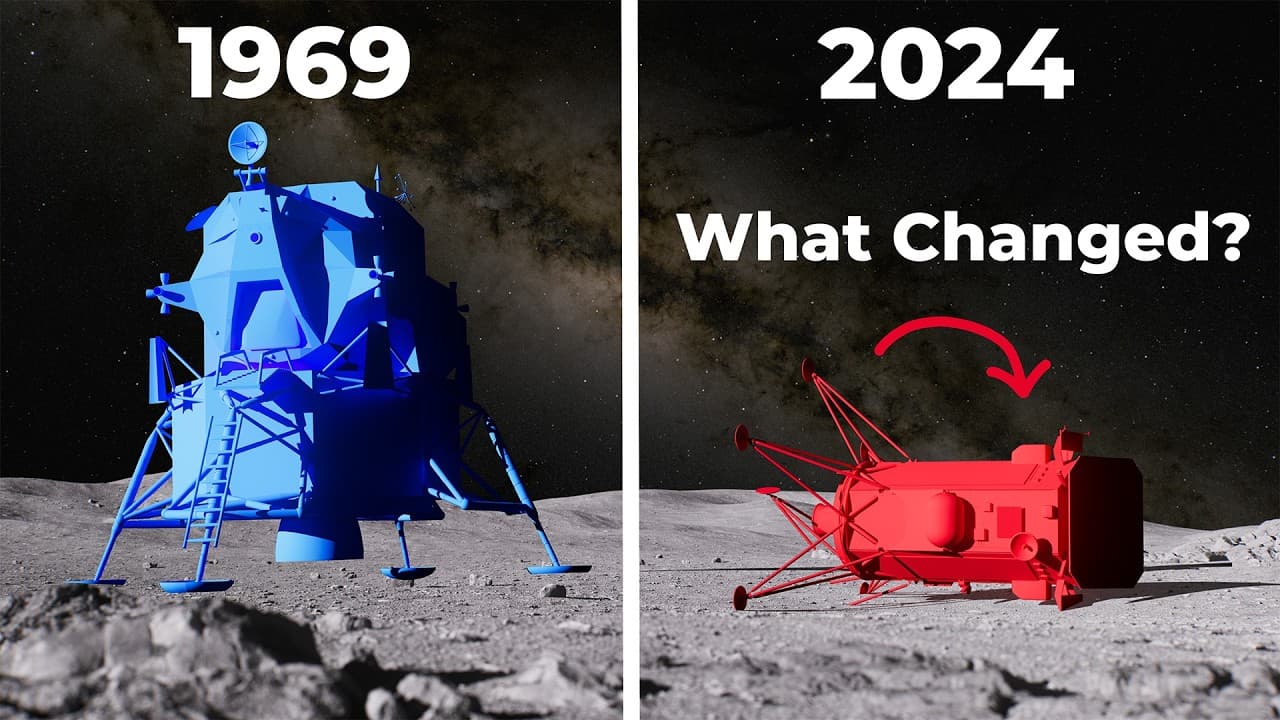
Landing on the moon is not easy. Just this year, the first two American lunar landing attempts since Apollo 17 in 1952 failed. First Astrorobotic’s Peregrine lander failed to reach the moon, due to a propellant leak, and just a month later Intuitive Machines lunar lander took a tumble as it was making its final descent onto the lunar surface. I... Read More
Key Insights
- The US has faced recent failures in lunar landing attempts due to technical issues, highlighting the complexity of space missions.
- NASA's focus is on developing reliable autonomous landing technologies for the moon, crucial for future manned missions.
- The Commercial Lunar Payload Services initiative funds private companies to advance lunar landing technologies.
- Autonomous navigation systems rely on detailed lunar maps and visual guidance, but face challenges at low altitudes due to dust.
- China's advanced lunar relay satellites offer continuous communication, a capability the US and Europe currently lack.
- Landing on the moon requires precise thrust control and careful engineering of lander components, including landing legs.
- Future lunar missions aim to build infrastructure like Luna Net for better communication and navigation.
- The Blue Ghost mission is part of efforts to improve lunar landing success rates and prepare for future manned missions.
Install to Summarize YouTube Videos and Get Transcripts
Explore YouTube Video Summarizer or Get YouTube Transcript Extractor
Questions & Answers
Q: Why did the recent US lunar landing attempts fail?
The recent US lunar landing attempts failed due to technical issues. Astrobotic's Peregrine lander experienced a propellant leak, while Intuitive Machines' lander tipped over after its leg struck a rock. These failures highlight the complexity and challenges of autonomous lunar landings, even with modern technology.
Q: What is the purpose of NASA's Commercial Lunar Payload Services initiative?
NASA's Commercial Lunar Payload Services initiative aims to fund private companies to develop technologies for lunar landings. With a budget of $2.6 billion, it supports missions by companies like Intuitive Machines, Astrobotic, and Firefly. The goal is to make lunar landings safer and more reliable, paving the way for future manned missions.
Q: How do autonomous lunar navigation systems work?
Autonomous lunar navigation systems work by using detailed maps of the moon's surface, created by the Lunar Reconnaissance Orbiter. These systems rely on cameras to compare real-time images with known surface features, like craters. However, challenges arise at lower altitudes when dust obscures the view, requiring reliance on inertial measurement units.
Q: What advantages does China have in lunar communication?
China has an advantage in lunar communication with its advanced relay satellites. These satellites, positioned at Lagrange Point 2, provide continuous communication with the far side of the moon. This capability allows for uninterrupted data transmission, unlike the US and Europe, which currently lack similar infrastructure.
Q: What challenges do lunar landers face during descent?
Lunar landers face several challenges during descent, including precise thrust control and maintaining stability. As the lander's weight changes due to fuel consumption, its center of gravity shifts, requiring careful adjustments. Dust kicked up during landing can obscure visual navigation, making it critical to rely on other systems for a safe touchdown.
Q: How is the Blue Ghost mission contributing to lunar exploration?
The Blue Ghost mission is contributing to lunar exploration by testing and developing technologies for safer and more reliable lunar landings. It aims to improve navigation and communication systems, and its success will help build the necessary infrastructure for future manned missions. The mission is part of NASA's broader effort to enhance lunar exploration capabilities.
Q: What is Luna Net and its significance for future lunar missions?
Luna Net is a planned network of communication and navigation nodes for future lunar missions. It aims to provide continuous data transmission and positioning information, enhancing the safety and reliability of lunar operations. Luna Net represents a critical step in building the infrastructure needed for sustained lunar exploration and eventual manned missions.
Q: What improvements are needed for future lunar missions?
Future lunar missions require improvements in communication, navigation, and landing technologies. Developing a network like Luna Net will ensure continuous communication, while advancements in autonomous navigation systems will enhance landing precision. Additionally, better engineering of lander components, such as landing legs, is necessary to ensure stability and safety during descent and touchdown.
Summary & Key Takeaways
-
The US faces challenges in lunar landings, with recent failures highlighting the need for improved autonomous technologies. NASA's Commercial Lunar Payload Services initiative funds private companies to develop these technologies, aiming to make lunar landings safer and more reliable for future missions.
-
Autonomous navigation systems are crucial for lunar landings, relying on detailed maps and visual guidance. However, challenges arise at lower altitudes due to dust and resolution limitations. China's advanced communication satellites provide an edge in continuous lunar communication, a gap the US aims to fill.
-
Future lunar missions will focus on building infrastructure like Luna Net for improved communication and navigation. The Blue Ghost mission is part of efforts to enhance lunar landing success rates and prepare for manned missions, emphasizing the importance of precise engineering and technology development.
Read in Other Languages (beta)
Share This Summary 📚
Summarize YouTube Videos and Get Video Transcripts with 1-Click
Try YouTube Summary with ChatGPT & Claude or YouTube Transcript Generator
Explore More Summaries from Real Engineering 📚




Summarize YouTube Videos and Get Video Transcripts with 1-Click
Try YouTube Summary with ChatGPT & Claude or YouTube Transcript Generator