Why Most AI Startups Lack a Defensible Moat
TL;DR
AI startups are most vulnerable when they offer little beyond a convenient interface and repeatable prompts, because competitors can copy that experience easily. Convenience can still support a real business, especially for customers who cannot or do not want to build workflows themselves, but lasting success requires stronger differentiation, reliable execution, customer adoption, or another defensible advantage.
Transcript
99% of AI startups will be dead by 2026. Now, one has to ask the question, isn't 99% of startups dead by 2006 or 2026? Isn't that how it always goes? Isn't it Isn't the amount of startups that actually work fairly low? I'm just saying. All right. In the late 90s, I was a student at Berkeley. Watching a.com boom unfold like a fever dream. Traffic eq... Read More
Key Insights
- • Startup failure is already common, so the claim that 99% of AI startups will die needs context rather than being treated as unique to AI businesses. The discussion asks whether such a failure rate simply reflects the historically low proportion of startups that succeed.
- • The dot-com boom rewarded attention and branding before sustainable economics were proven. In the late 1990s, companies without clear business models bought Super Bowl advertising, investors funded ambitious announcements, and adding “.com” to a concept could attract substantial enthusiasm.
- • Extreme valuations can anticipate decades of future performance. Qualcomm sold a real product, yet its stock reached about $900 a share during the boom and required almost 20 years to return to that level after the market reversed.
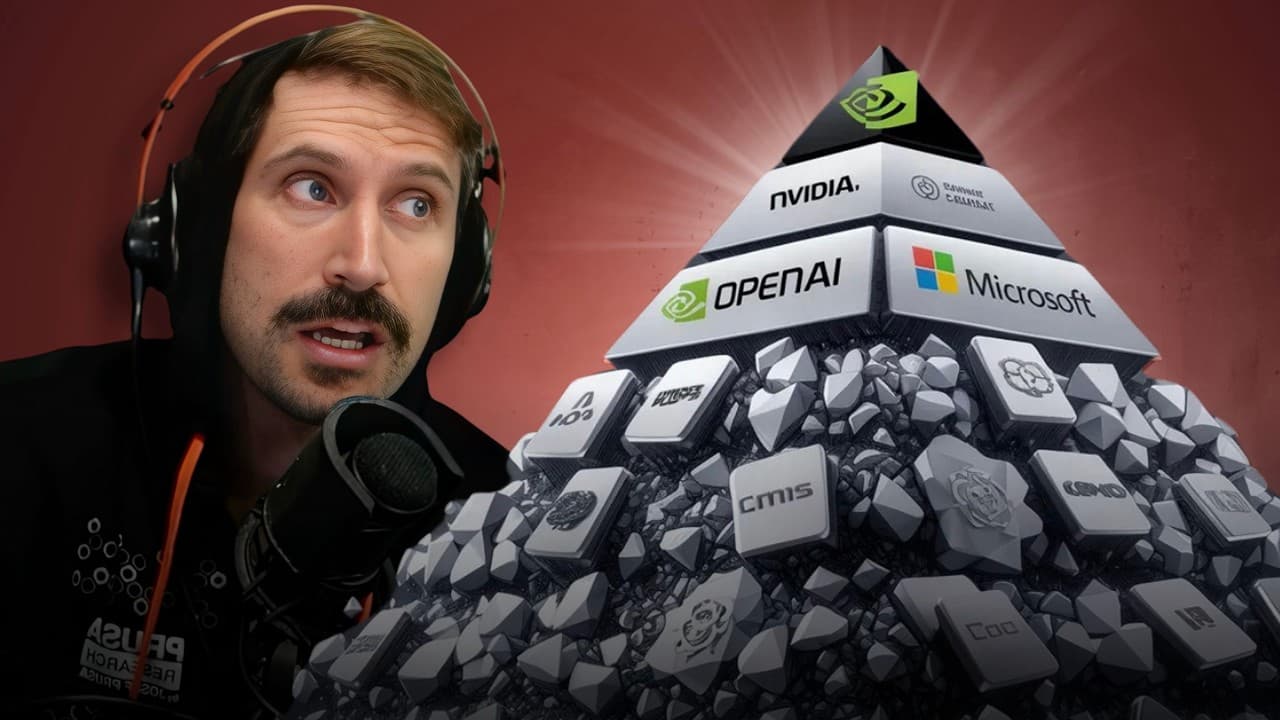
- • AI infrastructure is a chain of dependencies rather than a collection of fully independent companies. The discussion describes application wrappers relying on OpenAI, OpenAI relying on Microsoft, Microsoft needing Nvidia, and Nvidia supplying the chips that power the broader system.
- • An AI wrapper can provide genuine value when it transforms a difficult technical process into a clean workflow. Customers may willingly pay for convenience because many users cannot reproduce API-driven automation, even when an experienced programmer considers the underlying implementation simple.
- • The programmer’s problem is underestimating the economic value of saved effort. A developer may spend time worth thousands of dollars rebuilding a product to avoid a $60 monthly charge, while a nontechnical customer may reasonably pay because the service eliminates repeated hours of work.
- • Easy replication is dangerous primarily because it weakens competitive protection. A product built from common API calls, hard-coded prompts, and a basic interface may serve customers successfully, but another company can reproduce similar functionality and compete for those customers.
- • Cursor shows that an obvious initial moat is not always required for commercial traction. It began from Microsoft’s editor while Microsoft had more money, OpenAI access, and internal APIs, yet Cursor was described as succeeding despite those apparent competitive disadvantages.
Install to Summarize YouTube Videos and Get Transcripts
Explore YouTube Video Summarizer or Get YouTube Transcript Extractor
Questions & Answers
Q: Why might most AI startups fail?
Most AI startups may fail for the same fundamental reason many startups fail: only a relatively small share becomes sustainable. AI companies face additional pressure when their products consist mainly of common model APIs, hard-coded prompts, and easily copied interfaces. Without differentiation, customer loyalty, reliable distribution, or another defensible advantage, competitors can reproduce the core experience and challenge their pricing.
Q: How is the AI startup boom similar to the dot-com boom?
The similarity lies in investment enthusiasm arriving before durable business fundamentals are clear. During the late 1990s, traffic was treated like revenue, adding “.com” attracted investors, and companies without business models purchased Super Bowl advertising. The AI market shows comparable excitement, with many companies receiving large investments even when their purpose, independence, or ability to produce lasting value remains uncertain.
Q: What is an AI wrapper startup?
An AI wrapper startup builds a user-facing product around technology supplied by another company, often through an API. The example discussed accepts a podcast transcript, runs prompts that create summaries, tweets, LinkedIn posts, and newsletter drafts, then displays formatted results. Its value comes from packaging and workflow rather than owning the underlying model, infrastructure, or unique technical capability.
Q: Can a simple AI wrapper still be a valuable product?
A simple wrapper can be valuable when it makes a technical process accessible, fast, and dependable for customers who would not build it themselves. A polished interface and smooth workflow may save users hours of repeated effort. The discussion argues that dismissing such products overlooks convenience, particularly because many customers lack the technical knowledge needed to manage files, APIs, clients, servers, or automated prompt pipelines.
Q: Why is convenience important to AI product pricing?
Convenience matters because customers evaluate the time and difficulty removed, not merely the provider’s raw API cost. A podcast tool charged $60 a month even though a technically capable user believed the workflow could be reproduced in 5 minutes for under $4. For less technical users, paying the subscription may be rational if it consistently eliminates hours of confusing or repetitive work.
Q: What is the biggest risk for AI products built on APIs?
The biggest risk is weak competitive defensibility. If a product relies on widely available API calls, standard prompts, and an interface that others can recreate, competitors can launch similar services and take customers. Dependence on external providers also creates exposure across the infrastructure chain. The product therefore needs more than functional replication, such as superior execution, adoption, workflow design, or customer value.
Q: Why does the speaker criticize the programmer’s view of software value?
The programmer’s view can confuse technical reproducibility with a lack of commercial value. Experienced developers often assume they should rebuild a product rather than pay a subscription, even if their time makes that decision more expensive. That reasoning also ignores customers who do not understand the underlying technology. For those users, a finished workflow is valuable precisely because it removes technical decisions and repeated setup.
Q: How does Cursor challenge the claim that AI wrappers cannot succeed?
Cursor is presented as a counterexample because it initially appeared to lack a strong moat. It forked Microsoft’s editor, while Microsoft possessed more money, access to OpenAI, and internal APIs unavailable to ordinary VS Code users. Despite those disadvantages, Cursor was described as “crushing it.” The example suggests that execution and user adoption can produce success even without obvious proprietary technology at the beginning.
Summary & Key Takeaways
-
The discussion compares the current AI investment boom with the dot-com era of the late 1990s, when traffic, branding, and investor excitement often substituted for viable business models. Many companies disappeared after the market collapsed, while even a real business such as Qualcomm took almost 20 years to revisit its inflated stock level.
-
Many AI products depend on a layered ecosystem involving model providers, cloud platforms, and chipmakers. Some products are mainly interfaces that connect user inputs to hard-coded prompts and return formatted results. That structure creates exposure to suppliers and makes functionality easier for competitors or technically capable customers to reproduce.
-
A simple AI wrapper is not automatically worthless because convenience, usability, and saved time can justify subscription pricing. The greater risk is weak defensibility. Cursor illustrates that a company can begin without an obvious moat and still gain adoption, even while competing against Microsoft, which possessed substantial resources and platform advantages.
Read in Other Languages (beta)
Share This Summary 📚
Summarize YouTube Videos and Get Video Transcripts with 1-Click
Try YouTube Summary with ChatGPT & Claude or YouTube Transcript Generator
Explore More Summaries from The PrimeTime 📚






Summarize YouTube Videos and Get Video Transcripts with 1-Click
Try YouTube Summary with ChatGPT & Claude or YouTube Transcript Generator