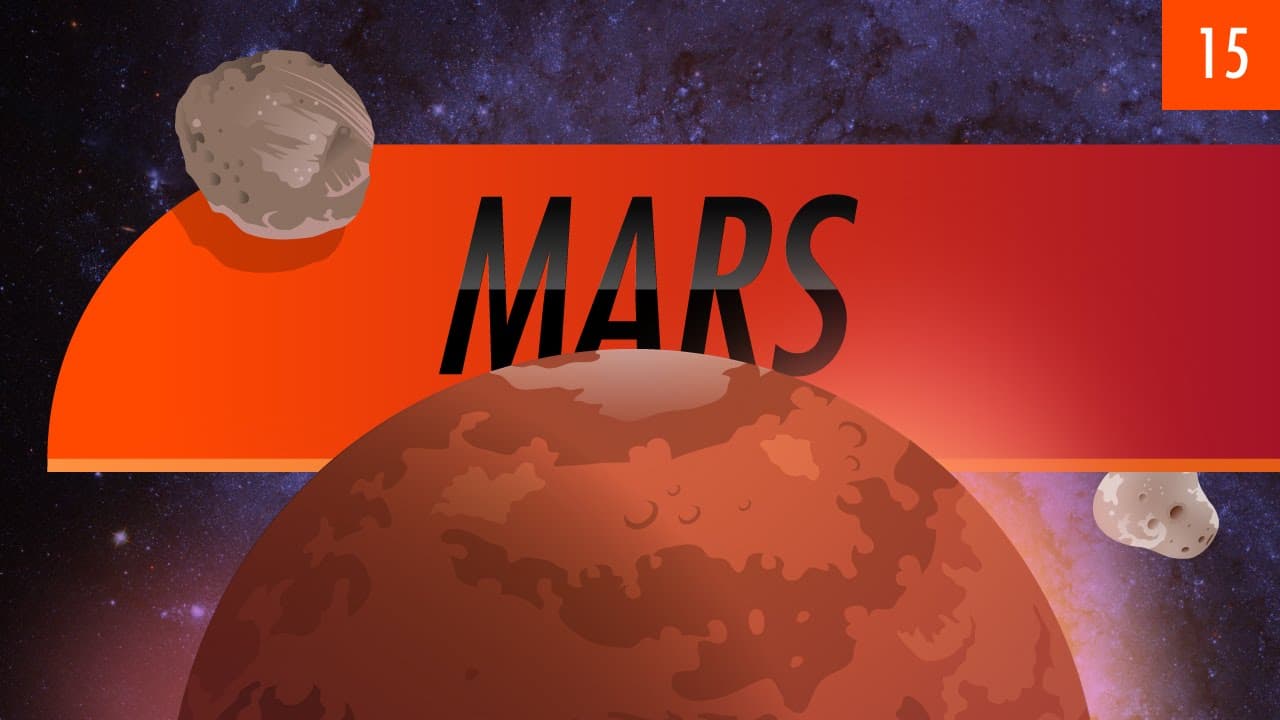
Mars: Crash Course Astronomy #15
TL;DR
Mars is a fascinating planet with a rusty surface and potential for future exploration.
Transcript
Hey folks, I’m Phil Plait and this is Crash Course Astronomy. You know, I can’t think of any object in the sky that’s captured our imagination like Mars has. The Red Planet was once thought to be the god of war, and in more modern times has been the setting for a zillion science fiction novels, movies, TV shows, and more. And now that we’ve gone th... Read More
Key Insights
- Mars, the fourth planet from the Sun, has captured human imagination through its depiction in various science fiction narratives and its potential as a future destination for human exploration.
- The planet is characterized by its red appearance, caused by iron oxide or rust on its surface, and features a diverse topography including the largest volcano and canyon in the solar system.
- Mars has two small moons, Phobos and Deimos, which may have been captured asteroids, with Phobos gradually spiraling closer to Mars due to tidal forces.
- While Mars has polar ice caps made primarily of water ice, the planet's thin atmosphere and low pressure make the presence of liquid water on the surface unlikely under current conditions.
- Mars once had a thicker atmosphere and was warmer and wetter, with evidence of past water flows, rivers, lakes, and possibly oceans, but it lost much of its atmosphere due to solar wind erosion.
- The possibility of past life on Mars is a significant area of interest, with NASA's Curiosity rover detecting organic molecules and a methane spike, though these do not conclusively indicate life.
- Human missions to Mars are being planned, with considerations for using lava tubes as potential habitats to protect against radiation and harsh weather conditions.
- Despite the challenges, technological advancements are making the dream of human exploration of Mars more feasible, with ongoing discussions about landing sites and base construction.
Install to Summarize YouTube Videos and Get Transcripts
Explore YouTube Video Summarizer or Get YouTube Transcript Extractor
Questions & Answers
Q: What causes Mars to appear red?
Mars appears red due to the presence of iron oxide, or rust, on its surface. This fine-grained dust, rich in oxidized iron, gives the planet its characteristic reddish hue. The dust is widespread, covering much of the surface and even getting blown into the atmosphere, contributing to Mars's distinctive appearance.
Q: What are the major geological features on Mars?
Mars features several significant geological formations, including Olympus Mons, the largest volcano in the solar system, and Valles Marineris, a massive canyon system. The Tharsis bulge is a large plateau housing multiple volcanoes, and the planet's surface shows a stark dichotomy between the smooth northern plains and the cratered southern highlands.
Q: How does the atmosphere of Mars compare to Earth's?
Mars's atmosphere is much thinner than Earth's, with surface pressure less than 1% of Earth's. It is composed mostly of carbon dioxide, and a significant portion of it freezes out to form polar ice caps during winter. The thin atmosphere provides little protection from impacts, contributing to the heavily cratered Martian surface.
Q: What evidence suggests Mars had water in the past?
There is substantial evidence that Mars once had flowing water, including dry river beds, sedimentary layers, and minerals that form in the presence of water. Features resembling shorelines suggest the presence of ancient lakes or oceans, indicating that Mars was once much wetter and had a thicker atmosphere.
Q: What challenges do humans face when exploring Mars?
Human exploration of Mars presents several challenges, including the need for water, air, and food, as well as protection from radiation and harsh environmental conditions. The thin atmosphere and low pressure make living conditions difficult, necessitating advanced technology and infrastructure to support human life on the planet.
Q: What role do Mars's moons play in its exploration?
Mars's moons, Phobos and Deimos, are of interest for exploration due to their proximity and potential as stepping stones for future missions. Phobos, in particular, is being studied for its gradual inward spiral, which could eventually lead to its impact with Mars, offering unique opportunities for scientific observation.
Q: How has technology advanced our understanding of Mars?
Technological advancements have significantly enhanced our understanding of Mars, with orbiters, landers, and rovers providing detailed data about the planet's surface, atmosphere, and potential for past life. These missions have revealed Mars's complex geology, climate history, and the presence of organic molecules, informing future exploration efforts.
Q: What are the prospects for discovering life on Mars?
The prospects for discovering life on Mars are intriguing, with missions detecting organic molecules and methane spikes, which could indicate biological or geological activity. While no definitive evidence of life has been found, ongoing and future missions aim to explore Mars's habitability and search for signs of past or present life.
Summary & Key Takeaways
-
Mars, known for its red surface due to iron oxide, is the fourth planet from the Sun and has been a source of fascination for humanity. It features diverse landscapes, including the largest volcano and canyon in the solar system, and has two small moons, Phobos and Deimos.
-
The planet's thin atmosphere and cold temperatures prevent liquid water from existing on its surface today, but evidence suggests it was once warmer and wetter, with rivers and lakes. This raises questions about the possibility of past life on Mars.
-
Future human exploration of Mars is being actively planned, with discussions about using natural features like lava tubes for protection. Despite the challenges, advancements in technology are bringing us closer to making human presence on Mars a reality.
Read in Other Languages (beta)
Share This Summary 📚
Summarize YouTube Videos and Get Video Transcripts with 1-Click
Try YouTube Summary with ChatGPT & Claude or YouTube Transcript Generator
Explore More Summaries from CrashCourse 📚




Summarize YouTube Videos and Get Video Transcripts with 1-Click
Try YouTube Summary with ChatGPT & Claude or YouTube Transcript Generator