How to Build a Lead Generation System That Scales
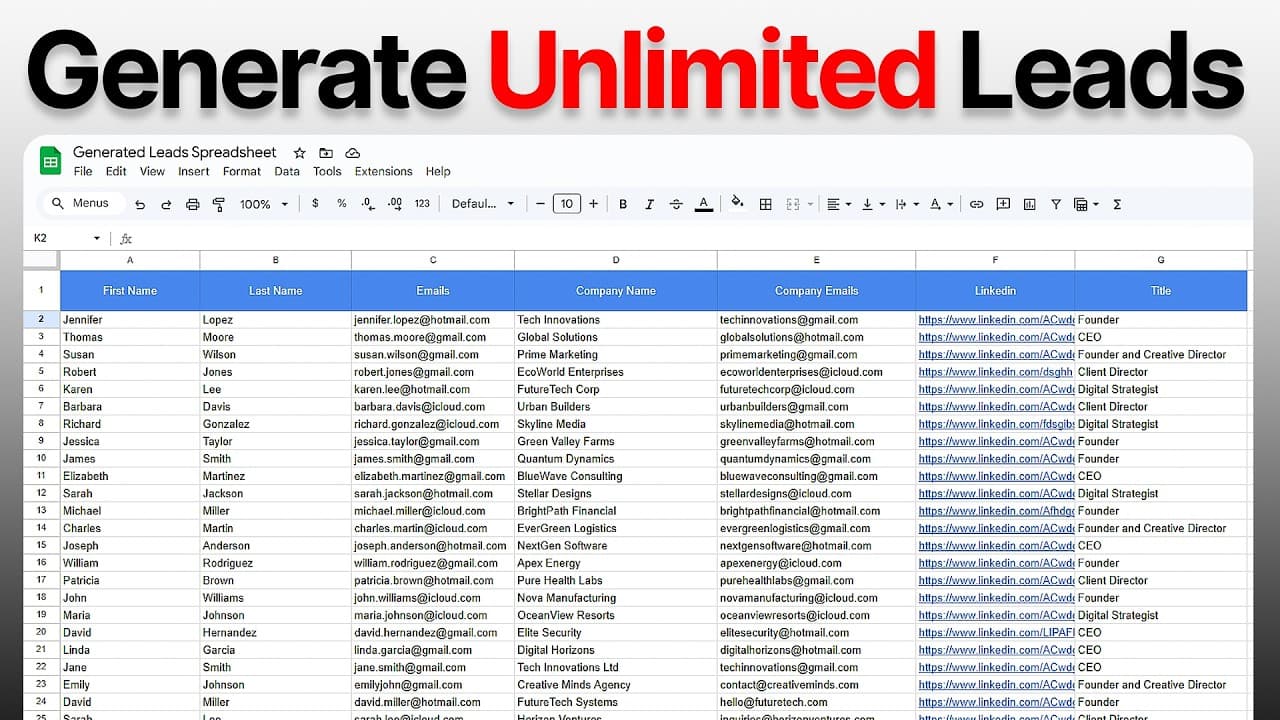
TL;DR
Build a scalable lead generation system by defining one ideal customer, creating an outcome-driven offer around that customer’s pain points, and using automated tools to maintain the pipeline. The complete system has seven parts and should be predictable, scalable, and automated rather than dependent on scattered, inefficient tactics. Read on to see how targeting, revenue filters, messaging, and cold email fit together.
Transcript
This is literally the only video that you'll need to watch on lead generation because I'm going to show you exactly how to set up a full endto-end lead generation system that you can use to generate thousands of leads for your business. And after not only helping over 400 businesses scale their lead generation strategy, but being able to scale our ... Read More
Key Insights
- Lead generation is finding customers who are interested in buying what you are selling, and doing it well requires seven different parts working together rather than a single tactic applied in isolation.
- The core problem with most lead generation is reliance on old-school or inefficient tactics: sending emails to anybody with a pulse, throwing messages out hoping they stick, spreading thin across strategies, or using tactics that no longer work.
- A lead generation system must be predictable, scalable, and automated. Predictable removes feast-or-famine months, scalable grows without burning money or hiring, and automated keeps the pipeline full without adding hours.
- Marketing to everybody means marketing to nobody. Blanket outbound worked when competition was slim, but people are now numb to the thousands of advertisements they see subconsciously, making it harder to stand out in a crowded market.
- Defining an ideal customer means more than the label 'business owner.' You need to understand what irks them, what their desires are, and exactly how you can solve their pain points before any outreach begins.
- Lead-finding tools let you filter by keyword, industry, location, and revenue range, for example plumbers, plumbing, or HVAC in California. Revenue filtering matters because a $50 million problem is very different from a $500,000 a year problem.
- An offer should be marketable and outcome-driven, speaking to customer pain points. Most offers fail because they are deliverable-based, selling the work performed rather than the result the customer actually wants.
- Cold email works as a channel because it is scalable, automated, analytics-driven, and makes customers easy to find. Business owners actively check their email, and lead generation means going where your customers' attention already is.
Install to Summarize YouTube Videos and Get Transcripts
Explore YouTube Video Summarizer or Get YouTube Transcript Extractor
Questions & Answers
Q: How do you build a lead generation system that scales?
Start by defining a specific ideal customer and understanding that customer’s pain points, desires, and desired outcomes. Create an outcome-driven offer, then use suitable tools and channels such as Instantly.ai, Instantly Lead Finder, and cold email to make lead generation predictable, scalable, and automated.
Q: What is lead generation?
Lead generation means finding customers who are interested in buying what you sell. Doing it well requires seven different parts working together as a system rather than relying on scattered tactics.
Q: What three qualities should a lead generation system have?
It should be predictable, scalable, and automated. Predictability reduces feast-or-famine months, scalability allows growth without adding substantial money or labor, and automation helps keep the pipeline full without adding more hours.
Q: Why do many businesses struggle with lead generation?
Many businesses use inefficient tactics, such as emailing anybody with a pulse, broadcasting messages without a strategy, or spreading themselves across several approaches. These habits drain energy and company resources while leaving the business constantly guessing where its next client will come from.
Q: How should you define an ideal customer for lead generation?
Go beyond a broad description such as “business owner” and identify what irks the customer, what they desire, and which pain points you can solve. You can then narrow prospects by keyword, industry, location, and revenue range so the outreach message addresses a specific audience.
Q: Why should lead generation target a specific revenue range?
Companies at different revenue levels can face very different problems. The transcript contrasts a $50 million problem with a $500,000-a-year problem, so filtering by revenue helps align the message and offer with the prospect’s circumstances.
Q: What makes a lead generation offer marketable?
A marketable offer is outcome-driven and speaks directly to the ideal customer’s pain points. Instead of selling only the work or deliverables you perform, focus the message on the implications of the customer’s problems and the result the customer wants.
Q: Why is cold email useful for lead generation?
Cold email can be scalable, automated, and measured with analytics, while making prospective customers easier to reach. It also places the offer where business owners already direct their attention: their email.
Summary & Key Takeaways
-
Lead generation means finding customers who are interested in buying what you sell, and doing it well requires seven distinct parts. Most businesses instead rely on old-school tactics: emailing anyone with a pulse, throwing messages out hoping something sticks, or spreading thin across multiple strategies. This drains energy and resources and traps the company in a feast-or-famine cycle of guessing where the next client comes from.
-
A working system has three properties: predictable, so revenue does not swing between feast and famine months; scalable, so it grows without burning money, adding labor, or hiring more people; and automated, since in the digital age there is no excuse for a manually kept pipeline. Picking the right tools and methods is what makes those three properties possible.
-
Execution starts with defining the ideal customer beyond a label like 'business owner,' understanding their irritations, desires, and pain points. Filtering tools narrow by keyword, industry, location, and revenue range, since a $50 million problem differs from a $500,000 problem. The offer is then built on pain-point implications and desired outcomes, and delivered through scalable channels such as cold email.
Read in Other Languages (beta)
Share This Summary 📚
Summarize YouTube Videos and Get Video Transcripts with 1-Click
Try YouTube Summary with ChatGPT & Claude or YouTube Transcript Generator
Explore More Summaries from Instantly 📚



Summarize YouTube Videos and Get Video Transcripts with 1-Click
Try YouTube Summary with ChatGPT & Claude or YouTube Transcript Generator