What Is the Holographic Principle and Its Implications?
TL;DR
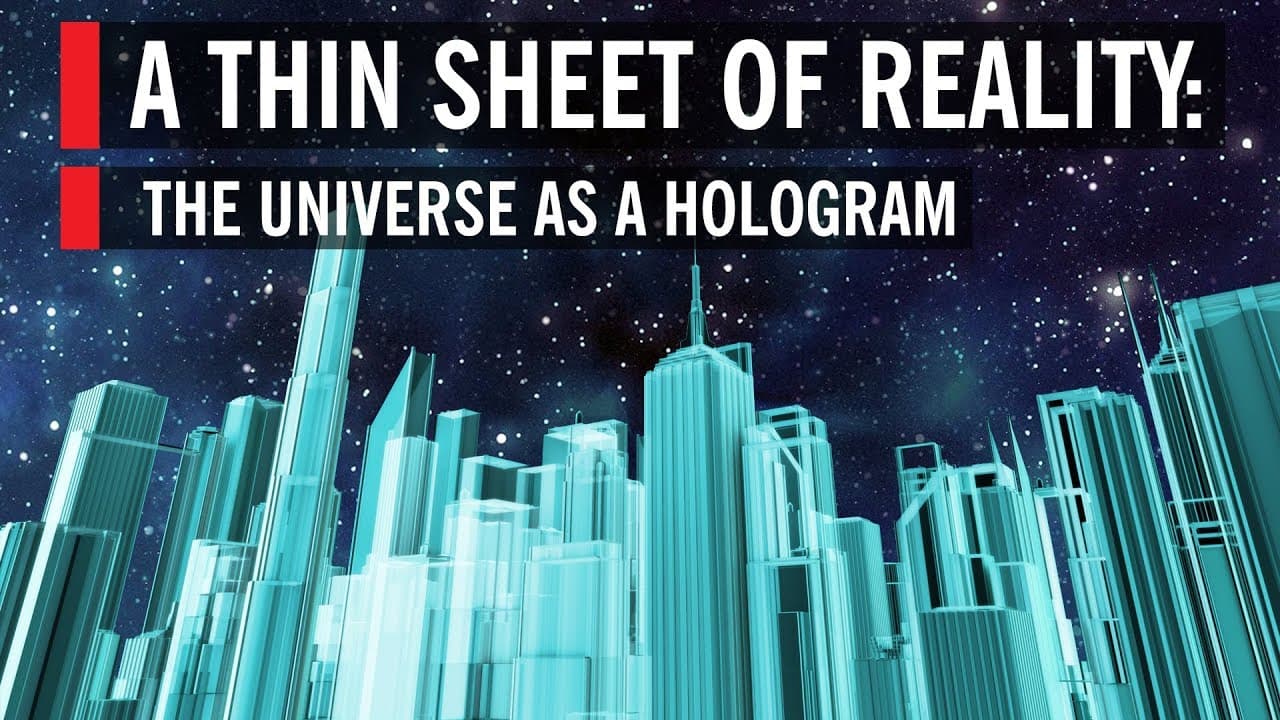
The holographic principle posits that all information in our universe can be encoded on a two-dimensional surface, implying that three-dimensional reality is a projection of this data. This challenges traditional views of volume and space, arising from debates over whether information is lost in black holes, particularly in discussions involving Stephen Hawking.
Transcript
here we are again good evening it's a beautiful gorgeous summer night in new york and here this place is full of people who want to talk about holograms and that's wow yeah world science festival's so great my name is john hockenberry first of all i'm the college dropout news guy who's going to hang out with nobel physicists tonight perfect for thi... Read More
Key Insights
- 🖤 The holographic principle states that information is preserved and encoded on the surface area of black holes and the entire universe.
- 👾 The holographic principle challenges traditional notions of volume, space, and the preservation of information.
- 🖐️ The debate between scientists, including Stephen Hawking, played a vital role in the development and acceptance of the holographic principle.
Install to Summarize YouTube Videos and Get Transcripts
Explore YouTube Video Summarizer or Get YouTube Transcript Extractor
Questions & Answers
Q: How does the holographic principle challenge our traditional understanding of volume and space?
The holographic principle suggests that the information in our three-dimensional universe can be encoded on a two-dimensional surface, indicating that our perception of volume and space may be illusory.
Q: Why is information preservation important in physics?
Information preservation is crucial because it is a fundamental principle of quantum mechanics that distinctions and information do not disappear. If information were lost, it would undermine the principles of physics and disrupt our understanding of the universe.
Q: How did the debate between scientists, including Stephen Hawking, contribute to our understanding of the holographic principle?
The debate sparked a deeper exploration of information preservation, leading scientists to discover the holographic principle. The clash of ideas and conflicting principles challenged physicists to resolve the paradox and explore new paradigms.
Q: Does the holographic principle have practical applications outside of theoretical physics?
While the holographic principle is a theoretical concept, it has implications for our understanding of the fundamental nature of reality. It may provide insights into the nature of space-time and could potentially have applications in quantum computing and information theory.
Summary & Key Takeaways
-
The holographic principle suggests that information is preserved and encoded on the surface area of black holes, as well as the entire universe.
-
This principle arose from a debate with Stephen Hawking, where it was believed that information was lost in black holes.
-
The holographic principle implies that our universe is a holographic projection of information encoded on a two-dimensional surface, challenging our traditional understanding of volume and space.
Read in Other Languages (beta)
Share This Summary 📚
Summarize YouTube Videos and Get Video Transcripts with 1-Click
Try YouTube Summary with ChatGPT & Claude or YouTube Transcript Generator
Explore More Summaries from World Science Festival 📚

Summarize YouTube Videos and Get Video Transcripts with 1-Click
Try YouTube Summary with ChatGPT & Claude or YouTube Transcript Generator