How Does Your Nervous System Shape Your Experiences?
TL;DR
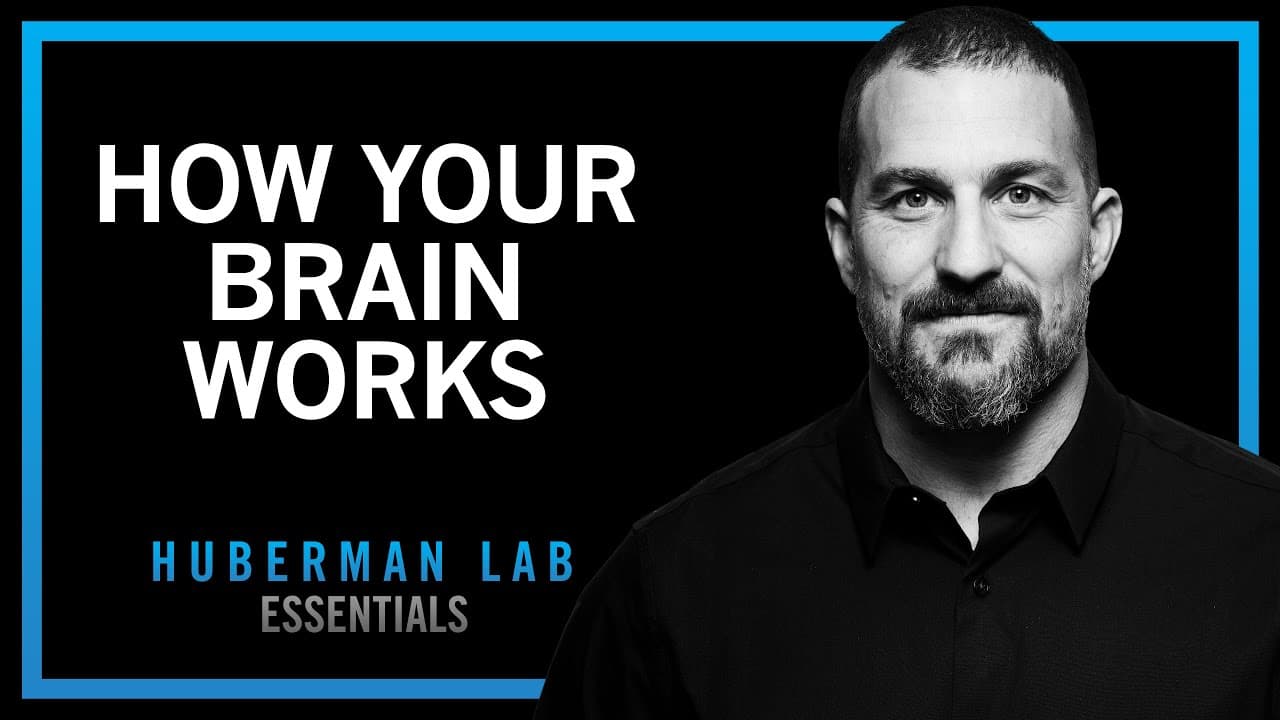
The nervous system creates a continuous feedback loop between the brain, spinal cord, and body, influencing sensations, emotions, thoughts, and actions. Neuroplasticity allows both children and adults to change their brain through focused effort, with vital shifts occurring during sleep and deep rest. Understanding and mastering personal ultradian rhythms can enhance learning and creativity, improving our ability to perform tasks optimally.
Transcript
ANDREW HUBERMAN: Welcome to Huberman Lab Essentials where we revisit past episodes for the most potent and actionable science-based tools for mental health, physical health, and performance. I'm Andrew Huberman, and I'm a professor of neurobiology and ophthalmology at Stanford School of Medicine. For today's podcast, we&... Read More
Key Insights
- The nervous system is a continuous communication loop between the brain, spinal cord, and body, influencing all experiences from birth to death.
- Attention is a spotlight controlled by us, allowing for both focused and diffused perception, essential for improving the nervous system.
- Emotions are reflexive and influenced by neuromodulators like dopamine and serotonin, affecting our mood and motivation.
- Neuroplasticity, the ability of the brain to change, is not limited to youth; adults can also experience brain changes through focused effort.
- Sleep and non-sleep deep rest are crucial for consolidating learning and neuroplasticity, as actual changes occur during rest, not during active learning.
- The autonomic nervous system, comprising alertness and calmness systems, regulates our daily cycles of focus and rest.
- Ultradian rhythms, 90-minute cycles of focus and rest, govern our ability to learn and perform tasks optimally throughout the day.
- Mastering the transitions between alertness and calmness, and understanding personal rhythms, can enhance learning and creativity.
Install to Summarize YouTube Videos and Get Transcripts
Explore YouTube Video Summarizer or Get YouTube Transcript Extractor
Questions & Answers
Q: What is the significance of the nervous system in human experience?
The nervous system is crucial as it forms a continuous communication loop between the brain, spinal cord, and body, influencing every aspect of human experience from birth to death. It governs sensations, perceptions, emotions, thoughts, and behaviors, making it fundamental to how we interact with the world and ourselves.
Q: How does attention function in the nervous system?
Attention acts like a spotlight, allowing us to focus on specific sensations and perceptions. It can be controlled deliberately, enabling us to concentrate on one or multiple tasks simultaneously. This control over attention is essential for the effective functioning and improvement of the nervous system.
Q: What role do neuromodulators play in emotions?
Neuromodulators such as dopamine, serotonin, and acetylcholine significantly influence emotions by affecting which neurons are active. They contribute to mood and motivation, with dopamine linked to reward and motivation, and serotonin associated with contentment and internal satisfaction.
Q: Can adults experience neuroplasticity?
Yes, adults can experience neuroplasticity, the brain's ability to change. While it is more pronounced in youth, adults can also undergo brain changes through focused effort and learning. Neuroplasticity in adults requires deliberate attention and is facilitated by neuromodulators like acetylcholine.
Q: Why are sleep and rest important for neuroplasticity?
Sleep and non-sleep deep rest are crucial for neuroplasticity because actual changes in the brain occur during these rest periods, not during active learning. They allow for the consolidation of learning and the strengthening of neural connections, making rest essential for effective brain function.
Q: What is the autonomic nervous system's role in daily cycles?
The autonomic nervous system regulates daily cycles of alertness and calmness, influencing our ability to focus and rest. It consists of the sympathetic (alertness) and parasympathetic (calmness) systems, working like a seesaw to balance our states of focus and relaxation throughout the day.
Q: How do ultradian rhythms impact learning and performance?
Ultradian rhythms are 90-minute cycles that govern our ability to focus and perform tasks optimally. Understanding these cycles can enhance learning and performance, as they dictate when our brain is most receptive to focus and when it benefits from rest, allowing for better task engagement and creativity.
Q: How can one master transitions between alertness and calmness?
Mastering transitions between alertness and calmness involves understanding personal rhythms and the autonomic nervous system's role. By recognizing when one is most focused or relaxed, and aligning activities with these states, individuals can optimize learning, creativity, and overall performance, making the most of their nervous system's capabilities.
Summary & Key Takeaways
-
The podcast discusses the nervous system's role in creating sensations, emotions, thoughts, and behaviors, emphasizing its continuous loop between the brain, spinal cord, and body. Attention, controlled by us, allows for perception and focus, crucial for improving the nervous system.
-
Neuroplasticity, the brain's ability to change, is explored, highlighting that it is not restricted to youth. Adults can experience brain changes through focused effort, with sleep and non-sleep deep rest playing vital roles in consolidating learning and neuroplasticity.
-
The autonomic nervous system regulates our daily cycles of focus and rest. Understanding and mastering personal rhythms, including ultradian rhythms, can enhance learning and creativity, as these 90-minute cycles govern our ability to perform tasks optimally.
Read in Other Languages (beta)
Share This Summary 📚
Summarize YouTube Videos and Get Video Transcripts with 1-Click
Try YouTube Summary with ChatGPT & Claude or YouTube Transcript Generator
Explore More Summaries from Andrew Huberman 📚



Summarize YouTube Videos and Get Video Transcripts with 1-Click
Try YouTube Summary with ChatGPT & Claude or YouTube Transcript Generator