How to Build Projects with Claude Fable and /goal
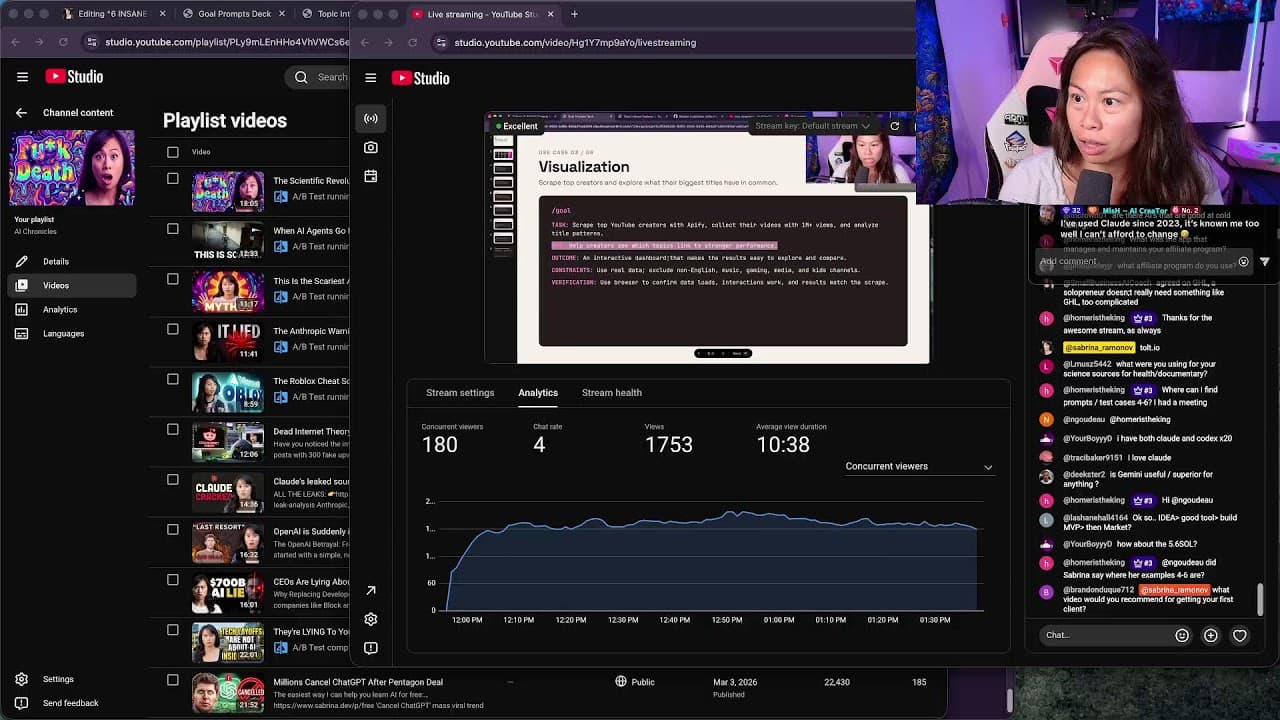
TL;DR
Reliable loop engineering starts with a prompt that defines the task, its purpose, the desired outcome, constraints, and a measurable verification test. In Claude Code, set Claude Fable as the model, enter the condition with /goal, grant necessary permissions, and require concrete evidence of success, such as completing a simulation task in at least eight of ten evaluations.
Transcript
Go. [snorts] Hello. Hello. Did Uh hello. Hello. Uh, hey, I'm just getting set up. Today will be pretty crazy, so Oops. 2 p.m. Okay. Going to Tik Tok. Uh, today will be pretty crazy. Just make if you are planning to follow along, make sure you have Claude Code set up uh with a terminal. We're going to be running the slashgo command with uh a bunch o... Read More
Key Insights
- The prompt template is built from five components: the task Claude must perform, why the work matters, the required outcome, operating constraints, and a verification condition that determines whether the goal has actually been achieved.
- The /goal command sets a condition that Claude checks before stopping. A user can enter /goal followed by the full project prompt, or use /goal clear after entering an incorrect goal or deciding to stop the current one.
- Verification is the most important part of a loop-engineering prompt because it gives Claude a concrete finish line. A vague checker can allow Claude to report completion even when the intended result has not been demonstrated.
- The spider simulation uses an eight-out-of-ten success threshold as evidence of learning. Claude must evaluate repeated simulation runs and verify that the spider reaches the top stair in at least eight attempts rather than relying on one successful example.
- Constraints are safeguards against shortcuts that technically satisfy a goal while violating the user's intent. The example restricts the project to Genesis World and keeps the implementation simple, while another possible guardrail is stopping after 20 turns.
- The desired outcome should name every deliverable needed at completion. For the Genesis World example, those deliverables include the codebase, a trained spider that performs the assigned task, and a video showing the resulting behavior.
- The first project trains a spider robot in a Genesis World 3D simulation. Related versions ask the spider to cross an obstacle course or escape a cavity by learning to jump upward after thousands of training iterations.
- The Claude Fable setup uses Claude Code in a terminal with the model switched to Fable and effort set to high for the complicated simulation task. The run can take 60 to 90 minutes and may pause for permissions.
Install to Summarize YouTube Videos and Get Transcripts
Explore YouTube Video Summarizer or Get YouTube Transcript Extractor
Questions & Answers
Q: How do you structure a prompt for Claude Fable and /goal?
Structure the prompt with five explicit sections: task, why, outcome, constraints, and verification. State what Claude must build, why the work matters, which finished deliverables you expect, what limits it must respect, and exactly how it can prove success. The simulation example requests a codebase, a trained spider, and a video, then requires successful stair climbing in at least eight of ten evaluations.
Q: What does the /goal command do in Claude Code?
The /goal command establishes a condition that Claude checks before it stops working. Enter /goal and then provide the project condition or full structured prompt. The command is intended to support loop engineering by keeping work directed toward a defined finish line. If the goal was entered incorrectly or should be stopped, the demonstrated command for removing it is /goal clear.
Q: Why is verification important in loop engineering?
Verification tells Claude how to determine whether the requested outcome has genuinely been achieved. Without a strong and measurable check, Claude may say that a task is complete even though the result remains defective or unproven. A precise verification condition also makes longer runs more trustworthy because Claude can repeatedly test its work against a clearly defined finish line.
Q: How can Claude verify that a simulated spider learned to climb stairs?
Claude can run repeated evaluations of the trained spider inside the Genesis World simulation and count how often it reaches the top stair. The stated acceptance threshold is at least eight successful attempts out of ten. This test provides stronger evidence than a single favorable run and directly measures the behavior requested in the project goal.
Q: What constraints should a /goal prompt include?
Constraints should identify tools, changes, shortcuts, and resource limits that are unacceptable. In the spider project, the instructions call for a simple implementation using only Genesis World instead of importing many additional libraries. A prompt can also include guardrails such as stopping after 20 turns. These restrictions prevent Claude from satisfying the metric through actions that conflict with the intended solution.
Q: How do you start the Genesis World spider project?
Open Claude Code in a terminal, switch the selected model to Fable, and choose high effort because the simulation is described as complicated. Enter /goal followed by the structured prompt covering the task, purpose, outcome, constraints, and verification. The system then begins downloading and setting up required components, and the user should return periodically to approve requested permissions.
Q: How long does the spider simulation project take to run?
The demonstrated spider project is said to take about 60 to 90 minutes, so it is not completed during the live walkthrough. During that period, Claude may download required components and request permissions. Anyone following along should monitor the terminal regularly so those requests can be approved and the run can continue toward its verification target.
Q: What projects can be built with Claude Fable and /goal?
The examples include 3D Genesis World simulations, interactive dashboards, and continuously running A/B tests. Within the simulation project, a spider is trained to climb stairs, complete an obstacle course, or escape a cavity by jumping upward after thousands of training iterations. The introduction also mentions a dashboard for analyzing human psychology and interest at scale, plus three additional projects not detailed in the provided transcript.
Summary & Key Takeaways
-
The demonstration uses Claude Code, Claude Fable, and the /goal command to create projects through loop engineering. The first project asks Claude to build a Genesis World simulation in which a spider learns to climb stairs, produce the codebase, train the behavior, and generate a video showing the result.
-
The recommended prompt structure contains five components: task, purpose, outcome, constraints, and verification. The purpose gives Claude the larger motivation, while the outcome describes the finished deliverables. Constraints prevent unwanted shortcuts, restrict tools or libraries, and can impose operational limits such as stopping after a specified number of turns.
-
Verification is presented as the most important component because it defines a measurable finish line. For the stair-climbing simulation, Claude must evaluate the trained spider and confirm that it reaches the top stair at least eight times across ten attempts. Strong checks support longer autonomous runs and make unsupported completion claims less likely.
Read in Other Languages (beta)
Share This Summary 📚
Summarize YouTube Videos and Get Video Transcripts with 1-Click
Try YouTube Summary with ChatGPT & Claude or YouTube Transcript Generator
Explore More Summaries from Sabrina Ramonov 🍄 📚






Summarize YouTube Videos and Get Video Transcripts with 1-Click
Try YouTube Summary with ChatGPT & Claude or YouTube Transcript Generator