Products
Features
YouTube Video Summarizer
Summarize YouTube videos
Web & PDF Highlighter
Highlight web pages & PDFs
Chat with PDF
Ask any PDF questions with AI
Ask AI Clone
Chat with your highlights & memories
Audio Transcriber
Transcribe audio files to text
Glasp Reader
Read and highlight articles
Kindle Highlight Export
Export your Kindle highlights
Idea Hatch
Hatch ideas from your highlights
Integrations
Obsidian Plugin
Notion Integration
Pocket Integration
Instapaper Integration
Medium Integration
Readwise Integration
Snipd Integration
Hypothesis Integration
Apps & Extensions
Chrome Extension
Safari Extension
Edge Add-ons
Firefox Add-ons
iOS App
Android App
Discover
Discover
Ideas
Discover new ideas and insights
Articles
Curated articles and insights
Books
Book recommendations by great minds
Posts
Essays and notes from readers
Quotes
Inspiring quotes collection
Videos
Curated videos and summaries
Explore Glasp
Glasp Story
How we grew from 0 to 3 million users
Glasp Newsletter
Weekly insights and updates
Glasp Talk
Interview series with great minds
Glasp Blog
Latest news and articles
Glasp Use Cases
Learn how others use Glasp
Build & Support
Glasp API
Access Glasp's API for developers
MCP Connector
Connect Glasp to Claude & ChatGPT
Community
Glasp Reddit Community
Students
Student discount and benefits
FAQs
Frequently Asked Questions
AboutPricing
DashboardLog inSign up

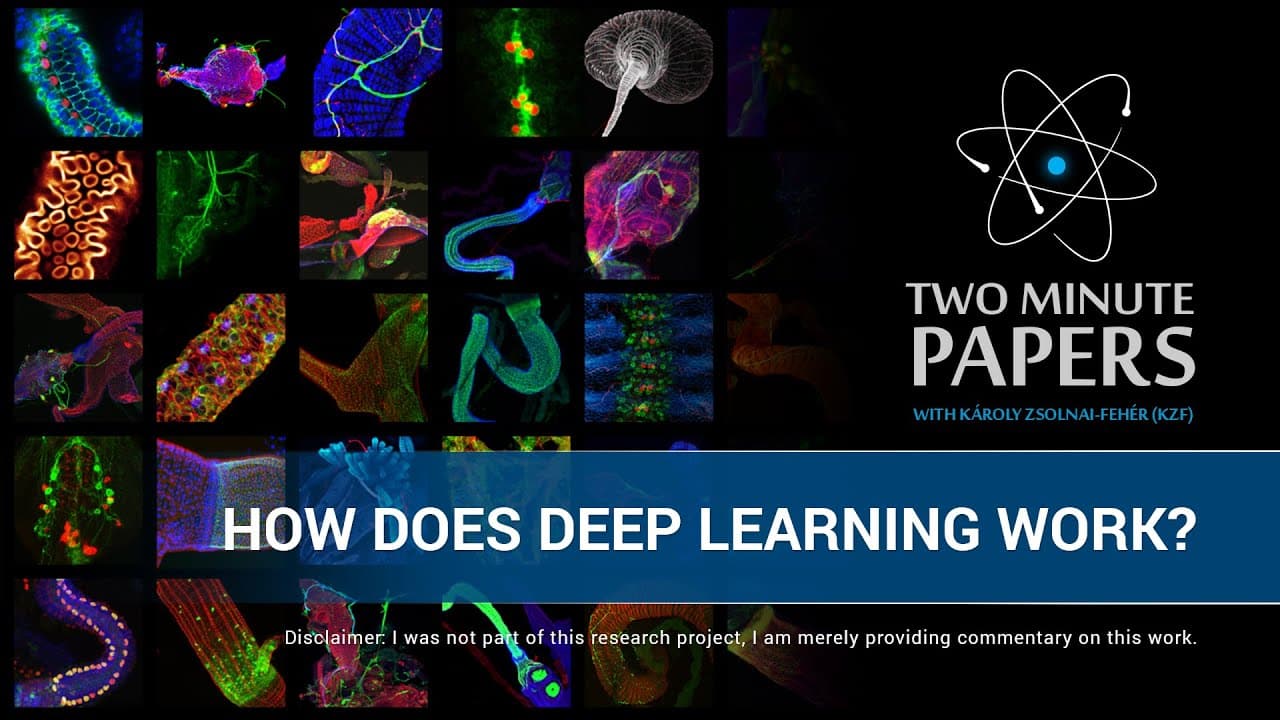
How Does Deep Learning Work? | Two Minute Papers #24
187.6K views
•
November 11, 2015
by
Two Minute Papers
YouTube video player
How Does Deep Learning Work? | Two Minute Papers #24

TL;DR

Neural networks use inner representations and transformations to solve classification problems, even when straight lines are not enough.

Transcript

Dear Fellow Scholars, this is Two Minute Papers with Károly Zsolnai-Fehér. A neural network is a very loose model of the human brain that we can program in a computer, or it's perhaps more appropriate to say that it is inspired by our knowledge of the inner workings of a human brain. Now, let's note that artificial neural networks have been studied... Read More

Key Insights

  • 🧠 Neural networks are inspired by the human brain and create inner representations to solve problems.
  • 🫥 Straight lines may not be sufficient to separate classes in classification problems, but neural networks can find solutions through transformations.
  • 🍽️ Deep learning with multiple layers enhances neural networks' ability to create more effective inner representations.
  • 🏑 Knot theory, a mathematical field, can provide insights into problem-solving in neural networks.

Install to Summarize YouTube Videos and Get Transcripts

Explore YouTube Video Summarizer or Get YouTube Transcript Extractor

Questions & Answers

Q: How do neural networks solve classification problems?

Neural networks create inner representations of the data and perform transformations to find solutions. This allows them to solve classification problems even when straight lines are not enough.

Q: What is the significance of deep learning in neural networks?

Deep learning, with multiple hidden layers, allows neural networks to create more effective inner representations of the data. This enables better solutions to complex classification problems.

Q: Can neural networks separate entangled patterns with a line?

No, the original representation of entangled patterns cannot be separated by a line. However, through appropriate transformations, neural networks can find states where separation is possible.

Q: How does knot theory relate to neural networks?

Knot theory, a subfield of mathematics, can help study problem-solving in neural networks by analyzing tangling and untangling patterns. This can have applications in fields like traffic sign recognition and self-driving cars.

Summary & Key Takeaways

  • Neural networks are loosely inspired by the human brain and can be programmed to learn from input data.

  • The inner representations created by neural networks allow them to solve classification problems even when straight lines are not sufficient.

  • Deep learning with multiple layers in neural networks enables the creation of more effective inner representations.


Read in Other Languages (beta)

English

Share This Summary 📚

Summarize YouTube Videos and Get Video Transcripts with 1-Click

Download browser extensions on:

Try YouTube Summary with ChatGPT & Claude or YouTube Transcript Generator

Explore More Summaries from Two Minute Papers 📚
How to Create Virtual Worlds with AI thumbnail
How to Create Virtual Worlds with AI
Two Minute Papers
Finally, Instant Monsters! 🐉 thumbnail
Finally, Instant Monsters! 🐉
Two Minute Papers
How Does the Material Point Method Enhance Simulations? thumbnail
How Does the Material Point Method Enhance Simulations?
Two Minute Papers
OpenAI’s DALL-E 3-Like AI For Free, Forever! thumbnail
OpenAI’s DALL-E 3-Like AI For Free, Forever!
Two Minute Papers
How Can DeepMind's AI Create Video Games from Scratch? thumbnail
How Can DeepMind's AI Create Video Games from Scratch?
Two Minute Papers
This Adorable Baby T-Rex AI Learned To Dribble 🦖 thumbnail
This Adorable Baby T-Rex AI Learned To Dribble 🦖
Two Minute Papers

Summarize YouTube Videos and Get Video Transcripts with 1-Click

Download browser extensions on:

Try YouTube Summary with ChatGPT & Claude or YouTube Transcript Generator

Apps & Extensions

  • Chrome Extension
  • Safari Extension
  • Edge Add-ons
  • Firefox Add-ons
  • iOS App
  • Android App

Key Features

  • YouTube Video Summarizer
  • Web & PDF Summarizer
  • Web & PDF Highlighter
  • Chat with PDF
  • Ask AI Clone
  • Audio Transcriber
  • Glasp Reader
  • Kindle Highlight Export
  • Idea Hatch

Integrations

  • Obsidian Plugin
  • Notion Integration
  • Pocket Integration
  • Instapaper Integration
  • Medium Integration
  • Readwise Integration
  • Snipd Integration
  • Hypothesis Integration

More Features

  • APIs
  • MCP Connector
  • Blog & Post
  • Embed Links
  • Image Highlight
  • Personality Test
  • Quote Shots
  • Open Graph Checker

Company

  • About us
  • Our Story
  • Blog
  • Community
  • FAQs
  • Job Board
  • Newsletter
  • Pricing
Terms

•

Privacy

•

Guidelines

© 2026 Glasp Inc. All rights reserved.