What Are Control Systems and Why Are They Matter?
TL;DR
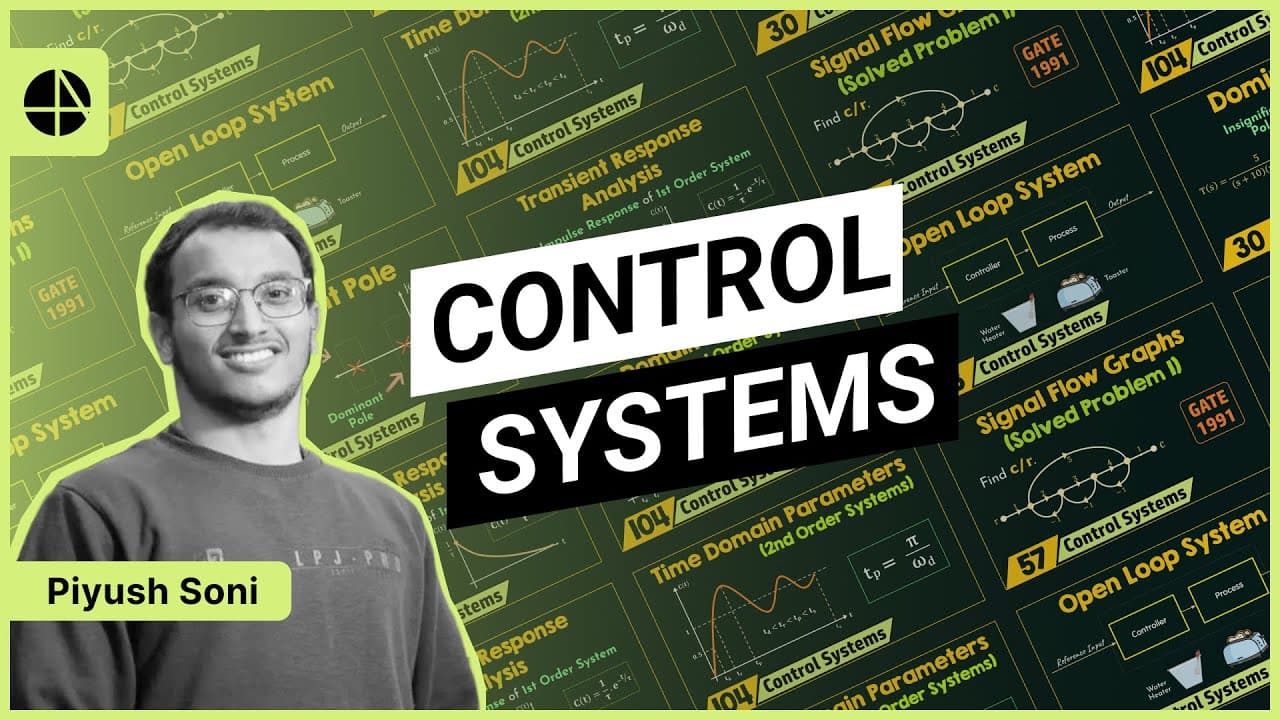
A control system combines processes or subsystems to accept an input, process it in a predefined manner, and produce a desired output. Such systems are built for power amplification, remote control, convenient input forms, and compensation for disturbances, with applications including air conditioners, cars, lifts, radar antennas, and robotic arms.
Transcript
hello everyone and welcome to this wonderful course on control systems i'm your instructor here to take you throughout this journey on control systems this is the first lecture so let's start with the session outlines in this presentation firstly we'll discuss the introduction to the subject to what we study then after that we'll discuss the reason... Read More
Key Insights
- A control system is a collection of processes or subsystems assembled to control the output of a process. It accepts an input, processes that input in a predefined manner, and generates an output intended to match the desired response.
- The error of a control system is the difference between its desired response and its actual response. These responses are not always identical, so understanding and correcting their difference is a central concern in control-system study.
- Control systems provide power amplification when a small input must operate equipment requiring much greater power. A radar antenna illustrates this function because a lightly operated rotating knob can command a motor to reposition the heavy antenna.
- Remote control is a primary reason for building control systems. A rotating knob can remotely command a radar antenna, while a remotely controlled robotic arm can pick up materials in a radioactive environment without requiring direct operation at the hazardous location.
- Convenience of input form allows a simple action to command a more complex physical process. Repositioning a knob can specify an antenna angle, and pressing controls on an air-conditioner remote can request a lower room temperature.
- Compensation for disturbances allows a system to respond when external forces or internal noise change its output. A radar antenna displaced by wind must detect the resulting error and correct its position without requiring the operator to modify the original input.
- The course syllabus covers both time-domain and frequency-domain approaches. Topics include transient and steady-state response, damping, stability, root locus, polar plots, Nyquist plots, Bode plots, compensators, controllers, and state-space analysis.
- State-space analysis offers a different approach to control systems through state parameters and state-variable representations. The course includes conversions between transfer functions and canonical state-variable models, solutions of state equations, controllability, and observability.
Install to Summarize YouTube Videos and Get Transcripts
Explore YouTube Video Summarizer or Get YouTube Transcript Extractor
Questions & Answers
Q: What is a control system and how does it work?
A control system consists of processes or subsystems assembled to control the output of a process. It receives an input, also described as a stimulus or desired response, and processes that input in a predefined manner. The system then produces an output, called the actual response. If the actual response differs from the desired response, the difference is identified as the control-system error.
Q: What are common examples of control systems?
Common examples include an air conditioner maintaining the temperature of a room, a car accelerating from rest to a speed of 100 kilometers per hour, and a lift moving upward to a desired floor. In each case, the equipment and its relevant internal elements form the control system, while the maintained temperature, commanded speed, or selected floor represents the desired output.
Q: What is the error in a control system?
The error in a control system is the difference between the desired response and the actual response. The desired response represents what the input commands the system to achieve, while the actual response is what the system produces after processing that input. Because the two responses are not always the same, control-system analysis examines the difference and how the system can correct it.
Q: Why are control systems used for power amplification?
Control systems are used for power amplification when the available input requires little effort but the commanded physical operation requires much greater power. For example, rotating a small knob requires far less power than rotating a heavy radar antenna. A motor supplies the necessary amplified power, allowing the low-power knob movement to command the antenna through the desired angle.
Q: How do control systems enable remote operation?
Control systems enable remote operation by allowing one device to command another system from a separate location. A rotating knob can serve as a remote control element for positioning a radar antenna. A remotely controlled robotic arm provides another example because it can pick up materials in a radioactive environment, allowing the required task to be performed without direct operation at the hazardous location.
Q: How do control systems make input more convenient?
Control systems make input more convenient by converting a simple user action into the form needed to control a physical process. Repositioning a rotating knob can command a radar antenna to move through a specified angle. Similarly, controls on an air-conditioner remote allow a person to request a lower room temperature without directly manipulating the equipment that produces the temperature change.
Q: How does a control system compensate for disturbances?
A control system compensates for disturbances by detecting an error and correcting it without requiring the input command to change. If wind moves a radar antenna away from its commanded direction, or if noise enters internally, the system must determine how much error occurred and restore the antenna position. This self-correction is presented as one of the most important reasons for building control systems.
Q: What topics are included in an introductory control-systems course?
The course includes system-response characteristics, open-loop and closed-loop systems, Laplace transforms, transfer functions for LTI systems, feedback, sensitivity, and dominant poles. It also covers block-diagram reduction, signal-flow graphs, Mason's gain formula, transient and steady-state analysis, damping, stability, root locus, polar, Nyquist, and Bode plots, compensators, controllers, state-space models, controllability, and observability.
Summary & Key Takeaways
-
A control system consists of processes or subsystems assembled to control an output. It receives an input or stimulus, processes that input in a predefined manner, and generates an actual response. Examples include an air conditioner maintaining room temperature, a car reaching a specified speed, and a lift moving to a desired floor.
-
A basic control-system block diagram distinguishes the desired response from the actual response. These responses are not always equal, and their difference is the system error. Control systems can detect and correct such errors, particularly when external forces or internal noise disturb a system without any corresponding change to its commanded input.
-
The course progresses from system-response characteristics, open-loop and closed-loop systems, Laplace transforms, transfer functions, feedback, sensitivity, and dominant poles to block diagrams, signal-flow graphs, time response, stability, root locus, frequency response, controllers, compensators, and state-space analysis. It targets students preparing for GATE, competitive examinations, or college control-systems courses.
Read in Other Languages (beta)
Share This Summary 📚
Summarize YouTube Videos and Get Video Transcripts with 1-Click
Try YouTube Summary with ChatGPT & Claude or YouTube Transcript Generator
Explore More Summaries from Neso Academy 📚





Summarize YouTube Videos and Get Video Transcripts with 1-Click
Try YouTube Summary with ChatGPT & Claude or YouTube Transcript Generator