How to Build and Break Habits, According to Science
TL;DR
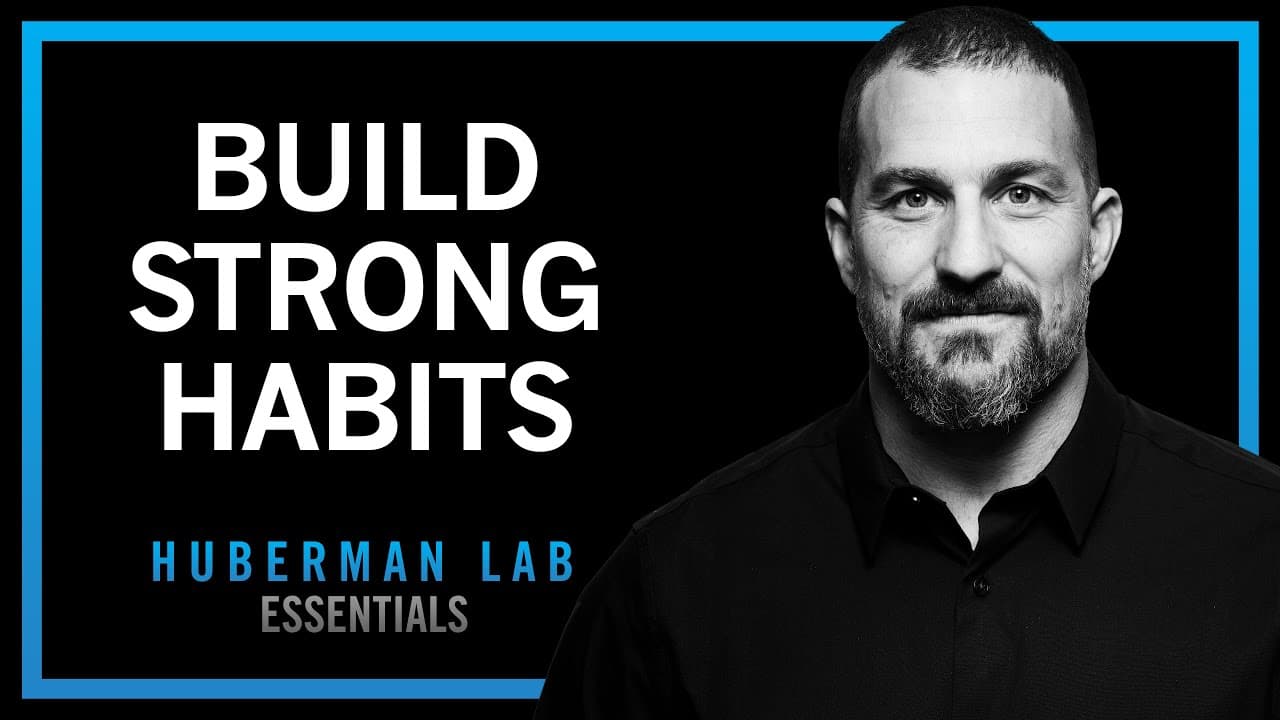
Up to 70% of waking behavior is habitual, and habit formation is neuroplasticity: the nervous system changing in response to experience. A 2010 study by first author Lai Ly found the same habit took anywhere from 18 to 254 days to form across individuals. Mentally walking through each step of a habit once raises the odds of performing it regularly.
Transcript
Welcome to Huberman Lab Essentials, where we revisit past episodes for the most potent and actionable science-based tools for mental health, physical health, and performance. I'm Andrew Huberman and I'm a professor of neurobiology and opthalmology at Stanford School of Medicine. Today we're talking all about habits. In particular, we're going to di... Read More
Key Insights
- Up to 70% of waking behavior is estimated to be habitual, which means most of what people do each day runs on circuits the nervous system learned, sometimes without conscious awareness, and often only noticed once a habit becomes a problem.
- Habit formation is neuroplasticity, the process by which the nervous system changes in response to experience. At its core this means building new neural circuits that make certain habits more likely to occur and other behaviors less likely.
- The claim that habits take 21 days is not supported by the data. A 2010 study with first author Lai Ly found that forming the same habit took anywhere from 18 days to as many as 254 days depending on the individual.
- Limbic friction is a term Huberman coined, not a formal neurobiological or psychological one. It describes the strain required to overcome either an anxious state you cannot calm down from, or a state of feeling too tired, lazy, or unmotivated to act.
- The autonomic nervous system behaves like a seesaw between alert and calm. Being alert and being calm are incompatible states, and limbic friction describes how much activation energy is needed to engage in a behavior from wherever you currently sit on that seesaw.
- Linchpin habits are habits that make many other habits easier to execute, and they are always things you genuinely enjoy doing. Huberman cites resistance training and running, which in turn bias him toward better sleep, hydration, food choices, and work alertness.
- Habit strength is measured by two criteria: how context dependent the habit is, meaning whether you perform it the same way at the same time regardless of environment, and how much limbic friction is required to perform it regularly.
- Mentally walking through the specific sequence of steps in a habit, done just once, shifts people toward a much higher likelihood of performing that habit regularly, not only the first time but across the days and weeks that follow.
Install to Summarize YouTube Videos and Get Transcripts
Explore YouTube Video Summarizer or Get YouTube Transcript Extractor
Questions & Answers
Q: How long does it actually take to form a habit?
There is no single number. Popular claims range from 18 to 21 to 30 to 60 days, but a 2010 peer-reviewed study with first author Lai Ly found that for the same habit, different individuals took anywhere from 18 days to as many as 254 days to form it. People are highly variable in this respect. Importantly, struggling to form one particular habit does not mean you will struggle with other habits, since ease of formation varies by both person and habit.
Q: What is limbic friction?
Limbic friction is a shorthand term coined by Andrew Huberman, not a formal term found in the neurobiological or psychological literature. It describes the strain required to overcome one of two bodily states: being so anxious that you cannot calm down and engage in a desired activity or thought pattern, or feeling too tired, lazy, or unmotivated to act. Both states relate to the autonomic nervous system, and limbic friction measures how much activation energy a given behavior requires.
Q: What is the difference between goal-based and identity-based habits?
Immediate goal-based habits are designed to produce a specific outcome each time you perform them. An example is aiming for zone 2 cardio four times a week, where you check off a box each time the session is done. Identity-based habits attach a larger overarching theme to the same behavior: you are trying to become a fit person or an athlete. With identity-based habits there is still the immediate goal of completing the session, but it is linked to a broader picture of who you are.
Q: What are linchpin habits and why do they matter?
Linchpin habits are habits that make many other habits easier to execute, and they are always things the person genuinely enjoys doing. Huberman gives resistance training and running as his own examples, placed early in the day because of the associated neurochemistry and hormones. Those habits are easy for him to execute because he likes them, and they in turn bias him toward staying alert for work, getting good sleep the night before, staying hydrated, and eating better foods than he would reach for otherwise.
Q: How do you measure how strong a habit is?
Habit strength is measured by two main criteria. The first is context dependence: whether you perform the habit the same way at the same time of day regardless of environment. Huberman uses brushing teeth as an example, noting he does it at roughly the same time relative to waking whether traveling or at home, which makes it context independent and therefore strong. The second is how much limbic friction is required to perform the habit regularly. Together these reveal whether a habit is deeply or shallowly embedded in the nervous system.
Q: What is automaticity in habit formation?
Automaticity is the goal of any habit you want to form. It is described as fancy language for the state in which the neural circuits can perform the behavior automatically, without deliberate effort. Huberman calls this the ultimate place to be for a habit. Reaching automaticity relates directly to habit strength, since a habit that is context independent and requires little limbic friction to execute has become deeply embedded in the nervous system rather than shallowly held.
Q: Why is mentally rehearsing the steps of a habit effective?
Drawing on a review article titled Psychology of Habit by Wendy Wood and Dennis Runger in Annual Review of Psychology, each repetition of a habit produces small changes in the cognitive and neural mechanisms associated with procedural memory. Procedural memory means holding in mind the specific sequence of things that must happen for an outcome to occur. Huberman gives the example of walking mentally through making espresso: entering the kitchen, turning on the machine, drawing the shot. Doing that mental exercise once shifts people toward a much higher likelihood of performing the habit regularly over the following days and weeks.
Q: Why can some people form habits more easily than others?
The mystery of why certain people form certain habits more easily probably has something to do with how well they manage limbic friction, the strain needed to overcome either excessive anxiousness or a state of feeling tired and unmotivated. Because habit formation depends heavily on being in the right state of mind and being able to control your state of body and mind, people who manage that autonomic seesaw better face less activation energy when starting a new behavior. Individual variability here is large, spanning 18 to 254 days for the same habit.
Summary & Key Takeaways
-
Habits are learned behaviors, sometimes acquired without conscious awareness, and estimated to make up as much as 70% of waking behavior. Because habits are learned, habit formation is a case of neuroplasticity: the process by which the nervous system changes in response to experience, forming new neural circuits that make some behaviors more likely and others less likely.
-
Two distinctions from the popular and psychological literature matter. Immediate goal-based habits target a specific outcome each time they are performed, such as hitting four zone 2 cardio sessions a week and checking off a box. Identity-based habits attach the same behavior to a larger self-concept, such as becoming a fit person or an athlete.
-
Habit strength is measured by two criteria: context dependence and limbic friction. A context-independent habit gets performed the same way at the same relative time whether at home, traveling, or on vacation, which signals it is deeply embedded. The goal is automaticity, meaning the neural circuits execute the habit without deliberate effort.
Read in Other Languages (beta)
Share This Summary 📚
Summarize YouTube Videos and Get Video Transcripts with 1-Click
Try YouTube Summary with ChatGPT & Claude or YouTube Transcript Generator
Explore More Summaries from Andrew Huberman 📚




Summarize YouTube Videos and Get Video Transcripts with 1-Click
Try YouTube Summary with ChatGPT & Claude or YouTube Transcript Generator