How Does the SVGF Algorithm Enable Real-Time Rendering?
TL;DR
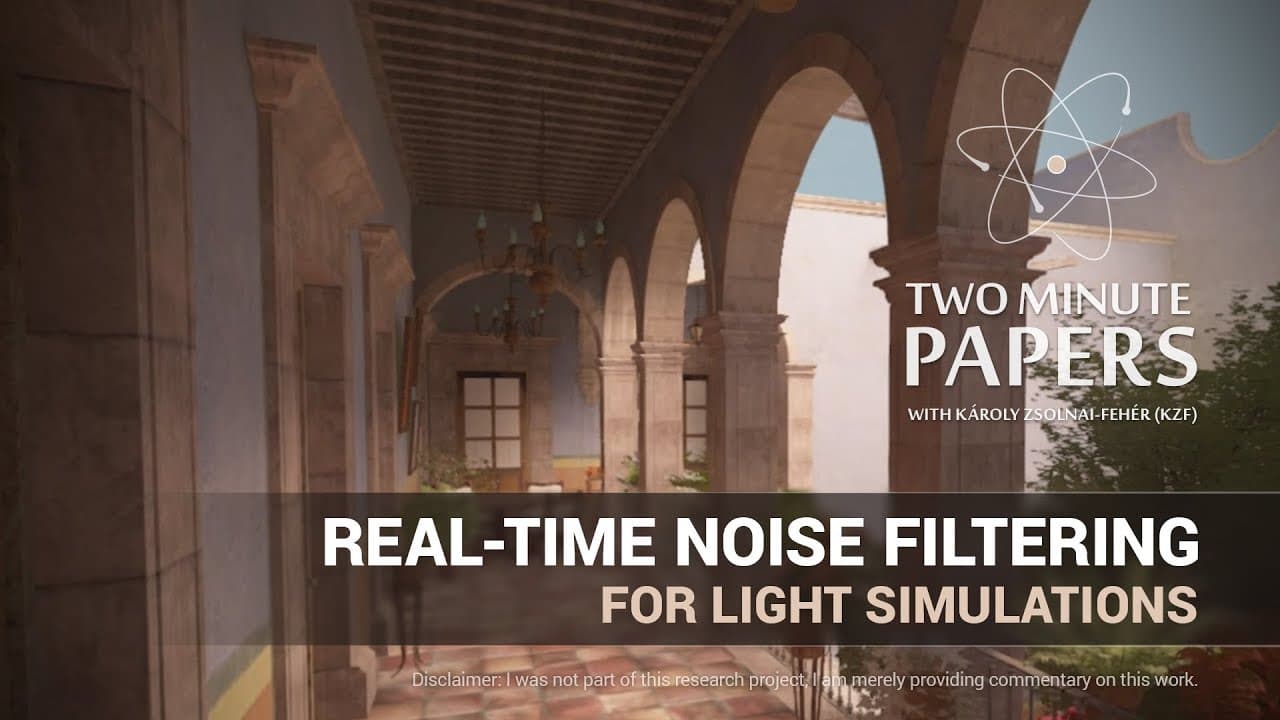
The SVGF algorithm allows real-time photorealistic rendering by quickly reconstructing images from noisy inputs without using neural networks. It achieves this by decoupling the direct and indirect effects of light, processing both separately on the graphics card. This innovation can create fully converged images in under 10 milliseconds, revolutionizing the speed of computer graphics.
Transcript
Dear Fellow Scholars, this is Two Minute Papers with Károly Zsolnai-Fehér. In this series, we talk a lot about photorealistic rendering, which is one of the most exciting areas in computer graphics research. Photorealistic rendering means that we put virtual objects in a scene, assign material models to them, and then run a light simulation program... Read More
Key Insights
- 👻 Photorealistic rendering is an essential area of research in computer graphics, allowing for the creation of highly realistic scenes and objects.
- ⌛ Traditional rendering techniques are time-consuming, often taking hours to days per image.
- ⌛ The SVGF algorithm enables real-time photorealistic rendering by eliminating noise and reconstructing images from noisy inputs.
- 🏃 The algorithm runs on the graphics card, demonstrating its simplicity and efficiency.
- 😒 The SVGF technique does not use neural networks or learning algorithms, showcasing the advancements in non-machine learning-based rendering methods.
- ☠️ The rate of progress in computer graphics research is remarkable, with real-time photorealistic rendering becoming a possibility in recent years.
- 🤗 The SVGF algorithm opens up new possibilities for artists to create visually stunning and realistic scenes.
Install to Summarize YouTube Videos and Get Transcripts
Explore YouTube Video Summarizer or Get YouTube Transcript Extractor
Questions & Answers
Q: What is photorealistic rendering and why is it important in computer graphics?
Photorealistic rendering involves simulating how objects and scenes would look in reality. It is crucial in computer graphics to create highly realistic visuals for various applications, including the film industry.
Q: How long does it typically take to render a photorealistic image using traditional techniques?
Rendering a single photorealistic image can take hours to days using traditional techniques. The process involves running complex light simulation programs to compute and converge light rays for each pixel.
Q: How does the SVGF algorithm achieve real-time photorealistic rendering?
The SVGF algorithm decouples the direct and indirect effects of light sources and denoises them separately. It also estimates the amount of noise in different parts of the image, providing more useful information for the denoising routines. This entire pipeline runs on the graphics card, enabling real-time rendering.
Q: Does the SVGF algorithm utilize neural networks or learning algorithms?
No, the SVGF algorithm does not rely on neural networks or learning algorithms. It achieves real-time photorealistic rendering by using spatiotemporal filtering and decoupling the direct and indirect effects of light sources.
Summary & Key Takeaways
-
Photorealistic rendering allows for the creation of highly realistic scenes and objects in a virtual environment.
-
Traditional photorealistic rendering techniques take hours to days to generate a single image.
-
A new algorithm, called SVGF, can create photorealistic images in real-time, eliminating noise and reconstructing images from noisy inputs.
Read in Other Languages (beta)
Share This Summary 📚
Summarize YouTube Videos and Get Video Transcripts with 1-Click
Try YouTube Summary with ChatGPT & Claude or YouTube Transcript Generator
Explore More Summaries from Two Minute Papers 📚






Summarize YouTube Videos and Get Video Transcripts with 1-Click
Try YouTube Summary with ChatGPT & Claude or YouTube Transcript Generator