How to Prepare Ketones Using Dialkyl Cadmium
TL;DR
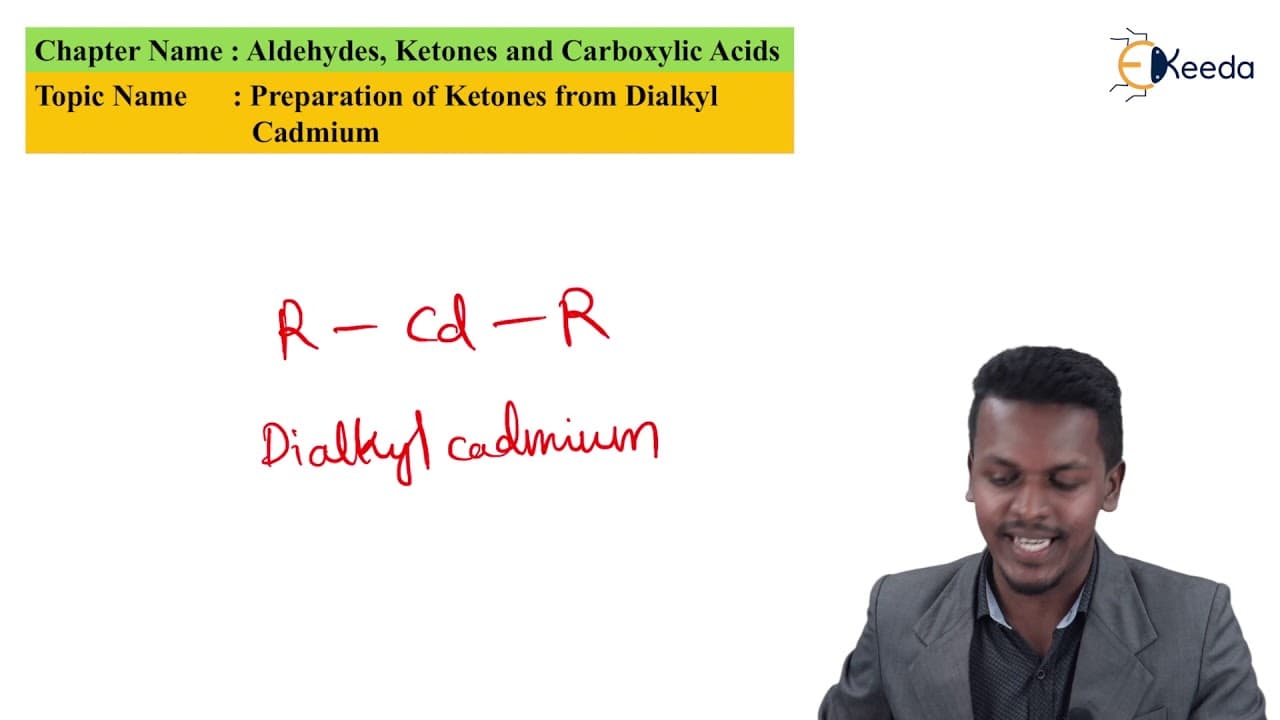
Ketones are prepared by reacting an acyl chloride with dialkyl cadmium, producing the ketone as the main product and cadmium chloride as a byproduct. Dialkyl cadmium is created by reacting an alkyl magnesium halide with cadmium chloride. For instance, using dimethyl cadmium with two moles of acetyl chloride yields acetone.
Transcript
hello friends say the previous topic we have discussed about that how we can prepare the aldehyde and how we can prepare ketone by using different chemicals so in this topic let me talk about how we can prepare a ketone by using dye alkyl can be a molecule so based on this let me talk about this topic so the topic is so friends here we are going to... Read More
Key Insights
- ❓ Dialkyl cadmium is a reagent used for preparing ketones.
- ❓ Alkyl magnesium halides can react with cadmium chloride to obtain dialkyl cadmium.
- ❓ The reaction between acyl chlorides and dialkyl cadmium produces ketones and cadmium chloride as a byproduct.
Install to Summarize YouTube Videos and Get Transcripts
Explore YouTube Video Summarizer or Get YouTube Transcript Extractor
Questions & Answers
Q: What is the reaction to prepare ketones from dialkyl cadmium?
An acyl chloride (RCOCl) is reacted with dialkyl cadmium (CdR2) to form the ketone. The cadmium attracts the chlorine, so cadmium chloride (CdCl2) is released as the byproduct while the ketone is the main product.
Q: How is dialkyl cadmium obtained?
Dialkyl cadmium is obtained by reacting an alkyl magnesium halide (RMgX) with cadmium chloride (CdCl2). Two molecules of RMgX react with CdCl2, and the magnesium halide is released as a byproduct while the dialkyl cadmium (CdR2) forms.
Q: What is the formula of dialkyl cadmium?
Dialkyl cadmium has the formula CdR2, where R is the alkyl group. For example, dimethyl cadmium is written as CH3-Cd-CH3.
Q: What is dialkyl cadmium used as a reagent for?
Dialkyl cadmium is used as a reagent for preparing ketones. It reacts with acyl chlorides to convert them into ketones.
Q: What is the byproduct when an acyl chloride reacts with dialkyl cadmium?
The byproduct is cadmium chloride (CdCl2). The cadmium takes up the chlorine atoms from the acyl chloride, leaving the ketone as the main product.
Q: How many moles of acyl chloride react with dialkyl cadmium?
Two moles of the acyl chloride are used. Because dialkyl cadmium carries two alkyl groups, each of its two R groups attaches to a separate acyl chloride carbon, producing two moles of ketone.
Q: Can dimethyl cadmium be used to obtain acetone?
Yes. Dimethyl cadmium (CH3-Cd-CH3) reacted with two moles of acetyl chloride (CH3COCl) gives acetone as the major product, along with cadmium chloride (CdCl2) as the byproduct.
Summary & Key Takeaways
-
Dialkyl cadmium can be obtained by reacting an alkyl magnesium halide with cadmium chloride.
-
Ketones can be prepared by reacting an acyl chloride with dialkyl cadmium, resulting in the formation of the desired ketone and cadmium chloride as a byproduct.
-
Dimethyl cadmium can be used with acyl chloride and another molecule of acyl chloride to obtain acetone as the main product.
Read in Other Languages (beta)
Share This Summary 📚
Summarize YouTube Videos and Get Video Transcripts with 1-Click
Try YouTube Summary with ChatGPT & Claude or YouTube Transcript Generator
Explore More Summaries from Ekeeda 📚




Summarize YouTube Videos and Get Video Transcripts with 1-Click
Try YouTube Summary with ChatGPT & Claude or YouTube Transcript Generator