How to Identify Outliers in Data Visualization
TL;DR
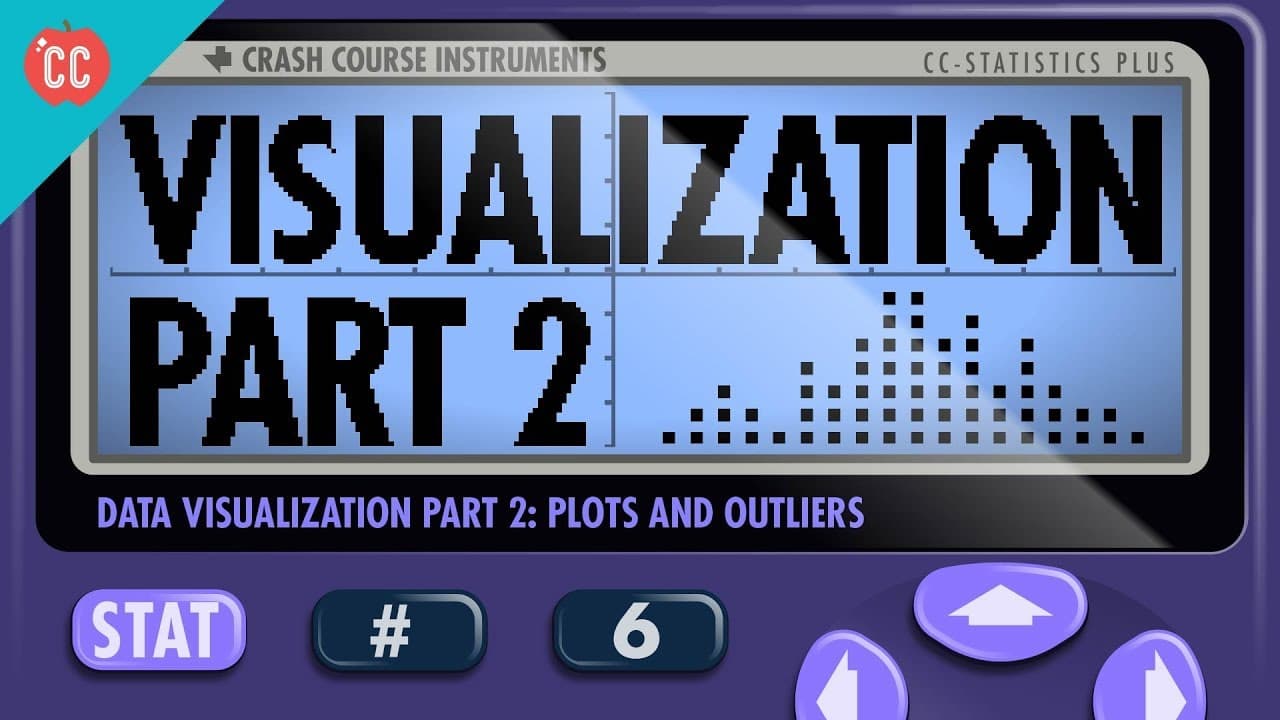
Dot plots, box plots, and stem and leaf plots are essential tools for visualizing data. They help identify outliers, which can either be rare valid data points or errors. Box plots use the interquartile range to flag potential outliers, which should be assessed carefully to determine their validity.
Transcript
Hi, I’m Adriene Hill and Welcome back to Crash Course Statistics. Last time we left off talking about different data visualizations. The ones we encounter every single day. Whether it’s a chart on the subway telling us the prevalence of heart disease in different age groups, or a histogram on Buzzfeed showing us how many times people use Lyft each ... Read More
Key Insights
- Dot plots replace histogram bars with dots, providing a clear view of data frequency.
- Stem and leaf plots use raw data values to show frequency, offering more detail than dot plots.
- Box plots display data spread and identify outliers using the interquartile range.
- Outliers are data points outside the 'fences' of a box plot, which could be rare or erroneous.
- Cumulative frequency plots accumulate data counts across bins, useful for specific data queries.
- Justin Timberlake's solo songs have more unique words compared to his *N’SYNC days.
- Outliers in data visualization should be scrutinized as they might be valid but rare data points.
- Effective data visualization communicates clear and accurate information.
Install to Summarize YouTube Videos and Get Transcripts
Explore YouTube Video Summarizer or Get YouTube Transcript Extractor
Questions & Answers
Q: How do dot plots differ from histograms?
Dot plots differ from histograms by replacing the solid bars with dots, where each dot represents a data point. This allows for a more granular view of data frequency, as you can visually count the dots to determine the number of occurrences, offering a clearer representation of the data distribution.
Q: What is a stem and leaf plot?
A stem and leaf plot is a method of displaying quantitative data that shows frequencies using raw data values. It organizes data into 'stems' and 'leaves', where stems represent data ranges similar to histogram bins, and leaves are the remaining digits of each data point, providing detailed insight into data distribution.
Q: How do box plots identify outliers?
Box plots identify outliers using the interquartile range (IQR). The box spans from the first quartile (Q1) to the third quartile (Q3), with whiskers extending to data points within 1.5 times the IQR. Points outside this range are flagged as potential outliers, indicating they are unusually distant from the rest of the data.
Q: Why might outliers be important in data analysis?
Outliers are important in data analysis because they can represent rare but valid data points that provide valuable insights or highlight errors that need correction. They can impact statistical analyses and visualizations, so understanding whether they are valid or erroneous is crucial for accurate data interpretation.
Q: What did the analysis reveal about Justin Timberlake's songs?
The analysis revealed that Justin Timberlake's solo songs tend to have a higher median number of unique words compared to his songs with *N’SYNC. This suggests that his lyrical vocabulary expanded when he went solo, as evidenced by the box plot showing a higher median and more spread out data in his solo work.
Q: How can cumulative frequency plots be useful?
Cumulative frequency plots are useful for understanding the accumulation of data points up to a certain value. They help answer questions about the number of data points below a specific threshold, offering a comprehensive view of data distribution and making it easier to assess cumulative trends and comparisons.
Q: What are the limitations of data visualization?
The limitations of data visualization include the potential for misleading representations if not designed correctly. Poorly constructed graphs can obscure data insights, mislead viewers, or oversimplify complex data. Effective visualizations should accurately convey information and encourage critical analysis and questioning.
Q: How should one approach data visualization critically?
Approaching data visualization critically involves questioning the accuracy and clarity of the information presented. Viewers should assess whether the visualization effectively communicates the data, consider potential biases, and verify data sources. Asking questions and being skeptical of unclear or misleading visualizations is crucial.
Summary & Key Takeaways
-
Dot plots, box plots, and stem and leaf plots are crucial for understanding data distribution and identifying outliers. Dot plots use dots instead of bars to show frequency, while stem and leaf plots retain raw data values for more detail. Box plots use quartiles to highlight potential outliers.
-
Box plots include a box spanning the interquartile range with whiskers showing data spread. Outliers, flagged outside the whiskers, may be rare valid points or errors. Justin Timberlake's solo songs, analyzed through box plots, show a higher median of unique words compared to *N’SYNC songs.
-
Cumulative frequency plots show accumulated data counts across bins, aiding specific queries. Effective data visualization should clearly communicate information, prompting viewers to ask questions and verify the accuracy of the presented data.
Read in Other Languages (beta)
Share This Summary 📚
Summarize YouTube Videos and Get Video Transcripts with 1-Click
Try YouTube Summary with ChatGPT & Claude or YouTube Transcript Generator
Explore More Summaries from CrashCourse 📚





Summarize YouTube Videos and Get Video Transcripts with 1-Click
Try YouTube Summary with ChatGPT & Claude or YouTube Transcript Generator