What Are the Cashflow Quadrants for Financial Success?
TL;DR
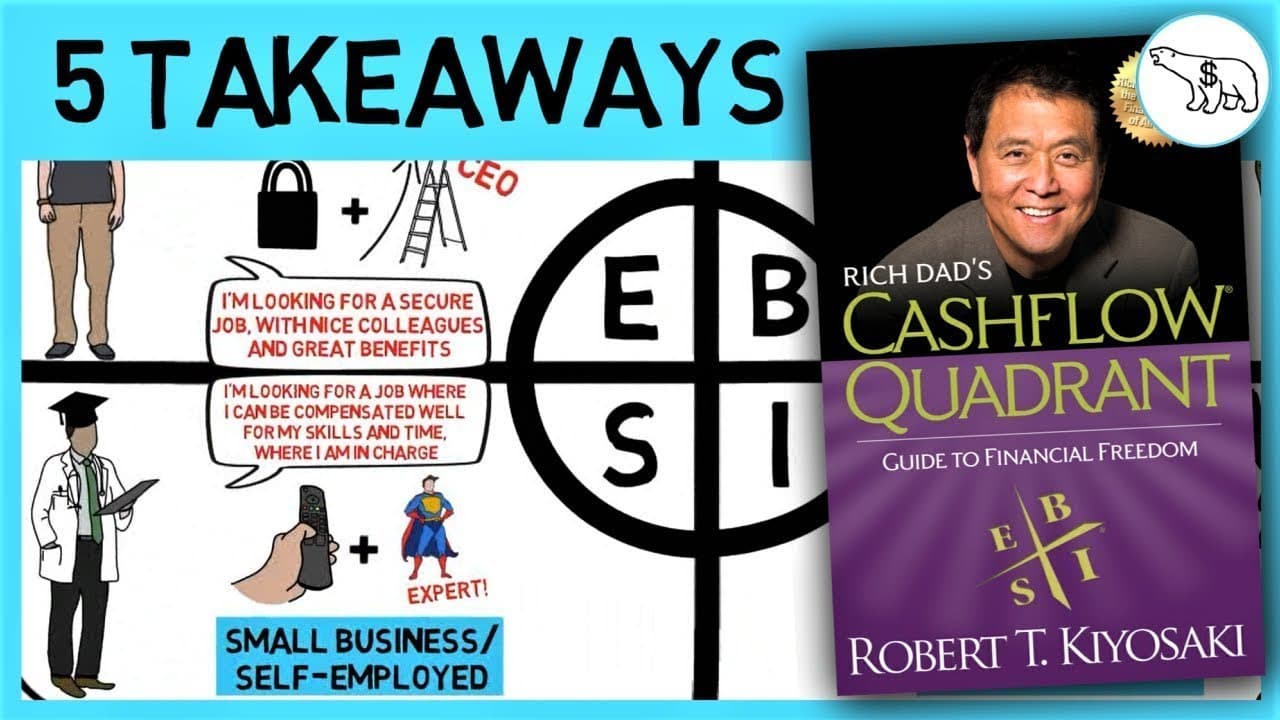
The Cashflow Quadrant describes four paths to financial success: employee, self-employed, business owner, and investor. Each quadrant has unique pros and cons, with the right side (business owner and investor) offering the quickest route to financial freedom through leveraging other people's time and money. Transitioning to these quadrants requires accepting risks and continuous learning.
Transcript
Did you ever hear this while growing up? "Just go to school! Get good grades, so you can get a secure and well-paid job!" I bet that 95% of you have been raised to believe that this is THE road to financial success. I know that I was. And this path might be the most suitable for some people, but definitely not for everyone. In Rich Dad's Cashflow Q... Read More
Key Insights
- 🤳 Wealth can come from four different sources: being an employee, self-employed, business owner, or investor.
- 😒 The right side of the cashflow quadrant (business owner or investor) offers greater financial freedom and the use of OPT and OPM.
- 😊 Each quadrant has its pros and cons, and the choice depends on individual goals and preferences.
- 🗯️ Transitioning to the right side may be challenging due to addiction to a specific quadrant and societal norms.
- 🦻 Educating oneself and surrounding oneself with successful individuals in the B and I quadrants can aid in the transition.
- 🎚️ There are five levels of investors, with the level 5 investor achieving the greatest profits by implementing business concepts.
Install to Summarize YouTube Videos and Get Transcripts
Explore YouTube Video Summarizer or Get YouTube Transcript Extractor
Questions & Answers
Q: What are the four quadrants of the cashflow quadrant?
The four quadrants are employee (E), self-employed (S), business owner (B), and investor (I).
Q: What is the main difference between the left and right side of the cashflow quadrant?
The main difference is the use of other people's time (OPT) and other people's money (OPM) in the right side (B and I quadrants).
Q: What are the pros and cons of being an employee?
Pros include reduced financial uncertainty, paid vacation, health insurance, and colleagues. Cons include more work, less free time, and limited salary growth.
Q: How can someone transition from the left side to the right side of the cashflow quadrant?
It requires breaking the addiction to a specific quadrant and overcoming mental obstacles. Surrounding oneself with successful business owners and investors can help with the transition.
Summary & Key Takeaways
-
The cashflow quadrant model explains that wealth can come from four different sources: employee, self-employed, business owner, or investor.
-
Each quadrant has its pros and cons, with different levels of financial security, control, and freedom.
-
Moving to the right side of the cashflow quadrant (business owner or investor) offers the fastest path to financial freedom.
Read in Other Languages (beta)
Share This Summary 📚
Summarize YouTube Videos and Get Video Transcripts with 1-Click
Try YouTube Summary with ChatGPT & Claude or YouTube Transcript Generator
Explore More Summaries from The Swedish Investor 📚






Summarize YouTube Videos and Get Video Transcripts with 1-Click
Try YouTube Summary with ChatGPT & Claude or YouTube Transcript Generator