How Does AI Reach Math Olympiad Gold Level?
TL;DR
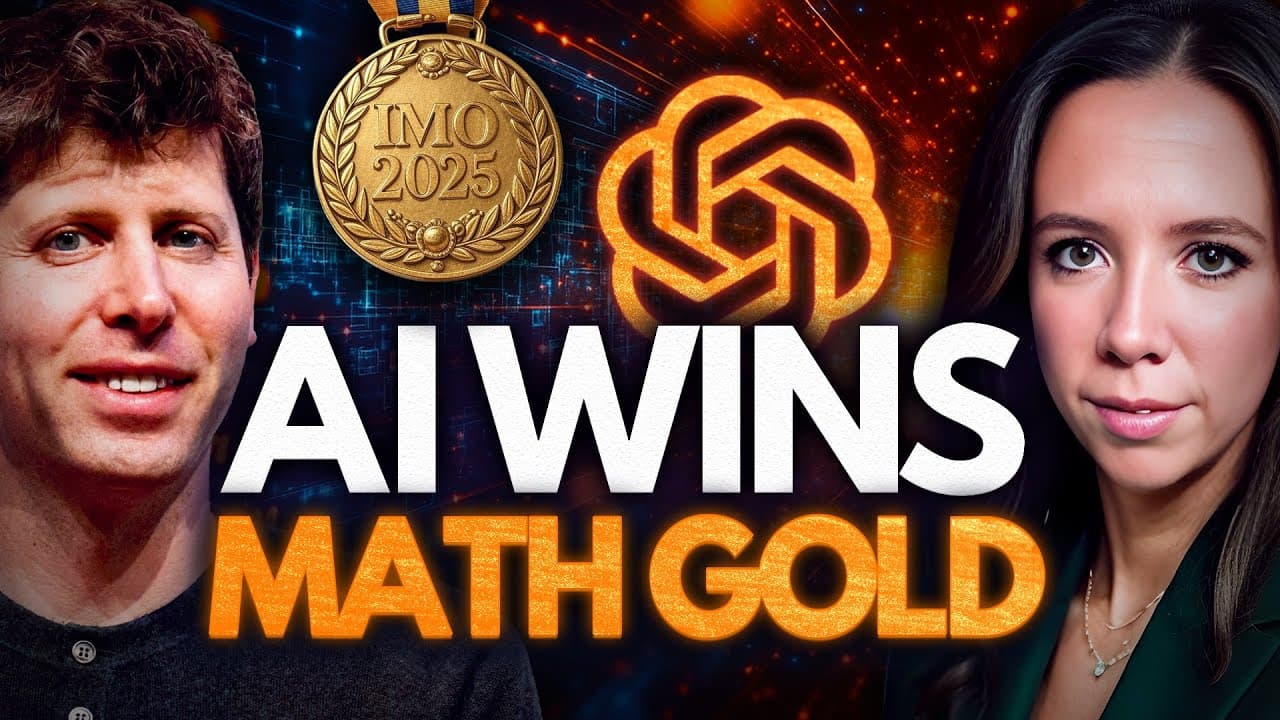
OpenAI’s experimental general-purpose reasoning model reportedly achieved gold-medal performance on International Mathematical Olympiad problems through reinforcement learning and increased test-time computation. The result suggests that broader reasoning improvements can produce major mathematical gains without math-specific training, potentially expanding AI’s usefulness in scientific research, engineering, financial modeling, cryptography, medicine, climate modeling, and AI development itself.
Transcript
OpenAI has an internal experimental model that is a generalpurpose reasoning model. They accidentally got gold medal on the International Math Olympia. They were not aiming to get better at math. Open AI has had an internal breakthrough that has allowed them to reason so much better that a general purpose reasoner is now better than the vast majori... Read More
Key Insights
- OpenAI’s experimental model reportedly reached gold-medal performance on International Mathematical Olympiad problems while operating as a general-purpose reasoning system, rather than as an AI designed solely for mathematics. The result is presented as evidence that broad reasoning improvements can transfer into specialized intellectual domains.
- The reported performance improvement came from general-purpose reinforcement learning and increased test-time computation. According to the presentation, this matters because the developers improved the model’s overall reasoning process, with advanced mathematical performance emerging as one consequence rather than as the only training objective.
- The International Mathematical Olympiad is described as a prestigious competition where mathematical prodigies solve difficult problems using pure reasoning, without tools or internet access. Human competitors are said to receive 4.5 hours, making gold-level performance a demanding test of sustained mathematical problem solving.
- Mathematics is foundational to science, technology, engineering, financial modeling, cryptography, medical research, climate modeling, quantum physics, and space exploration. The presentation argues that stronger mathematical reasoning could therefore affect many fields instead of merely producing a better calculator or competition solver.
- AI development itself depends on mathematics, including linear algebra, matrix multiplication, and reinforcement learning algorithms. The presentation proposes a feedback loop in which stronger AI assists AI research, that research produces more capable systems, and those systems further accelerate subsequent research and development.
- The pace of reported mathematical improvement is characterized as nonlinear. The account contrasts saturation of an advanced high-school mathematics benchmark in April with later gold-level Olympiad performance, using that progression to argue that reasoning capabilities may advance faster than many public forecasts anticipate.
- Advanced AI reasoning could make complex financial modeling, statistical analysis, and engineering calculations accessible to more people. The presentation compares this possibility with coding assistants that reduce the time required to begin programming, envisioning widely available mathematical support resembling access to a highly trained specialist.
- Human connection remains central in the presentation’s optimistic view of automation. AI is described as a tool for handling machine-like labor while augmenting human judgment, creativity, relationships, and purpose. The recommended response is to learn how to use the technology for beneficial goals rather than treating it as inherently autonomous or evil.
Install to Summarize YouTube Videos and Get Transcripts
Explore YouTube Video Summarizer or Get YouTube Transcript Extractor
Questions & Answers
Q: How did OpenAI’s experimental model achieve Olympiad-level math performance?
OpenAI’s experimental system reportedly achieved gold-medal performance through general-purpose reinforcement learning and increased test-time computation. The presentation emphasizes that it was a broad reasoning model, not a system built specifically for mathematics. Its mathematical gains are therefore attributed to stronger general reasoning, with difficult problem solving emerging as one application of that broader capability.
Q: Why is gold-level International Mathematical Olympiad performance significant?
The International Mathematical Olympiad is portrayed as the most prestigious mathematics competition, featuring exceptionally talented human problem solvers. Its problems require extended reasoning rather than routine calculation, and human champions are described as having 4.5 hours with no tools or internet. Gold-level performance therefore signals an ability to handle difficult, multi-step mathematical reasoning under demanding conditions.
Q: Why does a general-purpose reasoning model matter more than a math-specific AI?
A general-purpose model matters because its improvement may transfer across many kinds of problems rather than remaining limited to mathematics. The presentation argues that OpenAI did not deliberately build a specialized competition solver. Instead, better general reasoning produced advanced mathematics as a side effect, suggesting that the same underlying capability could support scientific, engineering, financial, medical, and technical work.
Q: How could stronger AI mathematics affect scientific research?
Stronger mathematical reasoning could support fields whose theories, models, and experiments depend on equations and quantitative analysis. The presentation specifically connects the capability to new physics theories, climate modeling, drug discovery, material science, quantum computing, medical research, and engineering innovation. These are proposed applications, not demonstrated outcomes of the reported Olympiad result itself.
Q: How might mathematical AI accelerate AI development?
Artificial intelligence relies on mathematical foundations such as linear algebra, matrix multiplication, and reinforcement learning algorithms. The presentation argues that an AI capable of stronger mathematics could assist researchers in improving AI systems. That creates a proposed feedback loop: AI supports AI research, the research improves AI capabilities, and the improved systems become more useful for further research.
Q: What evidence does the presentation give for rapid AI progress?
The presentation contrasts several reported milestones. It says OpenAI saturated an advanced high-school mathematics benchmark in April, while the experimental model later achieved gold-level International Mathematical Olympiad performance. It also claims that models had been outside the top 800 in math competitions six months earlier. These comparisons are used to characterize reasoning progress as nonlinear rather than gradual.
Q: When will users get access to the reported Olympiad model?
The presentation says the gold-level Olympiad system is an experimental research model that OpenAI did not plan to release for several months. It also states that GPT-5 was expected sooner, while distinguishing that upcoming release from the experimental system. No precise public release date for the Olympiad-performing model is provided in the source material.
Q: Should people view advanced AI as replacing human intelligence?
The presentation ultimately argues against viewing AI as a replacement for humanity. It describes artificial intelligence as a compilation of human-generated data that should augment, enable, and propel people. Machines could take over repetitive, machine-like labor, while human connection, voices, relationships, meaning, creativity, and moral choices remain central to how the technology is used.
Summary & Key Takeaways
-
OpenAI reportedly achieved gold-medal performance on International Mathematical Olympiad problems with an experimental general-purpose reasoning model. The system was not designed specifically for mathematics. According to the account, its performance emerged from general-purpose reinforcement learning and greater test-time computation, suggesting that improvements in broad reasoning can transfer to demanding mathematical tasks.
-
The reported result is presented as significant because mathematics supports numerous technical fields, including scientific research, engineering, financial modeling, cryptography, medicine, climate modeling, and artificial intelligence. If advanced reasoning becomes broadly accessible, users could apply high-level mathematical assistance to calculations, statistical analysis, research questions, and other complex problems across these areas.
-
The presentation combines concern about rapid capability growth with optimism about human use of AI. It argues that machines should handle repetitive machine-like labor while people preserve connection, meaning, family life, and human creativity. AI is framed as a catalyst built from human-generated data, not as a replacement for humanity itself.
Read in Other Languages (beta)
Share This Summary 📚
Summarize YouTube Videos and Get Video Transcripts with 1-Click
Try YouTube Summary with ChatGPT & Claude or YouTube Transcript Generator
Explore More Summaries from Julia McCoy 📚






Summarize YouTube Videos and Get Video Transcripts with 1-Click
Try YouTube Summary with ChatGPT & Claude or YouTube Transcript Generator