What Could Move Markets During Big Tech Earnings?
TL;DR
Markets expect a 25 basis point Federal Reserve rate cut after September inflation data showed slower increases in core goods, services, rents, and shelter costs. Investors are also watching a preliminary US-China trade framework, five major technology earnings reports, falling precious-metal prices, and whether debt-funded AI capacity arrangements create risks beyond the largest technology companies.
Transcript
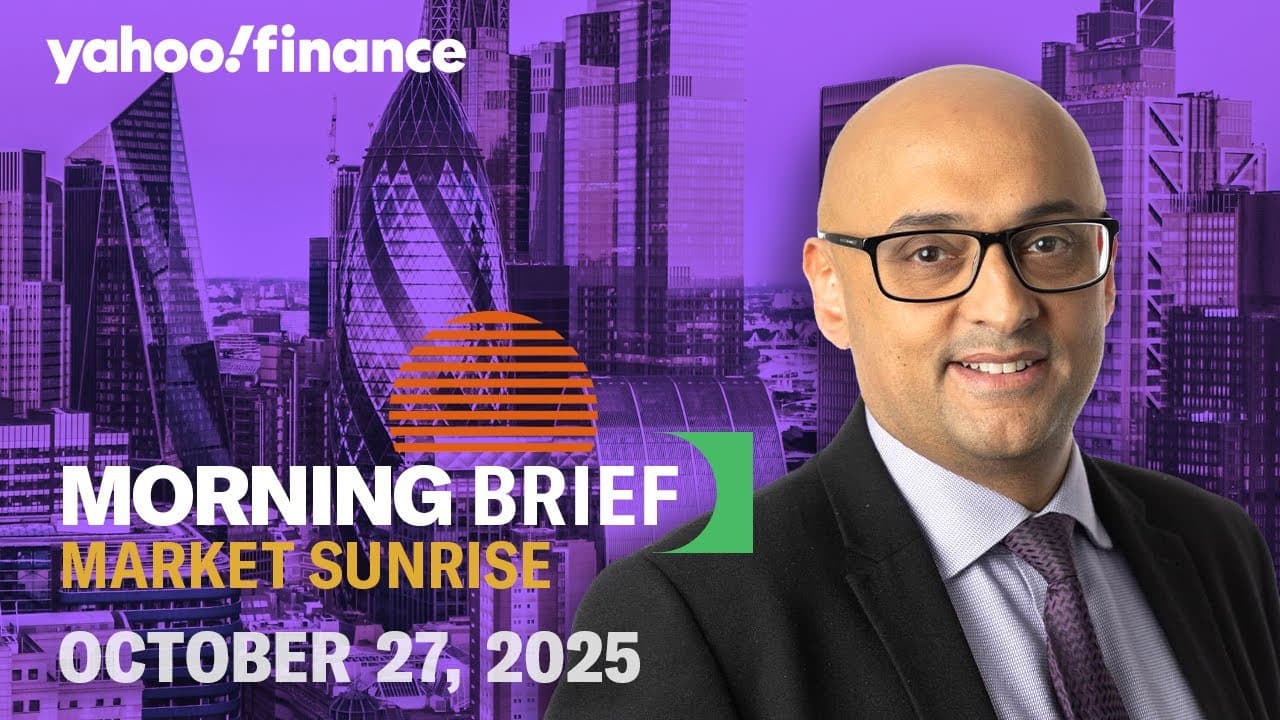
Hello and welcome to Morning Brief Market Sunrise. I'm Ramsan Karamali live from Yahoo Finance Studios in London. It's Monday 27th October. It's a big tech earnings week coming up on the show. So the US and China agree on a framework for a trade deal. Then there were five. Trump says he could name his next Fed chair before year end. and I'll tell y... Read More
Key Insights
- The US-China trade framework is preliminary, with both Treasury Secretary Scott Bessent and Chinese state-run media reporting progress ahead of a planned presidential meeting in South Korea. The shared acknowledgment increased optimism, but major implementation details remained unsettled.
- A 25 basis point Federal Reserve rate cut is almost fully anticipated by markets and expected by 99% of economists cited in the discussion. September data showed slower increases in core goods, core services, rents, and shelter, reducing the likelihood of a surprise.
- Federal Reserve independence is protected partly by institutional constraints, because the chair holds only one vote and governors serve 14-year terms. Courts also blocked an attempt to remove Governor Lisa Cook after finding insufficient cause, according to the interview.
- Big technology earnings remain stronger than the broader index, with the Magnificent Seven expected to deliver 16.6% earnings growth compared with 8.1% for the rest of the index. Five members were scheduled to report during the same week.
- Microsoft's AI position is supported by its OpenAI partnership and the Azure cloud business, which grew 39% in the prior quarter. Deals involving OpenAI, Oracle, Broadcom, Nvidia, and AMD were described as providing direct benefits to Microsoft Azure.
- AI capital spending by Microsoft, Amazon, Google, and Meta is largely intended to meet customer demand backed by long-term compute-capacity commitments. The analyst characterized this spending as prudent while distinguishing it from highly leveraged financing outside those companies.
- Debt-funded AI expansion is the more concerning part of the investment cycle, particularly through special-purpose vehicles and companies such as Oracle and CoreWeave. The discussion also identified circular transactions, including chip suppliers investing in customers that then commit to buying their chips.
- Gold and silver prices are falling as optimism about a possible US-China trade agreement weakens safe-haven demand and the US dollar strengthens. Analysts warned that additional negotiating progress could trigger further profit-taking after both metals rose strongly during 2025.
Install to Summarize YouTube Videos and Get Transcripts
Explore YouTube Video Summarizer or Get YouTube Transcript Extractor
Questions & Answers
Q: What did the United States and China agree to on trade?
The United States and China reached a preliminary framework for a potential trade agreement before a planned meeting between Presidents Trump and Xi in South Korea. Treasury Secretary Scott Bessent called it a very positive framework and said proposed 100% tariffs were effectively off the table. Chinese state-run media also reported progress, although important details and implementation questions remained unresolved.
Q: Which issues remain unresolved in the US-China trade talks?
The unresolved or vaguely defined issues include rare-earth export controls, Chinese purchases of American soybeans, TikTok, fentanyl, and shipping tariffs. China may postpone its rare-earth restrictions for one year, while Bessent said substantial soybean purchases were expected. Negotiators indicated consensus on other topics, but questions remained about a TikTok sale and enforcement of commitments involving fentanyl exports.
Q: Why do markets expect the Federal Reserve to cut rates?
Markets have fully priced in a 25 basis point rate cut, and 99% of economists cited in the interview expect the same move. Delayed September inflation data showed that core goods prices were not rising as quickly, while core services and rents were also easing. Shelter prices increased 0.2% in September, compared with 0.4% in August.
Q: How could the government shutdown affect Federal Reserve decisions?
A continuing government shutdown could make data collection during October and November difficult, reducing the clarity of future inflation readings. Although attention was already shifting toward a possible additional 25 basis point cut in December, incomplete or disrupted economic information could make that decision harder. The September consumer price index report had already been delayed because of the shutdown.
Q: Why are investors concerned about Federal Reserve independence?
Concern arises because Treasury Secretary Scott Bessent, a political appointee, discussed the five remaining candidates to replace Chair Jerome Powell. However, changing the chair alone would not transform policy because the chair has only one vote on the committee. Governors serve 14-year terms, courts can constrain removals, and markets would react negatively if the Fed appeared unable to pursue stable inflation and employment independently.
Q: What should investors watch in major technology earnings?
Investors should focus on artificial intelligence demand, cloud growth, capital spending, advertising exposure, and the financing used to expand computing capacity. Microsoft and Alphabet were expected to see particularly strong AI-related demand. Amazon Web Services remained the largest cloud provider but was growing more slowly, while Meta's AI exposure came mainly through advertising and infrastructure spending rather than a cloud business.
Q: Why was Microsoft viewed positively before its earnings report?
Microsoft was viewed positively because its OpenAI partnership remained a significant advantage and its Azure cloud business grew 39% in the previous quarter. The discussion argued that OpenAI's agreements with Oracle, Broadcom, Nvidia, and AMD also directly benefited Azure. These factors supported expectations that Microsoft would continue seeing strong demand connected to artificial intelligence computing and services.
Q: What are the main risks in current AI infrastructure spending?
The main risks are debt-funded capacity expansion, off-balance-sheet special-purpose vehicles, high leverage, and circular investment relationships. The analyst distinguished these arrangements from spending by Microsoft, Amazon, Google, and Meta, which was described as responding to long-term customer commitments. Transactions in which Nvidia invests in OpenAI and OpenAI commits to Nvidia chips were characterized as an unhealthy effort to extend demand beyond core customers.
Summary & Key Takeaways
-
The United States and China reached a preliminary framework ahead of a planned Trump-Xi meeting in South Korea. Markets welcomed the prospect of de-escalation, but unresolved questions remain around rare earths, soybeans, TikTok, fentanyl, and shipping tariffs. China may postpone planned rare-earth export restrictions for one year.
-
Markets have fully priced in a 25 basis point Federal Reserve rate cut after delayed September inflation data showed easing price pressures. Attention may quickly shift to another possible December cut, although a prolonged government shutdown could disrupt October and November data collection and make future inflation readings harder to interpret.
-
Five Magnificent Seven companies report during the week, with investors focused on cloud growth, artificial intelligence demand, capital spending, and financing structures. Microsoft and Alphabet were described positively, while analysts distinguished prudent demand-backed spending by large technology companies from riskier debt-funded arrangements and circular investments elsewhere in the AI ecosystem.
Read in Other Languages (beta)
Share This Summary 📚
Summarize YouTube Videos and Get Video Transcripts with 1-Click
Try YouTube Summary with ChatGPT & Claude or YouTube Transcript Generator
Explore More Summaries from Yahoo Finance 📚

Summarize YouTube Videos and Get Video Transcripts with 1-Click
Try YouTube Summary with ChatGPT & Claude or YouTube Transcript Generator