How to Master Emotions for Disciplined Trading
TL;DR
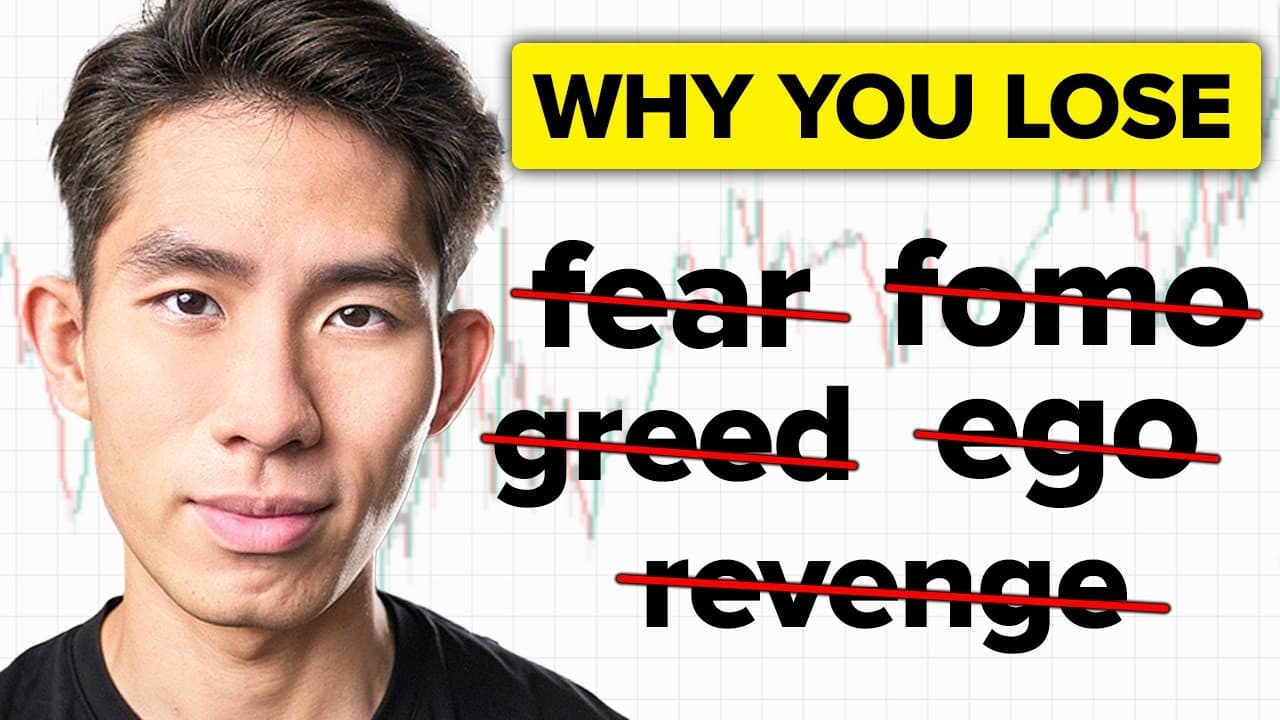
Emotional trading losses can be reduced by identifying the emotion, pain, and behavior behind each decision before acting. Traders cannot eliminate emotions, but they can manage them through preparation, structured trade plans, sufficient data, and predefined risk rules, reducing fear, hesitation, revenge trading, and impulsive attempts to recover losses.
Transcript
You don't lose money because of the market. You lose because you make emotional decisions in the market. If you think about it, every single loss that you have incurred so far, it stems from your emotion. So, if you can learn how to master your emotions, you can pretty much reduce the amount of money that you lose in the market, which increase the ... Read More
Key Insights
- Emotional decisions are presented as a major source of trading losses because they can override rational judgment, trade plans, and risk controls. Mastering emotions therefore means reducing their influence on execution, not expecting every trade to become profitable or every loss to disappear.
- Emotions are predictable responses to pain or discomfort that a person is actively trying to avoid. Breaking an emotion into its basic cause makes it easier to understand the resulting behavior and develop a specific response before that behavior damages trading performance.
- Emotions are neither good nor bad because each can serve a human purpose. Greed can motivate people to work and provide for others, while fear activates a protective response that helps people avoid threats capable of causing harm.
- Emotions cannot be eliminated from a healthy human experience, so attempting to remove them is an unwinnable objective. Traders must instead recognize, understand, and manage emotions before those emotions take control and produce decisions that conflict with their plans.
- Trading behavior is an action that moves a trader closer to or farther from a goal. Every such action is linked to an emotional state, and the resulting behavior produces consequences, including losses when impulsive execution replaces planned decision-making.
- Revenge trading is driven by the pain of recent losses and the desire to recover money quickly. Anger, blame, and catastrophic thoughts can lead traders to increase activity while ignoring their trade criteria and risk management rules.
- Pain avoidance can create greater future pain because an emotional trader seeks immediate relief through impulsive action. Trying to erase a losing streak with one large winning trade can instead produce bad decisions, additional losses, and regret.
- Fear is paralysis caused by uncertainty before entering a trade. Structure reduces this fear through advance analysis, research, clear points of interest, defined confirmation criteria, and enough data to strengthen trust in the trading plan.
Install to Summarize YouTube Videos and Get Transcripts
Explore YouTube Video Summarizer or Get YouTube Transcript Extractor
Questions & Answers
Q: How can traders manage emotions before making a trade?
Traders can manage emotions by identifying the feeling, tracing it to the pain or uncertainty underneath it, and recognizing the behavior it is encouraging. They should then return to a pre-planned process that includes chart analysis, research, a desired point of interest, entry confirmation, and risk rules. The aim is not to remove emotion, but to stop it from replacing the trading plan.
Q: Why do emotional decisions cause trading losses?
Emotional decisions can cause losses because the emotional part of the mind may override rational and logical judgment during stressful situations. A trader can abandon the trade plan, ignore risk management, or take extra trades solely to relieve immediate discomfort. Those bad decisions produce poor results, while the original attempt to avoid pain can create greater financial pain and regret later.
Q: What causes revenge trading after a losing streak?
Revenge trading begins when losses create anger, pain, and catastrophic thoughts about being a bad trader, paying bills, or facing a difficult future. The trader then seeks relief by taking more trades and hoping one large result will recover the earlier losses. Because this behavior disregards the trade plan and risk controls, it can lead to further losses rather than recovery.
Q: Why is eliminating emotions an unrealistic trading goal?
Eliminating emotions is unrealistic because emotions are part of normal human experience. Fear, greed, regret, sadness, happiness, and FOMO will continue to arise, and they are not inherently good or bad. A trader's workable objective is to understand why an emotion appears, redefine it at a fundamental level, and prevent it from controlling execution or overriding established rules.
Q: What is the relationship between emotion, pain, behavior, and results?
The sequence begins with an emotional state, which produces pain or discomfort that the trader wants to escape. That pain motivates a behavior, such as taking additional trades after several losses. The behavior then creates a result. When anger and urgency replace rational judgment, the trader may ignore both the trade plan and risk management, leading to losses and more pain.
Q: Why do traders feel fear before entering a trade?
Traders feel fear before entry because the outcome is unknown and they cannot predict what the market will do. They may doubt their strategy, worry about losing the trade or account, or assume another loss will follow a recent losing streak. This uncertainty can cause hesitation or freezing even when the available setup matches every criterion in the trading plan.
Q: How does pre-planning reduce fear in trading?
Pre-planning creates structure before uncertainty becomes emotionally overwhelming. The trader marks up charts, completes analysis, performs research, identifies a desired point of interest, and decides what entry confirmation is required. When price reaches the planned area, the trader has a defined process to follow. This preparation reduces dependence on impulsive judgment at the moment of execution.
Q: Why is understanding an emotion more effective than demanding discipline?
Simply telling a trader to remain disciplined, calm, or focused does not change the beliefs, thoughts, actions, and behaviors driving the problem. Understanding an emotion at its most basic level reveals the pain or uncertainty beneath it. That understanding allows the trader to develop a specific solution and makes the emotion feel less like an unknown force controlling decisions.
Summary & Key Takeaways
-
Trading emotions are predictable responses connected to avoiding pain and discomfort. They are neither inherently good nor bad, and traders cannot eliminate them. The practical objective is to understand each emotion at a fundamental level, identify its source, and prevent it from controlling decisions that should follow a prepared trading and risk plan.
-
Trading behavior follows a recurring chain: emotion creates pain, pain motivates an action, and the action produces a result. After a losing streak, anger and catastrophic thinking can trigger revenge trading. Because the trader disregards planned setups and risk management, the attempt to escape immediate discomfort can create additional losses and later regret.
-
Fear appears before entering a trade because the outcome remains unknown. A trader may hesitate even when a setup satisfies every planned criterion, particularly after several losses or when confidence in the strategy is weak. Pre-planning, chart analysis, research, clear entry conditions, and sufficient supporting data provide structure for acting under uncertainty.
Read in Other Languages (beta)
Share This Summary 📚
Summarize YouTube Videos and Get Video Transcripts with 1-Click
Try YouTube Summary with ChatGPT & Claude or YouTube Transcript Generator
Explore More Summaries from The Trading Geek 📚
Summarize YouTube Videos and Get Video Transcripts with 1-Click
Try YouTube Summary with ChatGPT & Claude or YouTube Transcript Generator