Tristan Buckmaster on OpenAI's Math Controversy
TL;DR
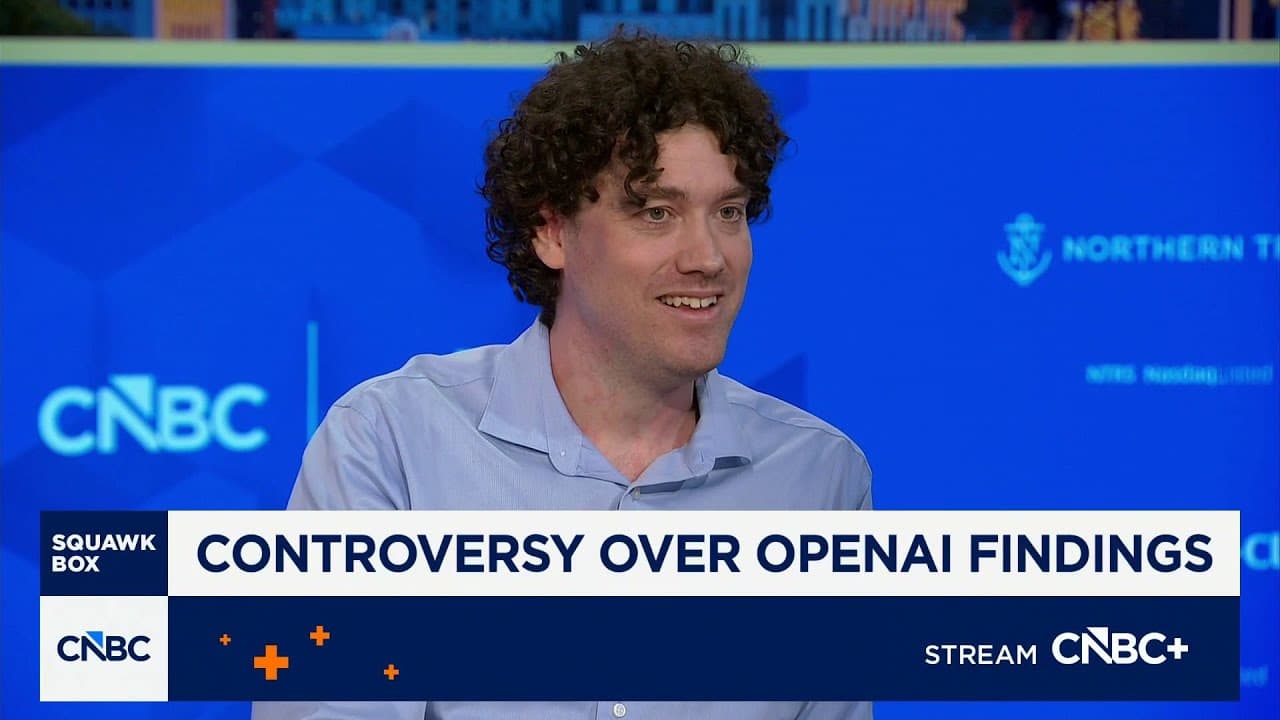
Tristan Buckmaster says OpenAI reached the same Navier-Stokes research position as his team within a day of learning his name, using the same argument and methods, but he cannot determine how it happened. OpenAI categorically denies that his recent Codex prompts influenced its system, while Buckmaster also alleges that company representatives offered him sole authorship and pressured him during a phone call.
Transcript
OPENAI RELEASED HUNDREDS OF NEW MATHEMATICS FINDINGS THIS WEEK ON A WIDE RANGE OF TOPICS INCLUDING ALGEBRA, NUMBER THEORY AND LOGIC. THIS FOLLOWS AN ANNOUNCEMENT LAST MONTH THAT IT SOLVED THE NAVIER-STOKES EQUATION, WHICH IS ONE OF THE MATH PROBLEMS OF THE MILLENNIUM PRIZES THAT OFFERS A $1 MILLION REWARD FOR EACH SOLUTION TO LONG STANDING MATH PUZ... Read More
Key Insights
- The Navier-Stokes equation is one of the most fundamental equations in mathematics and physics, describing fluids such as water, blood flow, and air. The unresolved question discussed is whether its solutions can break down through velocity becoming infinite within finite time.
- Buckmaster's Navier-Stokes work has been a central goal throughout his research career. He says he and collaborator Levant believed they were roughly one month away from obtaining their result at the end of August, before rumors about competing AI research spread.
- The competitive episode began with a reported leak that Anthropic was close to solving the Navier-Stokes problem and the Hodge conjecture. Buckmaster says OpenAI then spent millions of dollars on computing resources while attempting to solve Millennium Prize problems.
- Buckmaster's collaboration was not presented as an official Anthropic project, although Levant worked for Anthropic. Buckmaster says he informed OpenAI that the effort involved only the two researchers and that they were also using OpenAI's product.
- Buckmaster used Codex through paid personal accounts to interpret and develop mathematical work received from Levant. He says training access was disabled on two accounts but remained enabled by default on one, placing uncertainty around how the stored material was handled.
- Buckmaster alleges that OpenAI offered to let him publish its paper as sole author if Levant was excluded because of his Anthropic employment. He also alleges that representatives applied pressure after he called the proposal unethical and said he would speak publicly.
- OpenAI's stated position is that Buckmaster's Codex prompts from the preceding two months could not have influenced its system in any way, including through training. Buckmaster questions the statement because he says the relevant dates in OpenAI's explanations changed.
- Buckmaster's central evidence is circumstantial rather than conclusive. He says OpenAI had made no progress before learning his name, then reached exactly his team's position with the same argument and methods within a day, but he acknowledges that he cannot establish how this occurred.
Install to Summarize YouTube Videos and Get Transcripts
Explore YouTube Video Summarizer or Get YouTube Transcript Extractor
Questions & Answers
Q: What is the Navier-Stokes problem discussed by Tristan Buckmaster?
The Navier-Stokes problem concerns a fundamental partial differential equation used to describe fluid behavior, including water, blood flow, and air around airplane wings. The unresolved issue discussed in the interview is whether solutions can break down, meaning that velocity becomes infinite within a finite amount of time. At that point, the physical model and its equations would no longer make sense.
Q: Why is the Navier-Stokes equation important?
The Navier-Stokes equation is important because it is one of the most fundamental equations in mathematics and physics for describing fluids. Buckmaster identifies applications involving water, blood flow, air, and airflow around airplane wings. He says understanding rare breakdown behavior could help test fluid models, although he does not expect it to fundamentally change routine airplane design.
Q: What does Tristan Buckmaster allege OpenAI did with his research?
Buckmaster alleges that OpenAI reached exactly the same point as his research team, using the same argument and methods, within a day of learning his identity. He finds that sequence suspicious because he says the company previously had no progress. However, he explicitly acknowledges that he does not know how the company obtained its result and cannot prove that his data was used.
Q: How did Tristan Buckmaster use Codex in his mathematics research?
Buckmaster says he used Codex through paid personal accounts to help interpret and develop mathematical work that he received from his collaborator Levant. This meant their work was present on OpenAI's servers. He says he had disabled permission to train on his information for two accounts, while one account still had the default training setting enabled.
Q: How did OpenAI respond to claims that Codex prompts influenced its findings?
OpenAI stated categorically that Buckmaster's Codex prompts from the preceding two months could not have influenced its system in any way, including through training. Buckmaster disputes the credibility of the company's explanations, saying that the dates cited in its statements shifted from April to July. The transcript does not independently resolve the disagreement or establish how OpenAI produced its result.
Q: What offer does Buckmaster say OpenAI made during the disputed phone call?
Buckmaster says OpenAI offered to let him publish the company's paper as the sole author, provided that his collaborator Levant was not included because Levant worked for Anthropic. Buckmaster characterizes that proposal as an attempted bribe and says he rejected it as unethical. He further claims OpenAI admitted making the sole-authorship offer, although the interview provides no independent documentation of the call.
Q: Why did competition between OpenAI and Anthropic affect the research dispute?
Buckmaster says a rumor spread that Anthropic was close to solving two Millennium Prize problems, the Navier-Stokes problem and the Hodge conjecture. Because Levant was an Anthropic employee, the work could have been associated with that company even though Buckmaster describes it as a two-person project. He says OpenAI then treated the competition as extremely important and devoted major computing resources to the problems.
Q: Did OpenAI solve the Navier-Stokes problem with one prompt?
Buckmaster says OpenAI initially claimed it had solved the Navier-Stokes problem in one shot, meaning the prize problem was entered as a single prompt and the answer emerged immediately. According to him, that claim collapsed within minutes and was acknowledged as untrue. He says OpenAI instead used many agents across related problems, including 100 agents to move from the Euler result toward Navier-Stokes.
Summary & Key Takeaways
-
The Navier-Stokes equation is a fundamental partial differential equation used to describe fluids, including water, blood flow, and air. Buckmaster says the long-standing mathematical question concerns whether solutions can break down when velocity goes to infinity within a finite time, causing the equations to stop making physical sense.
-
Buckmaster and collaborator Levant were pursuing a research program connected to the Euler and Navier-Stokes equations. He says a rumor about Anthropic nearing solutions to two Millennium Prize problems prompted intense competition, after which OpenAI deployed many agents and reportedly reached the same research position, argument, and methods as his team.
-
Buckmaster used paid personal accounts and Codex to interpret and develop research received from Levant, leaving their work on OpenAI servers. He says training was disabled on two accounts but remained enabled on one. OpenAI states that his prompts from the previous two months could not have influenced its system in any way.
-
Key Insights order note: factual statements distinguish established context, Buckmaster's allegations, and OpenAI's denial throughout the interview.
Read in Other Languages (beta)
Share This Summary 📚
Summarize YouTube Videos and Get Video Transcripts with 1-Click
Try YouTube Summary with ChatGPT & Claude or YouTube Transcript Generator
Explore More Summaries from CNBC Television 📚
Summarize YouTube Videos and Get Video Transcripts with 1-Click
Try YouTube Summary with ChatGPT & Claude or YouTube Transcript Generator