Is 2026 a Bear Market or an AI-Driven Melt-Up?
TL;DR
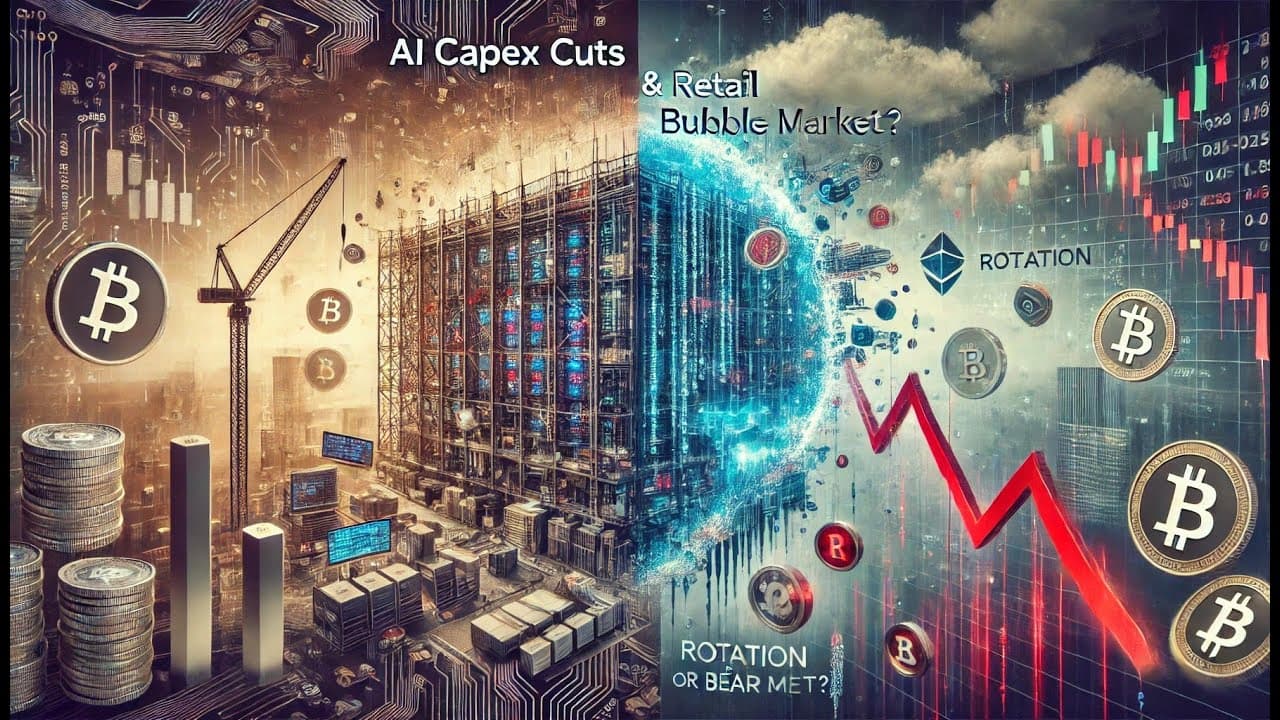
The retail speculation bubble has popped in quantum, Bitcoin miner, and nuclear names, but the broader backdrop stays intact: junk spreads sit at all-time tights, earnings are rising, and JP Morgan is making all-time highs. The 2026 thesis is capex losers and multiple compression for high-multiple AI winners, with pharma emerging as the year's defining AI story.
Transcript
another week. Um, all right. For everyone who complained about my banging on the desk last week, we'll try to do a better job with the mic and not have that go on. Uh, for those who reached out on 22V, I know there's been a large crowd. Uh, some of the emails have not been responded to. The goal is by the beginning of January to have a a place on t... Read More
Key Insights
- The retail speculation bubble has popped, with hope trades that carried no revenues, quantum names, Bitcoin miners, and nuclear plays, blowing up and resetting after being unable to keep rising on future promise alone.
- CoreWeave cut its capex guidance from $20 billion down to $12-14 billion, not because demand fell but because supply constraints intensified; management still called demand 'insatiable' yet the stock dropped 16%.
- The 2026 investment thesis is capex losers from supply bottlenecks and multiple compression for AI winners trading at 40-60x earnings, where delivery delays create repricing risk even as demand remains exponential.
- Credit conditions show no economic stress, as junk spreads sit at all-time tights while earnings tick up, a strength expected to spread into the Russell 2000 and support a double-digit S&P year.
- Bank stocks signal there is no systemic problem, with JP Morgan making all-time highs and financials positioned as a major AI beneficiary through M&A, IPOs, and improved profit margins.
- Pharma is set to become the defining AI story of 2026, driven by Eli Lilly's expanded partnership with Insilico and Google DeepMind's Isomorphic Labs approaching clinical trials.
- Market fatigue has set in across stocks, crypto, and retail, and the widespread giving up of hope, after even the bulls turned negative, often precedes a year-end rally.
- Stimulus is layered across timeframes: the one big beautiful bill hits near-term in Q1, capex provides longer-term support, and a two-year money-supply lag should feed through in early 2026.
Install to Summarize YouTube Videos and Get Transcripts
Explore YouTube Video Summarizer or Get YouTube Transcript Extractor
Questions & Answers
Q: Why did CoreWeave stock drop despite strong demand?
CoreWeave cut its capex guidance from $20 billion down to $12-14 billion, and the stock dropped 16% even though management described demand as 'insatiable.' The guidance cut was not caused by falling demand but by intensifying supply constraints. This illustrates the core 2026 risk: when delivery delays and supply bottlenecks hit, high-multiple AI names can face repricing even while underlying demand remains exponential.
Q: What caused the retail bubble to pop?
The bubble was concentrated in speculative names with no revenues, quantum names, Bitcoin miners, nuclear, and energy plays, that were hope trades further out than humanoids and easily disrupted. They could not keep rising purely on future expectations, so the air came out and they blew up. Retail traders buying call options had been driving velocity, and their losses on these spec names spread into other markets.
Q: What is the 2026 investment thesis outlined in the video?
The thesis is that 2026 will be about capex losers and multiple compression for AI winners, so investors should be careful in those names. Companies hit by supply bottlenecks become capex losers, while AI winners trading at 40-60x earnings face multiple compression risk. Beyond that, 2026 is framed as the year of humanoids, robo taxis, pharma, and the year AI doubts end permanently.
Q: Why is pharma expected to be a major story in 2026?
The video argues 2026 will officially become the pharma year as AI enters drug discovery. Cited developments include Eli Lilly's expanded partnership with Insilico and Google DeepMind's Isomorphic Labs approaching clinical trials, with the prospect of compressing drug discovery from ten years to months. Demis Hassabis is quoted on 'the end of all disease within the next decade,' while a name like Merck trades at just 11x earnings.
Q: How can the market not be bearish if retail has blown up?
The speaker points to signs of underlying strength: junk spreads remain at all-time tights, signaling nothing bad is happening in the economy, and earnings are ticking up. Bank stocks like JP Morgan are making all-time highs, and banks are typically where problems show up first. Financials are also positioned to benefit from M&A, IPOs, and AI-driven profit margins, supporting a potential double-digit S&P year.
Q: What does 'fatigue makes cowards out of all of us' mean for the market?
The quote, attributed to Patton and Lombardi, frames the idea that after a year with no obvious trade, everyone, bulls and bears alike, has grown exhausted and given up hope. The speaker views this capitulation across stocks, crypto, and retail as contrarian bullish: because everyone is giving up hope, the market probably rallies into the end of the year, as giving up hope often precedes a rally.
Q: When is the stimulus expected to impact the economy?
The video describes layered stimulus across timeframes, drawing on Francois Trahan's work. The near-term stimulus from the one big beautiful bill is expected to hit in the first quarter. The capex side represents longer-term stimulus still flowing through. The intermediate-term driver is a two-year lag on money supply rising with the Fed funds rate, which should have an impact in early next year.
Q: What happened to Oracle and Palantir during the unwind?
Oracle marked the peak of the retail-driven move: on the day the speaker attended a Robin Hood event, Oracle had a 30% up move, but it has since given back the entire gain and fallen further, with a big wave down in mid-October. Palantir was described as the clincher, posting massive numbers and trading higher right after the announcement before selling off, and it has since sold off again.
Summary & Key Takeaways
-
Fatigue has set in across every asset class, stocks, crypto, and retail, as traders and hedge funds give up after a year with no obvious trade. The retail bubble in speculative, revenue-less names has popped, resetting quantum, Bitcoin miner, and nuclear plays and driving a broad market rotation into 2026.
-
Despite AI bubble fears, the fundamentals hold: junk spreads sit at all-time tights, earnings are rising, and JP Morgan makes all-time highs. The S&P has held above its 50-day since liberation day lows. CoreWeave's capex cut from $20B to $12-14B on supply limits, not weak demand, crystallizes the capex-loser thesis.
-
The 2026 view favors caution on AI winners at 40-60x earnings facing multiple compression, while pharma becomes the year's big AI story via Eli Lilly-Insilico and DeepMind's Isomorphic Labs. Stimulus from the one big beautiful bill, rate cuts, and money-supply lags is expected to hit in early 2026.
Read in Other Languages (beta)
Share This Summary 📚
Summarize YouTube Videos and Get Video Transcripts with 1-Click
Try YouTube Summary with ChatGPT & Claude or YouTube Transcript Generator
Explore More Summaries from Jordi Visser 📚


Summarize YouTube Videos and Get Video Transcripts with 1-Click
Try YouTube Summary with ChatGPT & Claude or YouTube Transcript Generator