How Does React Native Really Work in Big Apps?
TL;DR
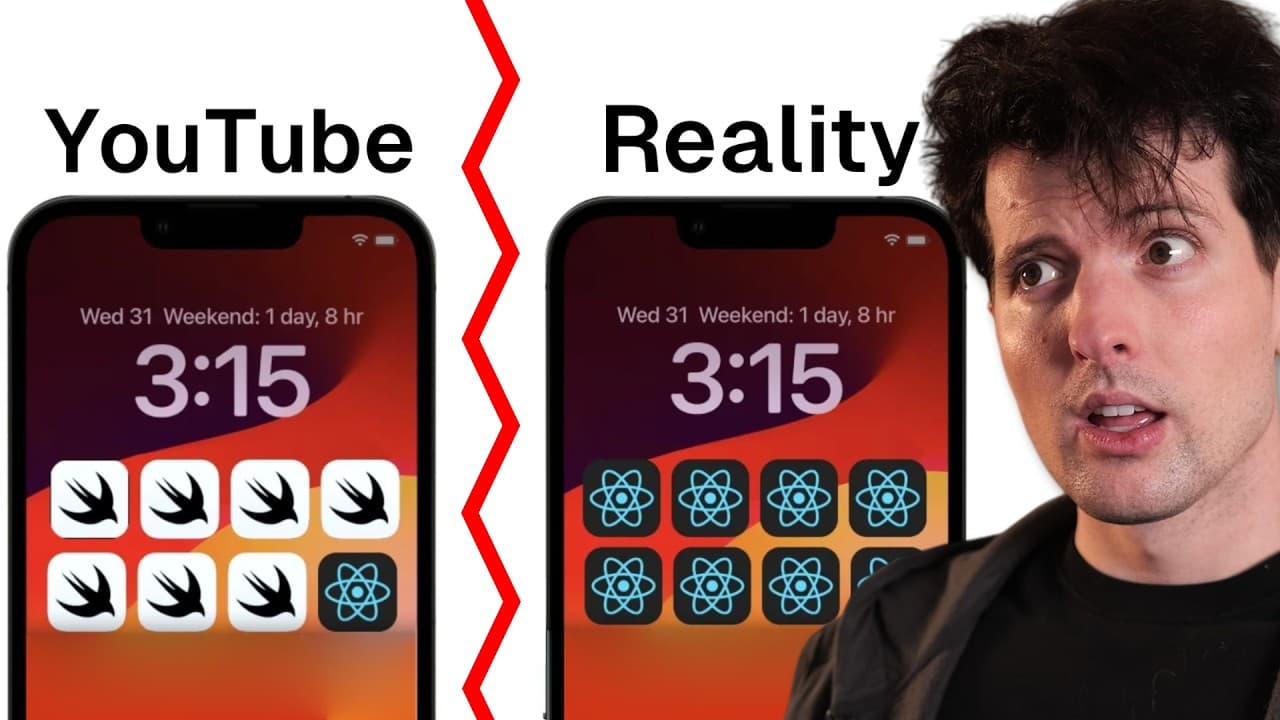
React Native is used to integrate into native apps, not necessarily the whole app. Big companies mix RN with native code to speed updates for specific features and teams. The Walmart and Facebook examples show nuanced usage, where RN powers certain modules rather than entire applications.
Transcript
I am regularly surprised with just how popular React Native has gotten. Why am I talking about this right now, though? Well, when I was out on my trip to React Miami, a video came out, a very interesting video about how React Native isn't as popular as you might think. This is created by Tastemaker Design. It's his third ever video. And considering... Read More
Key Insights
- RN is an integration tool rather than a full replacement for native apps, allowing teams to add or update UI without rebuilding the entire app.
- The screen shows that large firms employ vertical slicing, where small, cross functional teams own backend and frontend and can integrate RN where beneficial.
- Marketplace in the Facebook app is a major RN built component, illustrating selective RN adoption within a large app.
- Some companies list RN usage publicly for tools or internal apps, even if their main consumer app does not use RN wholesale.
- Doc references about RN usage can be misleading when they imply whole app adoption, leading to misunderstandings.
- Walmart example is debated, with RN used in internal tools rather than the main consumer app, highlighting nuance in usage claims.
- The speaker argues that claims about RN popularity should consider the depth of integration and context rather than headline numbers.
- Understanding RN requires recognizing that apps can be partially RN without fully replacing native code across the product.
Install to Summarize YouTube Videos and Get Transcripts
Explore YouTube Video Summarizer or Get YouTube Transcript Extractor
Questions & Answers
Q: What is the core misunderstanding about React Native usage in large apps?
The core misunderstanding is that people assume a company either uses React Native for the entire app or not at all. In reality, many large apps use React Native only for specific features or internal tools, integrated into existing native frameworks. This layered usage allows faster updates and team autonomy without rewriting entire codebases, which many sources fail to capture accurately.
Q: Why do some teams use React Native instead of rewriting whole apps?
Teams choose React Native to enable faster iteration for particular features or departments while preserving the stability of the native codebase. This reduces the need for a full native rebuild and supports vertical slicing where different teams own different parts of the product, allowing updates and experimentation with less risk.
Q: What does the video say about the Walmart example?
The video notes that Walmart’s consumer app may not be fully React Native, but the company is hiring RN engineers to work on internal tools and other on the floor applications. This shows that RN usage can be present in parts of a company’s software ecosystem without dominating the main consumer app, illustrating nuanced adoption.
Q: How does the Facebook app illustrate selective use of React Native?
Facebook uses React Native in certain sections like marketplace, while other areas remain native. This demonstrates that a large app can integrate RN to accelerate development in specific modules rather than converting the whole app to RN, which aligns with the idea of targeted adoption over full rewrite.
Q: What are the potential pitfalls of relying on doc lists for React Native usage?
Doc lists can be misleading if they imply full app adoption by a company. They may reference teams or projects within a company that use RN while ignoring other parts that remain native. This can create a false impression of universal adoption and misrepresent the true scope of RN in a given ecosystem.
Q: How does vertical slicing relate to React Native usage?
Vertical slicing allows a company to empower a small, specialized team to own a feature or module across platforms, using RN where it makes sense. This strategy reduces cross team dependencies and speeds updates, while maintaining the broader native architecture for the rest of the app.
Q: What is a key takeaway about React Native popularity from the video?
A key takeaway is that popularity claims should be tempered by understanding practical usage, where RN is often a tool for specific contexts rather than a universal solution. The depth and manner of integration matter more than headline counts, with many firms using RN selectively for efficiency and speed.
Q: Why is it important to verify claims about RN usage with real data?
Verifying claims with real data matters because anecdotes can mislead about how widely RN is adopted. Real data helps reveal where RN is genuinely used, such as internal tools, ad hoc modules, or customer facing features, and clarifies the scope of adoption across large organizations with complex app ecosystems.
Summary & Key Takeaways
-
React Native is used as an integration layer rather than a complete rewrite for most apps, enabling fast updates for specific teams and features.
-
The video argues that large companies use RN in a layered way, often mixing native and RN components within the same ecosystem.
-
Misconceptions about whole app usage are addressed, with examples indicating nuances in how different firms implement RN in practice.
Read in Other Languages (beta)
Share This Summary 📚
Summarize YouTube Videos and Get Video Transcripts with 1-Click
Try YouTube Summary with ChatGPT & Claude or YouTube Transcript Generator
Explore More Summaries from Theo - t3․gg 📚






Summarize YouTube Videos and Get Video Transcripts with 1-Click
Try YouTube Summary with ChatGPT & Claude or YouTube Transcript Generator