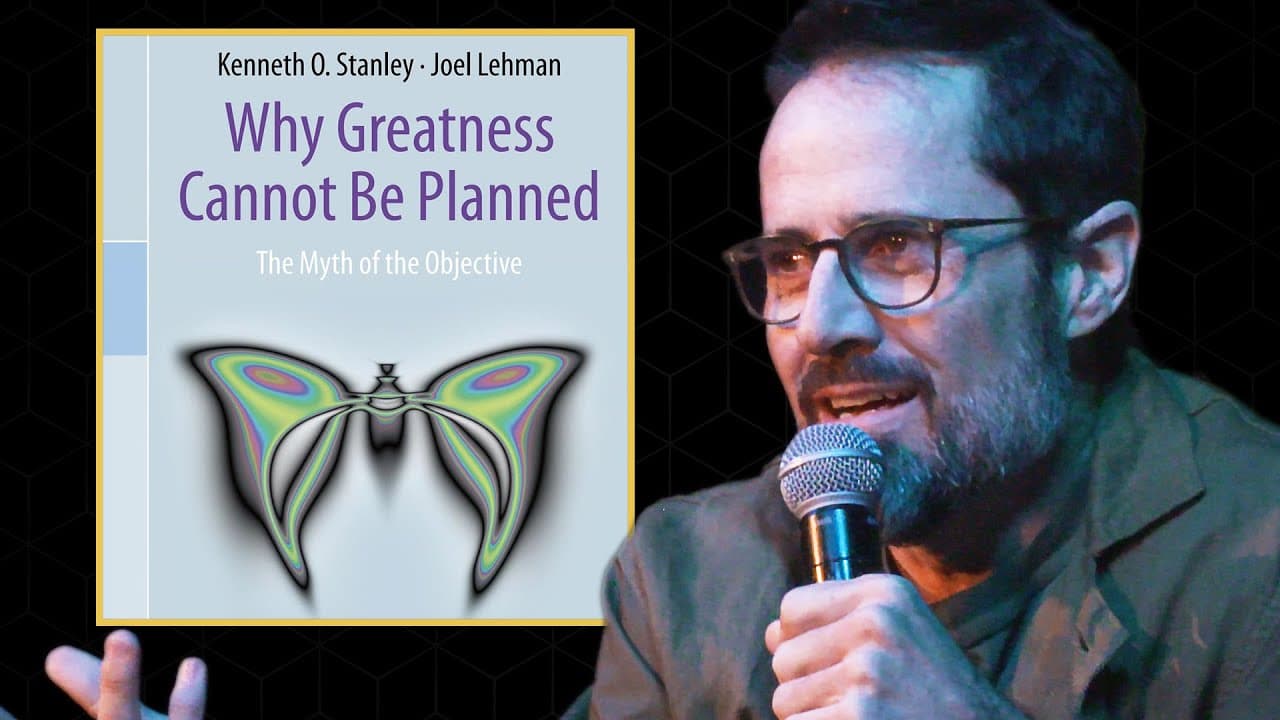
Why Greatness Cannot Be Planned
TL;DR
Greatness cannot be planned when the goal is unprecedented because rigid road maps cut off possibilities that emerge through exploration. “Why Greatness Cannot Be Planned,” recommended by the speaker to 100 people, argues that formulas can help with familiar goals such as running a marathon, but innovation and art require trial, error, adaptability, and comfort with ambiguity. Read on to see how this principle applies to AI research, nature, product development, and Medium.
Transcript
I've always found you to be a very deep thinker you think a lot and you choose your words carefully and ask a lot of good questions and I'm always curious about the inputs what you feed yourself in terms of information and I've read that you're fond of a few books this may have changed because this is from 2016 but Zen in the-art of Motorcycle Main... Read More
Key Insights
- 🇮🇴 Embracing uncertainty is crucial for true creativity, especially in uncharted territories like innovation.
- 🥅 The conventional approach to goal-setting can inhibit the flexibility necessary for breakthrough ideas.
- 🤗 Literature can significantly shape one’s understanding of creative processes and open fertile grounds for innovation.
- ❓ Nature's evolutionary processes demonstrate the effectiveness of trial and error, influencing creative practices.
- 🧑🏭 The act of developing a product or idea mirrors artistic creation, requiring a willingness to adapt and iterate.
- 💪 A strong focus on metrics and outcomes in business can detract from the organic growth process necessary for innovation.
- 🔇 The speaker’s personal experiences reflect how adapting to ongoing feedback and insights is essential in entrepreneurship.
Install to Summarize YouTube Videos and Get Transcripts
Explore YouTube Video Summarizer or Get YouTube Transcript Extractor
Questions & Answers
Q: What is the main idea of “Why Greatness Cannot Be Planned”?
The book argues that objectives and detailed plans work best for familiar, formulaic achievements, not for creating something unprecedented. When the path is unknown, trying something new and adapting can be more effective than rigidly pursuing a predetermined outcome.
Q: Why can planning obstruct innovation?
A fixed plan narrows attention to a chosen route and can cut off possibilities that appear during the creative process. The speaker says planning may help a little with reaching the next stage, but it does not work well for genuine innovation.
Q: When does goal-setting work well, according to the discussion?
Goal-setting works when an achievement has been completed many times and a reliable formula already exists. The speaker gives running a marathon as an example because a person can set that goal, download a training regimen, and follow it.
Q: Why can’t unprecedented achievements be approached like running a marathon?
A marathon has an established destination and repeatable training methods, while inventions and creative breakthroughs do not have known paths. The speaker says achievements such as inventing the computer or Twitter and creating amazing art cannot simply be plotted in advance.
Q: What did the maze-robot experiment teach the book’s authors?
The AI researchers tried programming smart algorithms to make a robot move through a maze. They found that the most effective strategy was simply to try something new, which became the starting point for the book’s broader argument.
Q: How did the book affect the speaker while running Medium?
The speaker read the book while running Medium and felt a deep sense of relief. It validated the view that building companies and products is a creative process in which the creator must discover the result along the way.
Q: How does exploratory product development work?
A creator begins with an intuition, develops it, and repeatedly decides to try one direction instead of another. Through that process, the creator feels their way toward the best first version rather than starting with a fully formed product.
Q: How does evolution support the book’s argument?
The book discusses evolution as an example of creativity without a predetermined plan. The speaker describes nature as the clearest creative force in the world and says it proceeds through trial and error.
Summary & Key Takeaways
-
The discussion highlights how certain books influence deep thinking and creativity, specifically focusing on "Why Greatness Cannot Be Planned," which emphasizes that innovative endeavors require flexibility rather than rigid planning.
-
The speaker reflects on their reading journey and how their perspective towards goal-oriented processes has evolved, particularly emphasizing the need for adaptability in creativity and innovation.
-
"Zen and the Art of Motorcycle Maintenance" and "The Effective Executive" were previously noted favorites, but the speaker now advocates for embracing uncertainty in creative projects through new literature.
Read in Other Languages (beta)
Share This Summary 📚
Summarize YouTube Videos and Get Video Transcripts with 1-Click
Try YouTube Summary with ChatGPT & Claude or YouTube Transcript Generator
Explore More Summaries from Tim Ferriss 📚


Summarize YouTube Videos and Get Video Transcripts with 1-Click
Try YouTube Summary with ChatGPT & Claude or YouTube Transcript Generator