Donald Knuth: Ant Colonies and Human Cognition | AI Podcast Clips
TL;DR
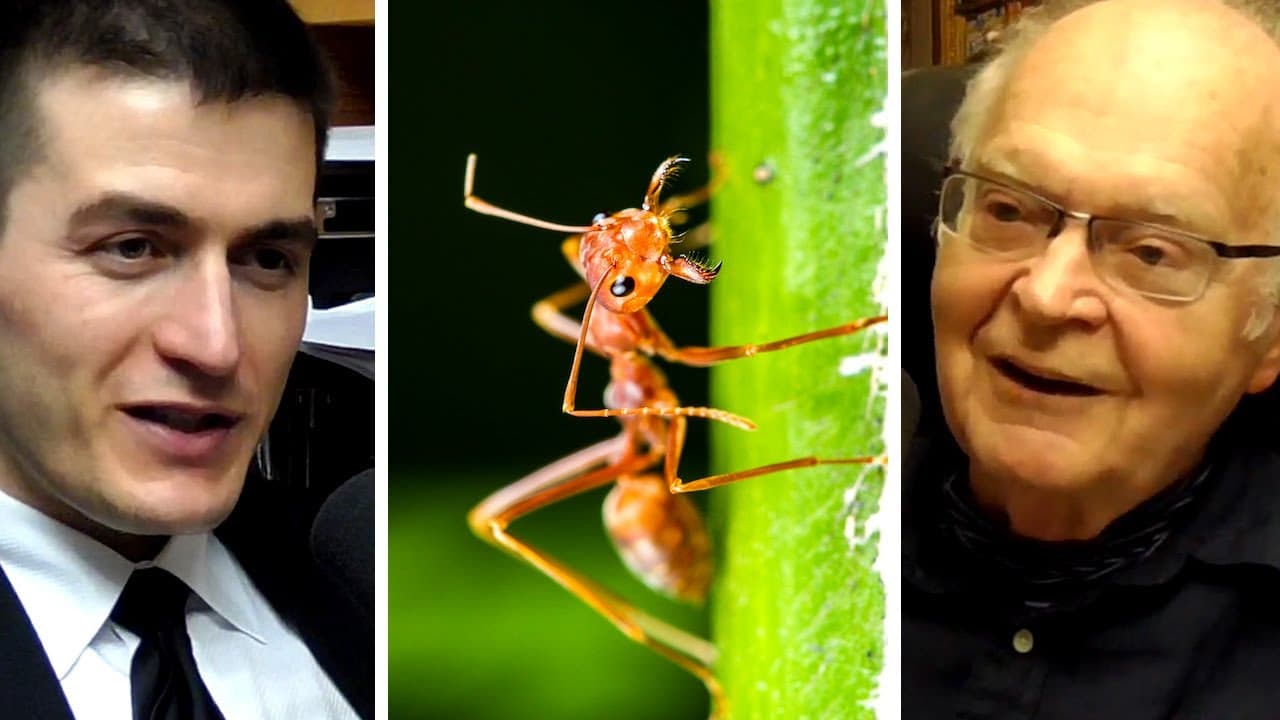
Exploring the similarities between ant colonies and human cognition, and how ants' distributed systems can provide insights into complex tasks.
Transcript
you did mention that that you thought that an understanding of the way ant colonies are able to perform incredibly organized tasks might well be the key to understanding human cognition so these fundamentally distributed systems so what do you think is the difference between the way Don Knuth would sort a list and an ant colony would sort a list or... Read More
Key Insights
- 🐜 Ant colonies may hold the key to understanding human cognition, as they are fundamentally distributed systems with observable communication between individual ants through pheromones and physical touch.
- 🤔 Understanding how ant colonies sort a list could provide insights into cognition, as it allows for better measurement and observation compared to the complex signals and interactions within the human brain.
- 🎮 Conway's Game of Life is a powerful tool for simulating computable and deterministic processes, with its distributed and simple units offering insights into the nature of determinism and free choice.
- 🔬 Studying ant colonies and Conway's Game of Life can help deepen our understanding of distributed systems, the role of simplicity in complex processes, and the potential efficiency of randomness in algorithms.
- 🧠 Ant colonies and the individual cells in our brains can be seen as interacting entities, hinting at a cognitive single being rather than just a colony of ants or a collection of neurons.
- ⚙️ Ant colonies and distributed systems demonstrate the ability to perform highly organized tasks without a central control, showcasing the power of distributed decision-making and coordination.
- 📈 Observing and studying ant colonies could lead to advancements in fields such as swarm intelligence, optimization algorithms, and distributed computing systems.
- 🎲 The concept of randomness, as seen in the Game of Life and potentially used by a higher power, like God, can be essential for achieving efficiency and certain processes that couldn't be done well without it.
Install to Summarize YouTube Videos and Get Transcripts
Explore YouTube Video Summarizer or Get YouTube Transcript Extractor
Questions & Answers
Q: What is the difference between the way Don Knuth would sort a list and an ant colony would sort a list?
The main difference lies in the visibility of the sorting process. While Don Knuth's sorting algorithm may be efficient, it is difficult to track the passing of signals between neurons in the brain. With ants, their communication through pheromones and touch allows us to observe and measure the sorting process.
Q: How does the distributed nature of ant colonies contribute to their cognitive abilities?
Ant colonies can be seen as a cognitive single being rather than a collection of individual ants. The distributed nature allows for efficient communication and coordination, which aids in performing complex tasks. This provides insights into how distributed systems, such as the human brain, can achieve cognitive abilities.
Q: Can Conway's Game of Life enhance our understanding of determinism and free choice?
Yes, Conway's Game of Life is a powerful simulation that can represent any computable or deterministic process. The simplicity and distributed nature of the individual units in the game offer insights into deterministic universes and the concept of free choice.
Q: What role does randomness play in understanding complex algorithms and processes?
Randomness, such as the concept of dice rolling, can be crucial in achieving efficiency in certain algorithms and processes. It allows for solutions that may not be possible with deterministic approaches. Therefore, randomness is not necessarily prohibited in the realm of understanding complex systems.
Summary & Key Takeaways
-
Ant colonies' ability to perform organized tasks may hold the key to understanding human cognition and distributed systems.
-
Ant colonies' communication through pheromones and physical touch provides a measurable advantage over understanding the complex signals in the human brain.
-
Conway's Game of Life, a simulation of distributed systems, offers insights into the understanding of determinism and free choice.
Read in Other Languages (beta)
Share This Summary 📚
Summarize YouTube Videos and Get Video Transcripts with 1-Click
Try YouTube Summary with ChatGPT & Claude or YouTube Transcript Generator
Explore More Summaries from Lex Fridman 📚



Summarize YouTube Videos and Get Video Transcripts with 1-Click
Try YouTube Summary with ChatGPT & Claude or YouTube Transcript Generator