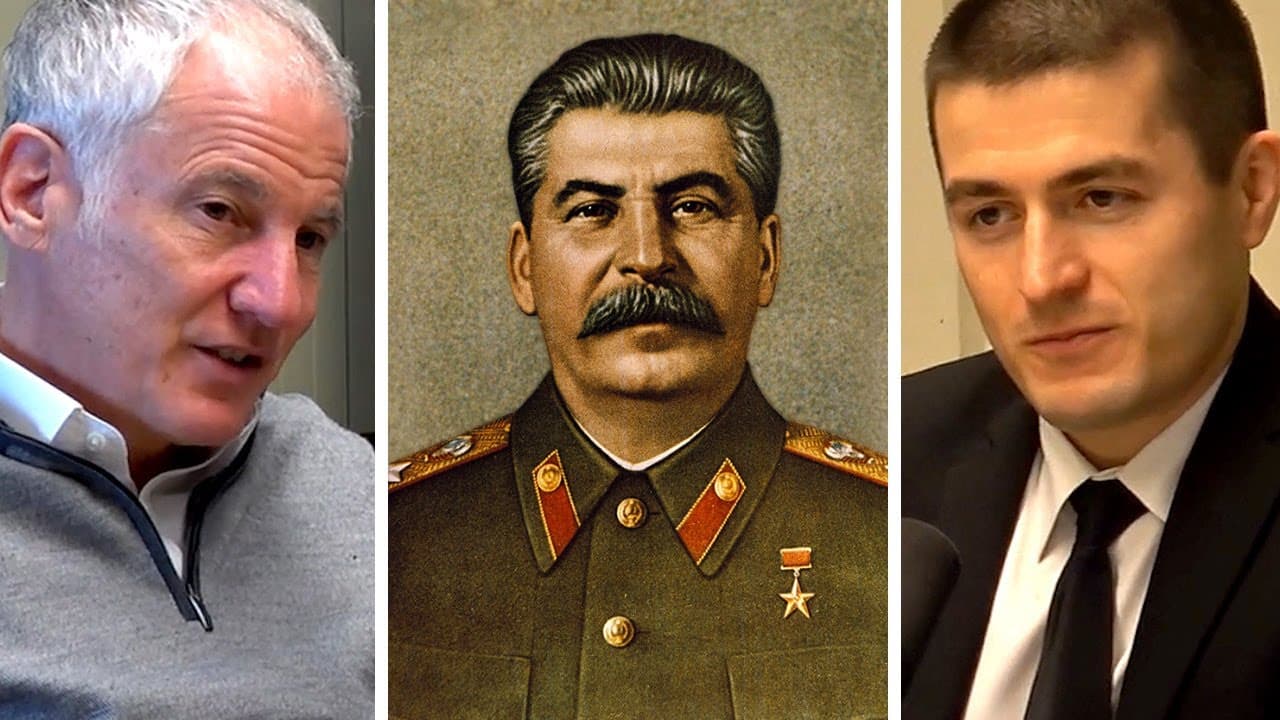
Stephen Kotkin: Stalin's Rise to Power | AI Podcast Clips
TL;DR
Stalin came to power through a series of contingent events and the institutionalization of a position created by Lenin, but ultimately used his position to build a personal dictatorship.
Transcript
first of all you've described a fascinating thought which is Stalin as having amassed arguably more power than any man in history she's an interesting thing to think about but can you tell about his journey to getting that power after the Russian Revolution how does that perhaps echo to the our current discussion about institutions and so on and ju... Read More
Key Insights
- 🌟 Stalin's rise to power was a result of historical circumstances rather than solely his own individual drive, such as the fall of the Czarist regime and the radicalizing effects of World War I.
- 🗝️ Lenin's seizure of power in the October Revolution was a coup against other socialist factions, not the Provisional Government. Stalin came to power through this seizure of power.
- 💡 Stalin's position as General Secretary of the Communist Party was created by Lenin to help manage the new regime. However, Lenin's ill health and stroke meant that Stalin took on a greater role in dictating policy and decisions.
- 😬 Despite his effective organizational skills and dedication to communism, Stalin's rise to power was not without manipulation, violence, and ruthless tactics. He was driven by his thirst for power and personal ambition.
- 💪 Communism played a significant role in Stalin's rise to power, as his dedication to communist ideals and Russian state interests resonated with many followers. However, he also resorted to manipulation, violence, and deceit to achieve his personal dictatorship.
- 🔄 History is full of contingency, and Stalin's rise to power was not inevitable. Factors such as Lenin's stroke and the context of the time period influenced his ascent.
- 🌎 The interwar period, marked by the Great Depression and disillusionment with capitalism, contributed to the appeal of communism. However, the post-World War II context and the success of capitalism highlighted the flaws of Stalin's regime.
- 🔀 Capitalism's transformation and success after World War II changed the perception of communism, undermining its appeal. The rise of middle-class economic booms and decolonization further eroded support for Stalin's regime.
Install to Summarize YouTube Videos and Get Transcripts
Explore YouTube Video Summarizer or Get YouTube Transcript Extractor
Questions & Answers
Q: Was Stalin's rise to power purely a result of his own abilities and ambitions, or were there other factors at play?
Stalin's rise to power was influenced by a combination of his own organizational skills and dedication to communism, as well as the circumstances of the Russian Revolution and the institutionalization of the General Secretary position created by Lenin.
Q: How did Stalin use his position to build a personal dictatorship within the Bolshevik dictatorship?
Stalin manipulated, used violence, and employed underhanded methods to eliminate potential rivals and consolidate his power. He justified his actions by appealing to communism and the importance of Russian glory, ultimately identifying his personal power with these ideals.
Q: How did the context of the interwar period and the Great Depression contribute to the appeal of communism and Stalin's rule?
During the interwar period, capitalism faced challenges such as mass unemployment, imperialism, and the disappointment of the capitalist system. In this context, communism offered a potential alternative and Stalin's rule seemed like a better option to some compared to fascism and economic hardships.
Q: What factors changed after World War II that weakened the appeal of communism and challenged Stalin's rule?
After World War II, capitalism underwent a transformation, with post-war economic booms and decolonization leading to a rise in middle-class prosperity. Capitalism became more successful and appealing, making Stalin's communist regime less attractive. The context shifted, and the flaws and violence of communism became more apparent.
Summary
This video discusses Stalin's journey to acquiring immense power after the Russian Revolution and how it reflects on discussions about institutions. It explores the role of contingency and Lenin's stroke in Stalin's rise to power, as well as his dedication to communism and the Russian state. It also discusses the appeal of communism during the interwar period and how it changed after World War II.
Questions & Answers
Q: How did Stalin acquire more power than any other man in history?
Stalin's rise to power was a result of various factors. He was a product of circumstances, including the downfall of the Czarist regime and the radicalizing effects of World War I. After the October Revolution, Lenin's group, the Bolsheviks, seized power from the rest of the left, leading to a personal dictatorship. Stalin played a role in this seizure of power and Lenin appointed him as General Secretary of the Communist Party.
Q: Was there anything nefarious about Stalin's rise to power?
While history is full of contingency and surprises, Stalin's rise to power was not inherently manipulative or plotted. Lenin chose Stalin because of his effective organizational skills and his dedication to enacting communism and building a powerful state. Stalin's thirst for power was accompanied by a genuine belief in communism and the improvement of the Russian state. However, he also resorted to manipulation and violence to eliminate potential rivals and consolidate his personal dictatorship.
Q: How did Stalin justify his actions and maintain support from others?
Stalin justified his actions by appealing to communism and the concept of Soviet power. He associated his personal power with communism and Russian glory, presenting himself as the only reliable figure who could accomplish these goals. While many people shared his ideals, it is important to acknowledge that not everyone around Stalin was a true believer. Nonetheless, communism had some appeal during the interwar period, especially considering the negative associations with capitalism at the time.
Q: Did Stalin truly believe in communism and the improvement of society?
Yes, Stalin was a true believer in communism and was driven by ideals. He genuinely aimed to enact communism in reality and build a powerful state. His dedication to both communism and the Russian state attracted followers who admired his commitment to these goals. However, it is crucial to note that Stalin also used manipulation, violence, and any means necessary to achieve his ends.
Q: How did the context of the time period influence perceptions of Stalin and communism?
During the interwar period, communism held some appeal due to the problems associated with capitalism, such as mass unemployment, fascism, and imperialism. However, after World War II, capitalism underwent significant changes, including a middle-class economic boom, which created a more positive perception of capitalism. As a result, communism lost its appeal and the Soviet Union had difficulty competing with the new context of capitalism's success.
Q: Was Stalin more competent than other individuals in power at the time?
Stalin was exceptionally competent in running the Soviet state. He had organizational skills, was diligent, and showed great memory, which proved advantageous in building a bureaucratic machine. His ability to hold onto power in difficult circumstances and establish a personal dictatorship demonstrated his competence. It is worth noting that competence alone does not explain long-term success in power; it requires skill in managing and holding onto that power, which Stalin possessed.
Q: How did the perception of capitalism change after World War II?
After the defeat of Nazism and imperialism, decolonization, and the middle-class economic boom in the period between the late 1940s and the 1970s, capitalism experienced a positive shift in perception. The rise of a mass middle class and the relative stability and success of capitalist societies altered the context in which communism was perceived. Capitalism became more successful and less violent compared to the interwar period, diminishing the appeal of communism.
Q: Did Stalin's personal dictatorship contribute to the success of the Soviet Union?
While Stalin's personal dictatorship allowed him to consolidate power and build the Soviet state, it did not necessarily contribute to the overall success of the Soviet Union. Stalin's regime was marked by violence, manipulation, and autocratic practices. It ultimately limited the potential of the Soviet Union and hindered its capability to compete with the changing context of capitalism after World War II.
Q: How did Stalin's rise to power differ from Putin's?
It is important to note that Stalin and Putin are very different individuals operating in different historical contexts. While both came to power through different means, Putin has proven adept at maintaining power, partly due to unforeseen qualities. Stalin's rise to power was a result of a seizure of power by the Bolsheviks against the rest of the left, while Putin's rise to power was through more conventional means within the framework of the Russian political system.
Q: Did everyone around Stalin share his communist ideals?
Not everyone around Stalin shared his communist ideals. It is crucial to avoid generalizing and assuming that everyone in the Soviet regime held the same beliefs. Different groups had different motivations, but there were widespread attractions to both Stalin's dedication to communism and his commitment to Russian state interests. However, some individuals may have been drawn to his organizational skills and promises of a better future.
Takeaways
Stalin's rise to power was a combination of contingency and personal ambition. While his rise was not manipulative in nature, he possessed a genuine belief in communism and the improvement of the Russian state. However, he also resorted to manipulation, violence, and any means necessary to achieve his personal power. The appeal of communism was based on the context of the interwar period, when capitalism faced challenges. The changing context after World War II diminished the appeal of communism, and the success of capitalism brought about a different perception. Ultimately, Stalin's personal dictatorship did not contribute to the long-term success of the Soviet Union.
Summary & Key Takeaways
-
Stalin's rise to power was a result of the Russian Revolution and the seizure of power by the left against the rest of the left in 1917.
-
Lenin created the position of General Secretary of the Communist Party and appointed Stalin, who proved to be an effective organizer and executor of tasks.
-
After Lenin's stroke, Stalin used his position to build a personal dictatorship within the Bolshevik dictatorship, eventually becoming the undisputed leader.
Questions:
-
Was Stalin's rise to power purely a result of his own abilities and ambitions, or were there other factors at play?
-
How did the seizure of power by the left against the rest of the left in the Russian Revolution contribute to Stalin's rise?
-
Why did Lenin choose Stalin for the position of General Secretary of the Communist Party?
-
How did Stalin use his position to build a personal dictatorship within the Bolshevik dictatorship?
-
Was there any opposition or resistance to Stalin's rise to power from within the Communist Party or the Soviet Union?
-
How did Stalin's beliefs in communism and Russian state interests influence his actions and policies?
-
How did the context of the interwar period and the Great Depression contribute to the appeal of communism and Stalin's rule?
-
What factors changed after World War II that weakened the appeal of communism and challenged Stalin's rule?
Answer:
Q: Was Stalin's rise to power purely a result of his own abilities and ambitions, or were there other factors at play?
Stalin's rise to power was influenced by a combination of his own organizational skills and dedication to communism, as well as the circumstances of the Russian Revolution and the institutionalization of the General Secretary position created by Lenin.
Read in Other Languages (beta)
Share This Summary 📚
Summarize YouTube Videos and Get Video Transcripts with 1-Click
Try YouTube Summary with ChatGPT & Claude or YouTube Transcript Generator
Explore More Summaries from Lex Fridman 📚

Summarize YouTube Videos and Get Video Transcripts with 1-Click
Try YouTube Summary with ChatGPT & Claude or YouTube Transcript Generator