What Caused the 2008 Financial Crisis and Its Impact?
TL;DR
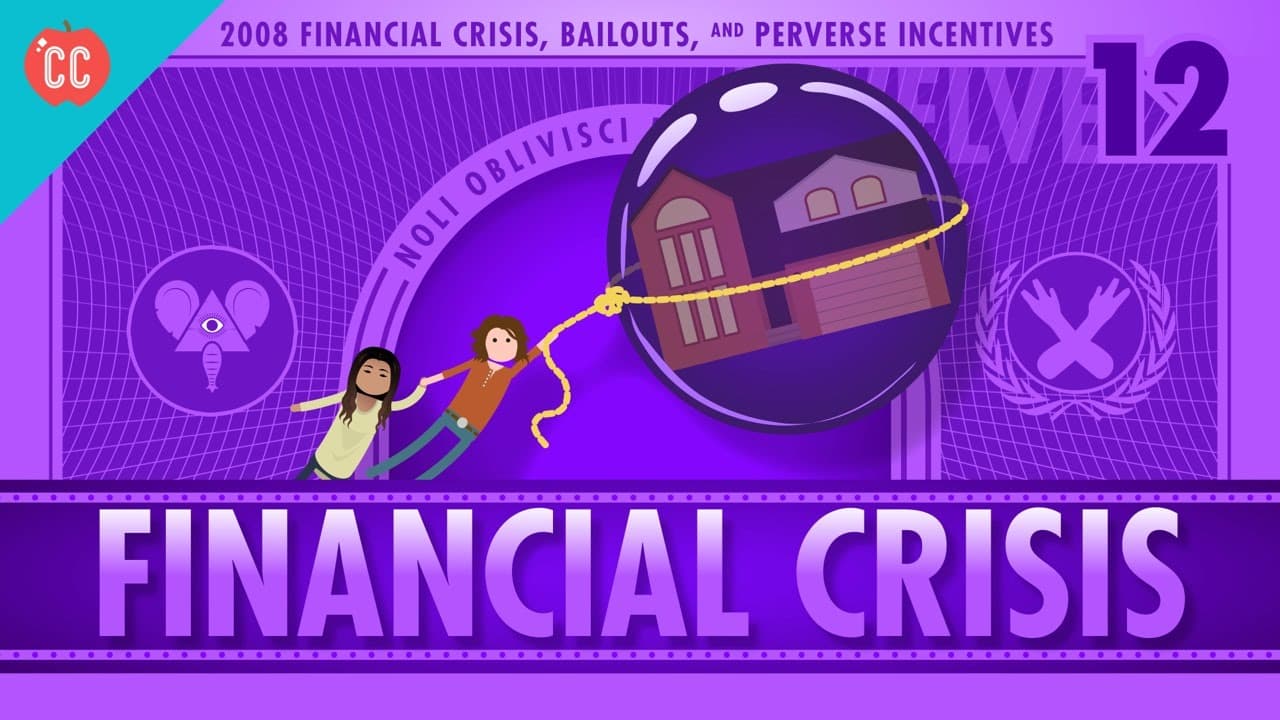
The 2008 financial crisis was primarily caused by risky mortgage practices, including sub-prime lending and the creation of mortgage-backed securities. As the housing bubble burst, defaults surged, leading to a systemic meltdown that required government intervention through bailouts and regulatory reforms, such as the Dodd-Frank Act, to stabilize the economy.
Transcript
Jacob: Welcome to Crash Course Economics. My name is Jacob Clifford. Adrienne: And I'm Adrienne Hill. And today we're going to do something a little different. We're going to explore one moment in history in depth. We're going to talk about how the 2008 Financial Crisis happened and the government response to it in the United States. Jacob: So let'... Read More
Key Insights
- The 2008 financial crisis was a significant global event, with potential for catastrophic economic consequences, but was ultimately mitigated by government intervention.
- The crisis was largely driven by the housing market, where mortgages were used as investment instruments, leading to a bubble that eventually burst.
- Investors were attracted to mortgage-backed securities for their perceived safety and high returns, despite underlying risks due to sub-prime mortgages.
- Credit rating agencies played a crucial role by giving high ratings to risky mortgage-backed securities, misleading investors about their safety.
- The burst of the housing bubble led to widespread mortgage defaults, causing a chain reaction that affected major financial institutions and investors.
- Unregulated financial instruments like credit default swaps exacerbated the crisis by creating a complex web of liabilities and risks.
- The U.S. government responded with emergency loans, the TARP bailout, and a stimulus package to stabilize the financial system and economy.
- The Dodd-Frank Act was introduced to increase transparency and reduce risk, but its effectiveness in preventing future crises is debated.
Install to Summarize YouTube Videos and Get Transcripts
Explore YouTube Video Summarizer or Get YouTube Transcript Extractor
Questions & Answers
Q: What caused the 2008 financial crisis?
The 2008 financial crisis was primarily caused by the bursting of the housing bubble, driven by risky mortgage practices and the widespread use of mortgage-backed securities. Lenders issued sub-prime mortgages to borrowers with poor credit, leading to defaults and a collapse in housing prices. This, in turn, affected financial institutions and investors globally.
Q: How did mortgage-backed securities contribute to the crisis?
Mortgage-backed securities contributed to the crisis by creating a false sense of security among investors. These securities were bundles of thousands of individual mortgages, sold to investors as safe, high-return investments. However, many included risky sub-prime mortgages, and when borrowers defaulted, the securities lost value, leading to massive financial losses.
Q: What role did credit rating agencies play in the crisis?
Credit rating agencies played a significant role in the crisis by giving high ratings to mortgage-backed securities, despite their underlying risks. These ratings misled investors into believing the securities were safe investments, contributing to the widespread purchase of these risky financial products and exacerbating the eventual financial collapse.
Q: How did the U.S. government respond to the crisis?
The U.S. government responded to the crisis with several measures, including emergency loans from the Federal Reserve to banks, the Troubled Asset Relief Program (TARP) to bail out financial institutions, and a stimulus package to boost the economy. These actions aimed to stabilize the financial system, restore confidence, and prevent a deeper economic downturn.
Q: What is the Dodd-Frank Act, and what did it aim to achieve?
The Dodd-Frank Act, passed in 2010, was a financial reform law aimed at increasing transparency and reducing risk in the financial sector. It established the Consumer Financial Protection Bureau, required financial derivatives to be traded on exchanges, and introduced mechanisms for large banks to fail in a controlled manner, all to prevent future financial crises.
Q: What is a moral hazard, and how did it relate to the crisis?
Moral hazard refers to a situation where one party takes on excessive risk because another party bears the consequences. In the 2008 crisis, banks and lenders engaged in risky lending practices, knowing they could sell the mortgages to investors. The expectation of government bailouts further encouraged risky behavior, contributing to the financial collapse.
Q: What lessons were learned from the 2008 financial crisis?
The 2008 financial crisis highlighted the dangers of perverse incentives, moral hazard, and inadequate regulation in the financial sector. It underscored the need for transparency, responsible lending practices, and effective oversight to prevent similar crises. The crisis also demonstrated the interconnectedness of global financial systems and the potential for widespread economic impact.
Q: What impact did the crisis have on the global economy?
The 2008 financial crisis had a profound impact on the global economy, leading to a severe recession, high unemployment, and significant financial losses worldwide. It exposed vulnerabilities in the financial system and prompted governments to implement regulatory reforms and stimulus measures to stabilize their economies. The crisis also influenced economic policy and financial regulation for years to come.
Summary & Key Takeaways
-
The 2008 financial crisis was a result of risky mortgage practices and the bursting of a housing bubble, leading to widespread economic turmoil. The U.S. government's response included emergency loans, bailouts, and regulatory reforms to stabilize the economy and prevent future crises.
-
Investors were misled by high credit ratings on mortgage-backed securities, despite the underlying risks of sub-prime mortgages. The crisis was exacerbated by unregulated financial instruments, creating a complex web of liabilities that affected the entire financial system.
-
Government interventions, including the TARP bailout and Dodd-Frank Act, aimed to restore stability and prevent future crises. Despite these efforts, the effectiveness of the reforms remains debated, highlighting the need for ongoing vigilance and regulation in the financial sector.
Read in Other Languages (beta)
Share This Summary 📚
Summarize YouTube Videos and Get Video Transcripts with 1-Click
Try YouTube Summary with ChatGPT & Claude or YouTube Transcript Generator
Explore More Summaries from CrashCourse 📚




Summarize YouTube Videos and Get Video Transcripts with 1-Click
Try YouTube Summary with ChatGPT & Claude or YouTube Transcript Generator