How to draw daily for a year and improve
TL;DR
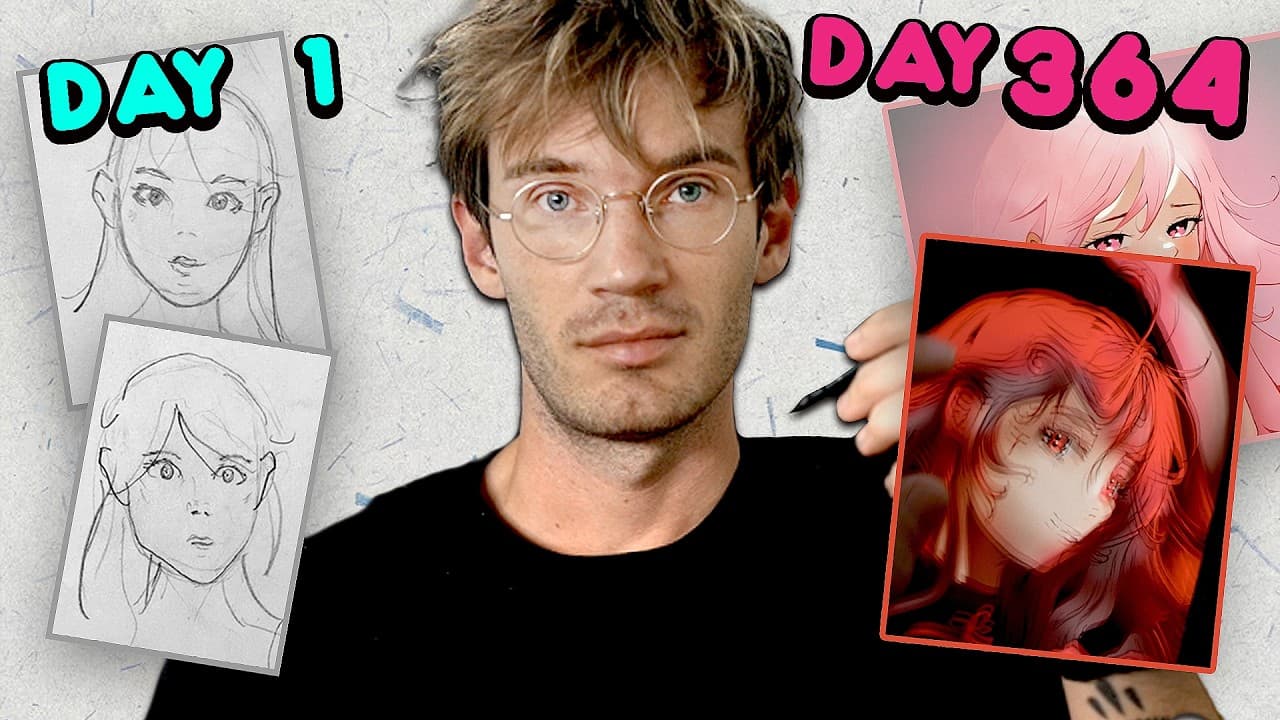
Drawing every day for a year can reveal real progress and the value of consistency. The creator shares starting struggles, the shift toward studying anatomy and perspective, and the impact of trying new tools like color, ink, and an iPad. The key takeaway is that persistence and deliberate practice drive improvement.
Transcript
I drew every day for a year What's the progress was it worth it so this all started as a random idea I wanted to make a progression video and I picked art because I thought it was easy to track like I'll draw for 30 days I can show the first day and then I can compare to the last day that'll be interesting to see did I make progress people were so ... Read More
Key Insights
- Drawing daily builds skills through repetition and gradual refinement.
- Color and media experimentation can enhance learning by revealing new possibilities.
- Studying anatomy and perspective helps fix proportion and balance in drawings.
- Switching to new tools (ink pens, iPad) can accelerate learning when used intentionally.
- Progress can feel slow; persistence is essential to cross plateaus.
- Feedback from the community and other creators can boost motivation.
- Understanding that drawing is more about training the brain to see than just hand movements.
- Long-term growth comes from combining practice with study and curiosity.
- More videos from this channel:
- More from this channel: PewDiePie
Install to Summarize YouTube Videos and Get Transcripts
Explore YouTube Video Summarizer or Get YouTube Transcript Extractor
Questions & Answers
Q: A real search query question about the video (e.g. 'How to...', 'What is...', 'Why does...', 'When should...'). Question 1
Question 1: How does daily drawing over a year impact skill development and confidence for someone starting from little formal art training? The answer is that consistent daily practice creates a cumulative effect, improving perception and technique as the brain learns to recognize proportions, anatomy, and balance. Progress may be gradual, but the cumulative weeks and months yield noticeable results. The artist notes early progress after 30 to 100 days, and later breakthroughs come from studying anatomy and perspective, along with trying new tools like color, ink, and digital drawing. This approach also builds resilience and a healthier mindset toward mistakes.
Q: Question 2
Question 2: What strategies helped the creator avoid getting stuck in repetitive subjects and maintain improvement over time? The key strategy was to vary subjects and media, moving from anime-style sketches to landscapes, perspective studies, and full body drawings. He also used new tools such as a brush pen and later an iPad to challenge his skills. Studying art books and practicing with careful attention to anatomy and proportion provided structure, while allowing room for experimentation to keep learning engaging rather than monotonous.
Q: Question 3
Question 3: How did feedback from others influence the artist during the year long challenge, and what role did community play in sustaining motivation? Community feedback served as encouragement and validation, confirming progress and inspiring continued effort. Reactions from other YouTubers and viewers gave external motivation beyond personal goals. This social dimension helped the artist feel accountable and reinforced the value of sharing progress to support others attempting similar challenges.
Q: Question 4
Question 4: What are the practical steps someone can take to start a year long drawing journey today? Begin with a simple daily commitment, such as 15 to 20 minutes per day, then gradually increase as confidence builds. Use a familiar subject to build consistency early, then introduce new topics like anatomy, perspective, or color. Collect notes or a blog to reflect on progress, and experiment with at least one new tool or medium each month to avoid stagnation.
Q: Question 5
Question 5: How important is studying art books and reference material in accelerating improvement during long running drawing projects? It is very important because books provide structured knowledge about anatomy, perspective, and composition that complements practice. The artist found value in specific art books and a shift toward understanding how things fit together rather than just copying. Reference materials help identify common errors and offer new approaches to rendering forms and space.
Q: Question 6
Question 6: What challenges typically arise when learning to draw realistically, and how can a learner address them effectively? Common challenges include balancing proportions, achieving accurate anatomy, and constraining scribbles into coherent forms. Address these by breaking subjects into simple shapes, using reasoning and grids for structure, and practicing from life or high-quality references. Accept that early results may be imperfect, and use critiques as a guide for the next session rather than as a personal verdict.
Q: Question 7
Question 7: What role does setting realistic goals and tracking progress play in a long term art project, according to the video? Realistic goals provide direction and a measure of progress, while tracking progress fosters accountability. The artist shows a year long arc with milestones like 30 days, 100 days, and day 365. Reflecting on the journey helps identify turning points, such as recognizing when to shift focus from technique to understanding form or when to switch media to spark renewed interest.
Q: Question 8
Question 8: How can fans and aspiring artists use this video to motivate their own creative practice without copying the creator, and what mindset should they adopt? Viewers should interpret the process as an example of persistence and mindful practice, not as a perfect blueprint. Emulate the habit of regular drawing, seek knowledge through study, and stay open to evolving interests. The mindset should emphasize curiosity, patience, and willingness to step outside comfort zones to explore new tools and subjects.
Summary & Key Takeaways
-
The creator documents 365 days of drawing, noting initial challenges and the decision to keep going despite frustration. He discusses the shift from rigid routines to exploring new subjects and techniques, and the importance of enjoying the process to sustain long-term practice.
-
Progress is not linear; early gains may plateau while learning deepens when the artist branches into anatomy, perspective, and different media. The narrative emphasizes self-acceptance, patience, and continuing education as core components of growth.
-
Towards the end, using an iPad and learning new workflows leads to renewed attempts at ambitious pieces. The video concludes with a reflection that improvement comes from embracing discomfort and pursuing projects that stretch skills, not just comfortable repetition.
Read in Other Languages (beta)
Share This Summary 📚
Summarize YouTube Videos and Get Video Transcripts with 1-Click
Try YouTube Summary with ChatGPT & Claude or YouTube Transcript Generator
Explore More Summaries from PewDiePie 📚





Summarize YouTube Videos and Get Video Transcripts with 1-Click
Try YouTube Summary with ChatGPT & Claude or YouTube Transcript Generator