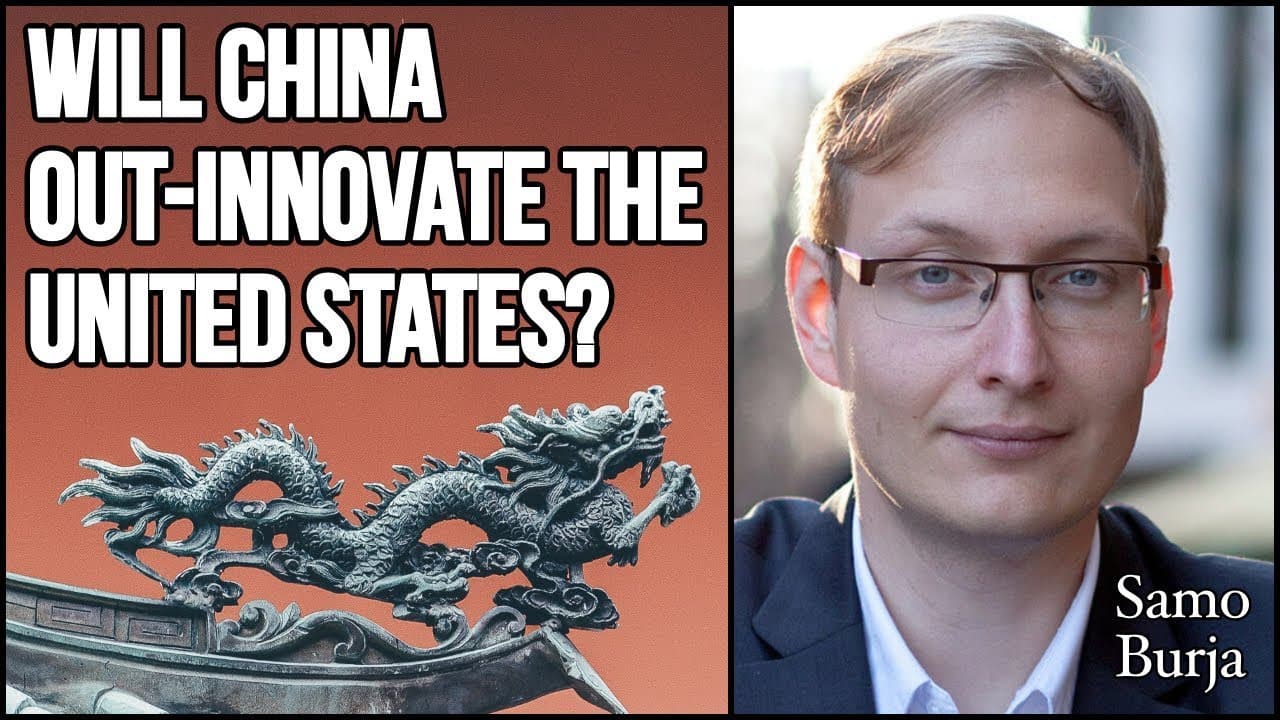
Will China Out-Innovate The United States?
TL;DR
China could out-innovate the United States, based on its expanding technological capabilities, manufacturing scale, state-backed priorities, and ability to attract or reclaim scientific talent. The speaker points to competitive electric-car batteries, a goal of global AI leadership by 2030, extensive AI research, biotech experimentation, and access to Western advances through industrial espionage. Read on to understand why mass production and talent flows may matter as much as invention itself.
Transcript
well China out-innovate the US we have been used to seeing progress mostly arise from Western countries in the last 200 years of human history everything from the application of the steam engine to industry to the invention of the atomic bomb has been spearheaded in countries such as Britain Germany France the Netherlands and the United States Amer... Read More
Key Insights
- 🌍 China's economy and international influence pose a challenge to the US's status as the center of innovation.
- 😨 Chinese advancements in technology, such as electric cars and electronics, indicate their growing capabilities.
- 🧘 The Chinese government's focus on areas like artificial intelligence and biotech positions China as a potential global leader.
- 🧑🏭 Industrial espionage is a significant factor in China's access to innovation from the West.
Install to Summarize YouTube Videos and Get Transcripts
Explore YouTube Video Summarizer or Get YouTube Transcript Extractor
Questions & Answers
Q: Will China out-innovate the United States?
The speaker argues that China could out-innovate the United States, but does not present the outcome as certain. China’s competitive technology, large-scale manufacturing, state support for AI, biotech activity, industrial espionage, and ability to attract returning talent all strengthen its position.
Q: What evidence suggests that China is becoming more technologically innovative?
Chinese electric cars have batteries described as being as efficient and lightweight as Tesla batteries. The speaker also points to China’s electronics manufacturing, AI research, and the birth of the first genetically modified humans, known as CRISPR babies, in China.
Q: Why does mass production count as innovation?
The speaker argues that a technical achievement remains an interesting toy if it cannot be produced at scale. An industrial supply chain and assembly line capable of producing hundreds of thousands or millions of cars or phones can transform the broader economy.
Q: How is the Chinese government promoting artificial intelligence?
The Chinese state has vowed to make China a global leader in artificial intelligence by 2030. The speaker also describes China’s president appearing on state television with two AI books on his desk, signaling that AI knowledge is a national priority.
Q: What does China producing more academic papers than the United States indicate?
The speaker cautions that academic papers are a poor measure of knowledge or intellectual innovation. However, China’s paper output, at least in AI, indicates that substantial resources support a large population of academics and researchers.
Q: What do the CRISPR babies reveal about biotech innovation in China?
The first genetically modified humans, described as CRISPR babies, were born in China. Although the scientist faced ethical trouble, the case demonstrated a technical capability that the speaker treats as evidence of biotech innovation occurring in China.
Q: How does industrial espionage affect China’s innovation capacity?
The speaker says China excels at industrial espionage, giving it access to Western innovations through military espionage or copyright infringement. The argument also notes that industrial espionage previously contributed to French industrialization through efforts to obtain 19th-century British technology and recruit British experts.
Q: How could scientific talent flows help China surpass the United States?
China is described as generous to Western scientists who move there, potentially enabling them to build new technologies inside China. The speaker also says many Chinese students return home after studying in the United States and that some Asian Americans pursue careers in China, transferring hard-won knowledge into Chinese institutions.
Summary & Key Takeaways
-
China's economy is comparable to the US, and its international influence is increasing, challenging the US's position as the center of innovation.
-
Chinese electric cars and electronics are becoming competitive with Western counterparts, showing China's advancements in technology.
-
The Chinese state is actively investing in areas of development, particularly artificial intelligence and biotech, positioning itself as a global leader.
Read in Other Languages (beta)
Share This Summary 📚
Summarize YouTube Videos and Get Video Transcripts with 1-Click
Try YouTube Summary with ChatGPT & Claude or YouTube Transcript Generator
Explore More Summaries from Samo Burja 📚






Summarize YouTube Videos and Get Video Transcripts with 1-Click
Try YouTube Summary with ChatGPT & Claude or YouTube Transcript Generator