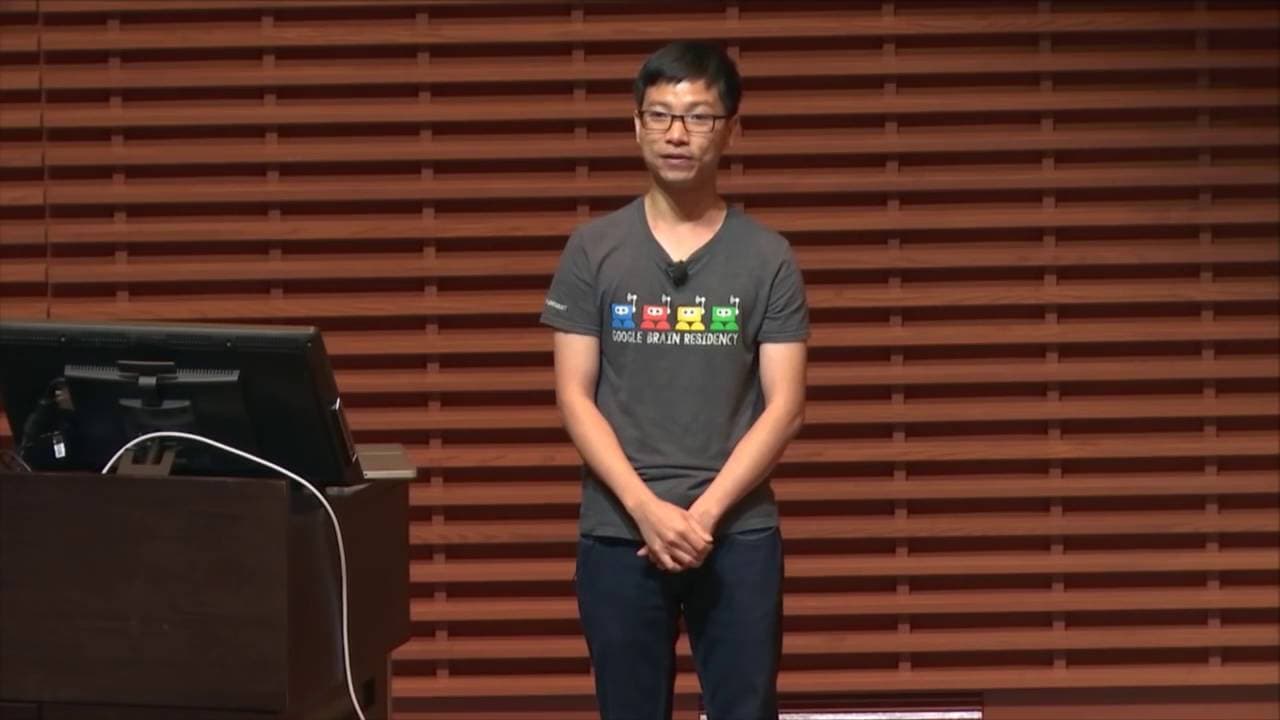
Sequence to Sequence Deep Learning (Quoc Le, Google)
TL;DR
Sequence to sequence (Seq2Seq) learning is a deep learning method that transforms variable-length input sequences into variable-length output sequences using an encoder-decoder architecture. This technique is widely used in various NLP applications such as language translation, email auto-replies, and speech recognition, enhanced by an attention mechanism that focuses on relevant input parts to improve output accuracy.
Transcript
eating that were divided in two parts so number one and we work with you and develop the sequence to sequence learning and then that's the second part I would I will place sequin to sequence in a broader context or a lot of exciting work in this area now so let's multiply this by a an example so a week ago I came back from vacation and my in my inb... Read More
Key Insights
- ❤️🩹 Sequin to Sequence Learning is an end-to-end deep learning technique that can process variable-length input and output sequences.
- 😯 It is a powerful framework that has been successfully applied in various NLP tasks, including translation, summarization, and speech recognition.
- 🥳 The attention mechanism plays a crucial role in Sequin to Sequence Learning, allowing the model to focus on relevant parts of the input sequence.
- ❓ Augmenting recurrent networks with memory and operations can further enhance their capabilities.
- 🧑🏭 The amount of training data and the size of the vocabulary are important factors in the success of Sequin to Sequence Learning.
- 🆘 Pre-training with language models or word2vec can help improve performance when training data is limited.
Install to Summarize YouTube Videos and Get Transcripts
Explore YouTube Video Summarizer or Get YouTube Transcript Extractor
Questions & Answers
Q: How does Sequin to Sequence Learning handle variable-length input and output sequences?
Sequin to Sequence Learning uses an encoder network to process the input sequence and generate a fixed-length representation called a context vector. The decoder network then uses this context vector to generate the output sequence, one word at a time.
Q: Can Sequin to Sequence Learning be used for tasks other than translation?
Yes, Sequin to Sequence Learning can be applied to various NLP tasks, such as summarization, question-answering, speech recognition, and conversation generation. It is a flexible framework that can be adapted to different tasks.
Q: How does the attention mechanism work in Sequin to Sequence Learning?
The attention mechanism allows the model to focus on different parts of the input sequence at each step of generating the output. It computes a set of weights (alphas) that determine how much attention to give to each input element, and then combines the weighted inputs to produce the context vector.
Q: How does Sequin to Sequence Learning handle out-of-vocabulary words or rare words?
Sequin to Sequence Learning usually uses a fixed vocabulary, and out-of-vocabulary or rare words are represented as unknown tokens. However, there are techniques such as character-level or subword-level tokenization that can help address this issue.
Summary
This video discusses sequence-to-sequence learning, which is the task of mapping variable-sized input sequences to variable-sized output sequences. The speaker provides an example of automatically replying to emails with simple yes or no answers. The video then explores the steps involved in processing the input sequence, such as tokenization and feature representation. The speaker also explains the use of logistic regression in this problem and the concept of stochastic gradient descent for training the model. The video introduces the idea of using recurrent networks to preserve ordering information in the input sequences. Finally, the speaker discusses the use of attention mechanisms in sequence-to-sequence learning, as well as the application of these models in tasks like translation and speech recognition.
Questions & Answers
Q: What is the task of sequence-to-sequence learning?
Sequence-to-sequence learning involves mapping variable-sized input sequences to variable-sized output sequences.
Q: How can sequence-to-sequence learning be applied to email responses?
In the example provided, sequence-to-sequence learning is used to automatically reply to emails with simple yes or no answers.
Q: What are the steps involved in processing the input sequence?
The input sequence is processed through tokenization and normalization, where each word is counted and represented as a 2,000-dimensional vector.
Q: What is the purpose of feature representation in sequence-to-sequence learning?
Feature representation involves constructing a vector that represents the occurrence of each word in the input sequence.
Q: What type of problem does logistic regression help solve in sequence-to-sequence learning?
Logistic regression is used to solve the problem of mapping input sequences to one of multiple categories, such as classifying emails as "yes" or "no" responses.
Q: How is stochastic gradient descent utilized in training the model?
Stochastic gradient descent is used to update the parameters of the model, increasing the probability of generating the correct output based on the input.
Q: What is the significance of the recurrent network in sequence-to-sequence learning?
The recurrent network preserves ordering information in the input sequences, allowing the model to capture dependencies between words.
Q: How does attention improve the performance of sequence-to-sequence models?
Attention mechanisms allow the model to selectively focus on different parts of the input sequence, improving the model's ability to generate accurate output sequences.
Q: What are some applications of sequence-to-sequence learning?
Sequence-to-sequence learning can be used in applications such as translation, image captioning, summarization, speech recognition, and conversation generation.
Q: How can the issue of vocabulary size be handled in sequence-to-sequence learning?
Vocabulary size can be managed by using techniques like tokenization, normalization, or character splitting to represent out-of-vocabulary words.
Q: How is the model trained in sequence-to-sequence learning for speech recognition?
In speech recognition, the model is trained by dividing the input into windows, converting them into spectrograms or MFCCs, and using the attention mechanism to predict one word at a time.
Takeaways
Sequence-to-sequence learning is a versatile technique for mapping variable-sized input sequences to variable-sized output sequences. The process involves tokenization, feature representation, and the use of recurrent networks. Logistic regression can be used in classification tasks, while attention mechanisms improve the model's ability to generate accurate outputs. Sequence-to-sequence learning has been successfully applied in email responses, translation, image captioning, summarization, speech recognition, and conversation generation.
Summary & Key Takeaways
-
Sequin to Sequence Learning involves training neural networks to take variable-length sequences as input and produce variable-length sequences as output.
-
The technique uses an encoder network to process the input sequence, an attention mechanism to focus on relevant parts of the input, and a decoder network to generate the output sequence.
-
Sequin to Sequence Learning has been successfully applied in tasks such as translation, email auto-reply, and speech recognition.
Read in Other Languages (beta)
Share This Summary 📚
Summarize YouTube Videos and Get Video Transcripts with 1-Click
Try YouTube Summary with ChatGPT & Claude or YouTube Transcript Generator
Explore More Summaries from Lex Fridman 📚

Summarize YouTube Videos and Get Video Transcripts with 1-Click
Try YouTube Summary with ChatGPT & Claude or YouTube Transcript Generator