What Are Claude Skills and How Do You Build Them?
TL;DR
Claude Skills are automated, repeatable workflows you apply globally or per-project, and they load context only when a task needs it. They solve context rot, where too much context degrades LLM performance and raises hallucination risk. Skills combine markdown instructions, reference files, and executable scripts so data analysis runs on deterministic code rather than the model's varying judgment.
Transcript
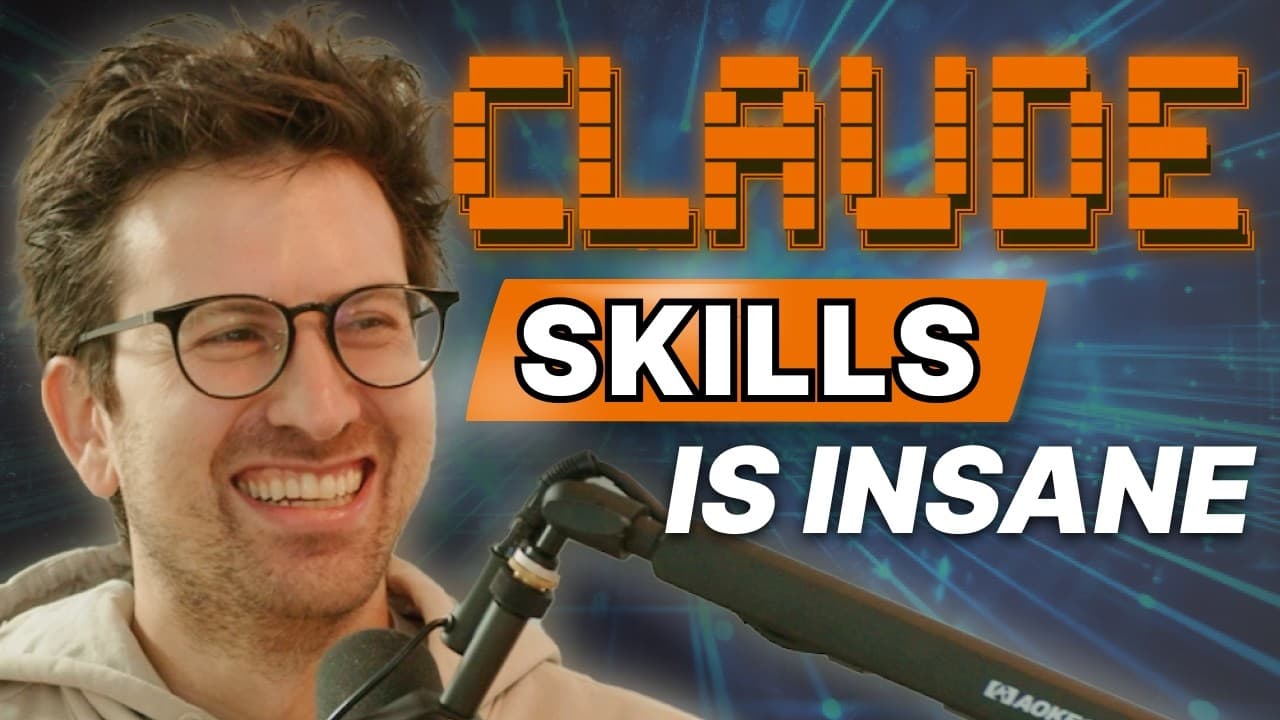
In this episode, Amir takes us through how to use Claude skills to build digital employees. We go through AB testing idea agent, marketing insight agent, and then we build one live together. You're going to learn about what [music] cloud skills is, why it's the biggest thing that happened since sub agents, and how [music] to actually build them you... Read More
Key Insights
- Claude Skills are automated workflows and tasks that can be applied globally, at a project level, or at an individual chat level, acting as an augmented skill set that performs specialized tasks built by you the expert.
- Skills load context only when it is relevant to the task, unlike projects where the LLM decides which context to retrieve, keeping the input laser focused on exactly what needs to get done.
- Custom Skills are built from a markdown file that explains what the skill is and does, plus optional reference files the skill pulls in only when needed for additional context.
- Context rot, described in a paper on effective prompt engineering, shows that adding too much context can degrade LLM performance and make hallucination more likely, so the right amount of context matters.
- Skills can run scripts or code to perform specific functions, making data analysis deterministic instead of relying on the model's nondeterministic judgment that can interpret data differently each time.
- Claude Projects are workspaces with custom instructions, relevant context, memories, and connected tools, useful for repeatable tasks and team collaboration such as analyzing marketing data or generating newsletters.
- Sub-agents, used mainly in Claude Code, break complex multi-workflow tasks into individual specialized agents with isolated context, for example delegating front-end work to one agent and back-end to another.
- Amir references Karpathy's analogy that AI is like a coworker or someone reporting to you whom you train, set guidelines for, and give the right amount of information to get the task done well.
Install to Summarize YouTube Videos and Get Transcripts
Explore YouTube Video Summarizer or Get YouTube Transcript Extractor
Questions & Answers
Q: What are Claude Skills?
Claude Skills are automated workflows and tasks that you can apply globally, at a project level, or at an individual chat level. They act as an add-on or augmented skill set within a project or chat, able to create documents and PDFs, analyze documents, help build MCPs, create other skills, or make visual art. They are used for specialized tasks based on constraints, guidelines, and steps built by you the expert, and they only load context when it is relevant to the task.
Q: How are Claude Skills different from Claude Projects?
Claude Projects are workspaces with custom instructions, relevant context, memories, and connected tools, where the LLM determines which context to retrieve and add into the conversation. Skills instead only pull in context based on the judgment of the task and only what is relevant to exactly what you want done. Projects also require you to constantly go back and update context files as your business and data change, whereas Skills are laser-focused, repeatable instructions that can also run scripts or code.
Q: What is context rot and why does it matter?
Context rot comes from a paper on effective prompt engineering that discusses how the right amount of system prompts, from very detailed to vague, and the right amount of context has a huge impact on LLM performance. As you add more context, you could potentially be degrading performance from the LLMs and making them more likely to hallucinate. Skills matter because they pull in context only as needed, helping avoid this degradation by giving the model the right amount of context rather than overwhelming it.
Q: How do you build a custom Claude Skill?
You create a markdown file that explains exactly what the skill is and what it does. You can add reference files that the skill can reference back into for additional context, such as an existing brand guidelines document, which it only pulls in when it needs to. You can take it another layer and create custom scripts as part of the skill. Anthropic has documentation on how to write good skills and descriptions, covering how to structure these instructions and reference materials.
Q: Why do scripts in Skills produce better data analysis?
In a normal Claude project, the model determines how to look at data and perform insights, which is nondeterministic and can interpret the data differently every single time without proper guidelines. With Skills you can create very specific scripts, for example telling it to look at columns X, Y, and Z, multiply by this, divide by that, to produce an insight. That way it is actual functional code running the analysis rather than being left to the model's varying judgment.
Q: What are sub-agents in Claude Code?
Sub-agents are more relevant in Claude Code specifically and let you spin up multiple agents that break down complex multi-workflow tasks into individual tasks with specialized agents. For example, when building a complex feature you can delegate the front end to one agent and the back end to another, each with its own set of system instructions. The context is isolated to that conversation window, so whatever context is provided or gathered there is used as an input for that agent.
Q: When should you use a Claude Skill instead of just a project?
You use a Skill for very specialized tasks based on constraints, guidelines, and steps built by you the expert. Amir gives the example of a paid media expert running client campaigns who wants detailed analysis of visits to booked appointments, conversion rates, and channel attribution. A Skill can follow custom instructions plus scripts you build to analyze that data. It is best when you need repeatable, laser-focused instructions that pull context only as needed and can run code to perform specific functions.
Q: What is the coworker analogy for training AI with Skills?
Amir references Karpathy, who a couple days earlier gave an analogy that AI is essentially your coworker or someone that reports to you. You want to train it, build the guidelines, and set the constraints around how you want it to respond. This is similar to how Skills work: like a coworker, you should give the right amount of information rather than bombarding them with everything, so the model has the right amount of context to get the correct task done without increasing hallucination.
Summary & Key Takeaways
-
Amir explains Claude Skills as digital employees, contrasting them with Claude Projects and sub-agents. Projects are workspaces holding custom instructions, context files, memories, and connected tools, ideal for repeatable team tasks like marketing analysis, but they require constant updating of context files as the business and data change.
-
Sub-agents, used primarily in Claude Code, split complex tasks into specialized agents with isolated context, such as one handling front-end and another back-end. Skills go further as automated workflows applied globally or per project, pulling in context only when relevant and able to run scripts to perform specific functions.
-
Skills address context rot, where excessive context degrades model performance and increases hallucination. By combining markdown instructions, reference files, and custom scripts, Skills turn nondeterministic model judgment into deterministic code, solving real problems Amir saw with clients whose Claude projects failed to produce reliable analytics insights.
Read in Other Languages (beta)
Share This Summary 📚
Summarize YouTube Videos and Get Video Transcripts with 1-Click
Try YouTube Summary with ChatGPT & Claude or YouTube Transcript Generator
Explore More Summaries from Greg Isenberg 📚



Summarize YouTube Videos and Get Video Transcripts with 1-Click
Try YouTube Summary with ChatGPT & Claude or YouTube Transcript Generator