How to Draw and Name Organic Molecules Effectively
TL;DR
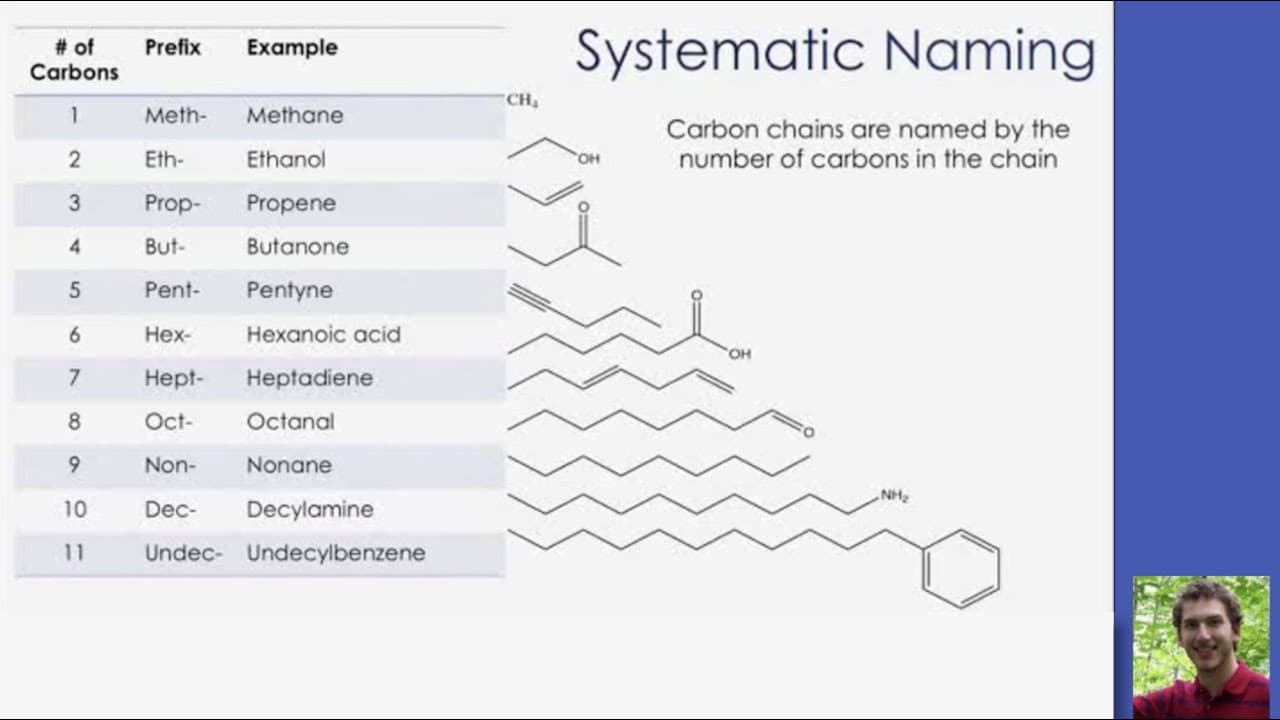
To draw and name organic molecules, use prefixes for the number of carbon atoms and suffixes to denote functional groups and bond types. Carbon chains and rings form the backbone, while systematic names and symbolic structures help simplify complex representations. Understanding these naming conventions is essential for clarity in organic chemistry.
Transcript
drawing and naming molecules small inorganic molecules are named based on their molecular formula usually using the most electronegative atom last and then we use prefixes that denote the number of atoms for example dinitrogen tetroxide is a molecule with two nitrogens and four oxygens but most of the molecules that we're going to be coming across ... Read More
Key Insights
- 🫀 Organic molecules are named based on their molecular formula, incorporating prefixes and suffixes to indicate the number and type of atoms.
- 📛 Systematic names and symbolic structures efficiently communicate the complexities of organic molecules.
- 🛟 Carbon chains and rings serve as backbones of organic molecules, with prefixes and suffixes indicating the number of carbon atoms and functional groups.
- 🧘 Substituents on organic molecules are named using suffixes, with their positions and functional groups determining the numbering scheme.
- 💨 Three-dimensional orientations of organic molecules can be represented using wedges and dashed bonds.
- 📏 Different types of bonds, such as double and triple bonds, have specific nomenclature rules.
- 😋 Certain rings and heteroatoms have special names in organic chemistry.
Install to Summarize YouTube Videos and Get Transcripts
Explore YouTube Video Summarizer or Get YouTube Transcript Extractor
Questions & Answers
Q: How are small inorganic molecules named?
Small inorganic molecules are named based on their molecular formula, using the most electronegative atom last. Prefixes denote the number of atoms in the molecule.
Q: What are organic molecules?
Organic molecules are carbon-based molecules that contain carbon-hydrogen bonds. They can be very complex, allowing for chemical diversity essential for life.
Q: What are the different ways to communicate about organic molecules?
There are three main languages: common names, systematic names, and symbolic structures. Symbolic structures efficiently represent the complexity of molecules.
Q: How are carbon chains named?
Carbon chains are named using prefixes that indicate the number of carbon atoms. For longer chains, prefixes derived from archaic words are used.
Q: How are double and triple bonds specified in organic molecules?
Double bonds can be indicated by using the suffix "ene," and triple bonds by using the suffix "yne." The position of the bond can also be specified.
Q: How are substituents on organic molecules named?
Substituents on organic molecules are named using suffixes in the name. The functional group and substituents determine the numbering and naming scheme.
Q: Are there special names for certain rings or atoms in organic molecules?
Certain rings, like benzene and pyridine, have special names. Heteroatoms in rings are usually named using the hetero atom as position one.
Q: How are three-dimensional orientations of organic molecules represented?
Wedges and dashed bonds are used to demonstrate relative orientation in 3D space. Wedges indicate that a substituent is coming out, and dashes indicate that it is going back.
Summary & Key Takeaways
-
Organic molecules are named based on their molecular formula, with prefixes indicating the number of atoms. The names can be complex due to the diversity of organic compounds.
-
Three languages are used to communicate about organic molecules: common names, systematic names, and symbolic structures. Symbolic structures, though not accurate, efficiently represent the complexities of molecules.
-
The backbone of organic molecules is often a carbon chain, with prefixes indicating the number of carbon atoms. Double bonds, triple bonds, and geometries can also be specified.
Read in Other Languages (beta)
Share This Summary 📚
Summarize YouTube Videos and Get Video Transcripts with 1-Click
Try YouTube Summary with ChatGPT & Claude or YouTube Transcript Generator
Explore More Summaries from YaleCourses 📚

Summarize YouTube Videos and Get Video Transcripts with 1-Click
Try YouTube Summary with ChatGPT & Claude or YouTube Transcript Generator