How to Prepare for the Kubernetes CKA Administrator Exam
TL;DR
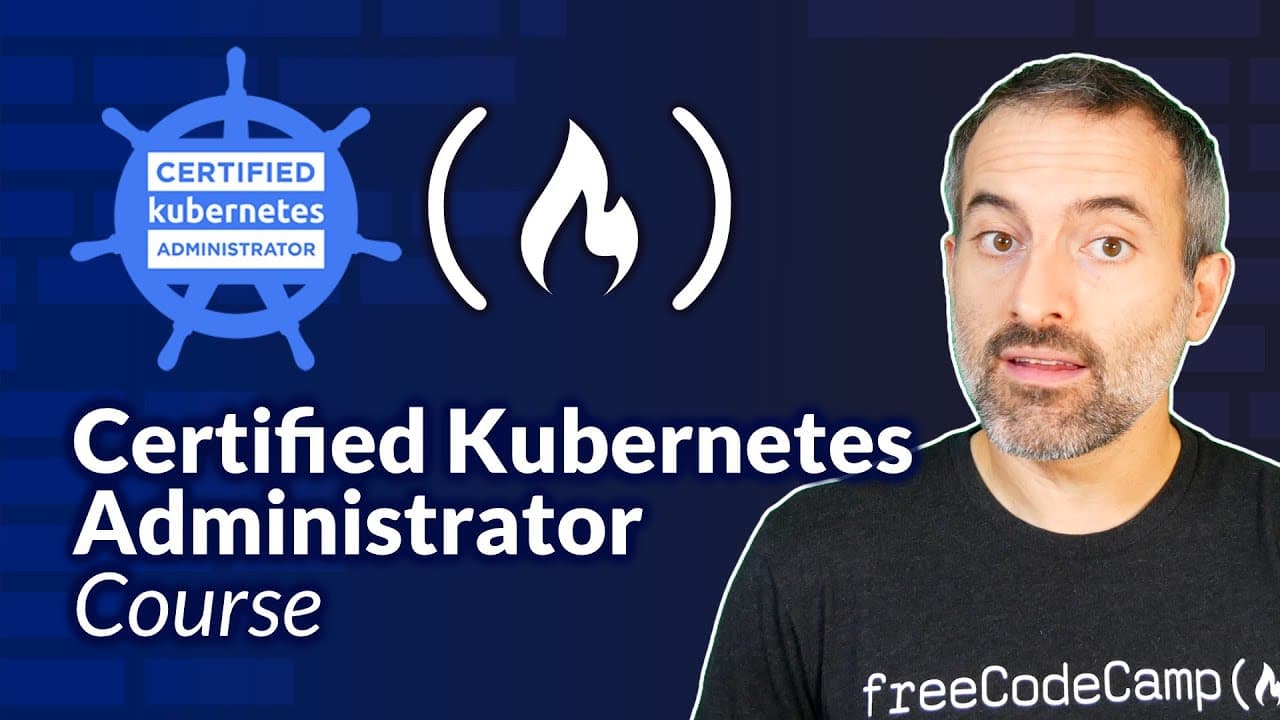
The Certified Kubernetes Administrator (CKA) exam is a two-hour, online-proctored, performance-based test where you solve hands-on tasks from a command line. Its curriculum weights troubleshooting at 30%, cluster architecture and installation at 25%, services and networking at 20%, workloads and scheduling at 15%, and storage at 10%. Passing requires thinking declaratively and working fluently with YAML manifests.
Transcript
Welcome to this comprehensive Kubernetes course. This course is perfect for anyone who wants to learn about Kubernetes, but it's designed for people who want to take the certified Kubernetes administrator or CKA examination. My name is Bo KS and I'm teaching this course. This course is designed to provide a deep practical understanding of Kubernete... Read More
Key Insights
- Kubernetes is an open-source container orchestration platform that automates the deployment, scaling, and management of containerized applications, providing a framework for running distributed systems resiliently across a fleet of machines.
- The CKA exam is a rigorous online proctored performance-based test that requires solving multiple hands-on tasks from a command line interface within a two-hour time limit, testing application and problem-solving speed rather than rote memorization.
- The CKA curriculum is divided by weight into troubleshooting at 30%, cluster architecture installation and configuration at 25%, services and networking at 20%, workloads and scheduling at 15%, and storage at 10%.
- Kubernetes uses a declarative model where an administrator defines the desired state in YAML manifests, and controllers run continuous control loops to reconcile the actual cluster state with that desired state, enabling self-healing.
- The control plane is the brain of a cluster, containing the API server as the central communication hub, etcd as the single source of truth key-value store, the scheduler that assigns pods to nodes, and the controller manager running control loops.
- Worker nodes run application workloads and contain the kubelet node agent that ensures containers are healthy, kube-proxy that maintains network rules for services, and a container runtime like containerd or CRI-O accessed via the CRI.
- A pod is the smallest deployable unit and encapsulates one or more tightly coupled containers sharing storage, a network IP, and run options; deployments manage replica sets to provide declarative, controlled updates for stateless applications.
- Candidates have access to the official Kubernetes documentation during the exam, which shifts the test toward knowledge application and speed, and the local practice cluster is built with kubeadm, the same tool used for production clusters.
Install to Summarize YouTube Videos and Get Transcripts
Explore YouTube Video Summarizer or Get YouTube Transcript Extractor
Questions & Answers
Q: What is the CKA exam and how is it structured?
The Certified Kubernetes Administrator (CKA) exam is a rigorous online proctored, performance-based test created by the Cloud Native Computing Foundation and the Linux Foundation. It requires solving multiple hands-on tasks from a command line interface within a two-hour time limit. Rather than testing rote memorization, it evaluates knowledge, application, and problem-solving speed, validating the skills required to perform the responsibilities of a Kubernetes administrator.
Q: How is the CKA exam curriculum weighted across domains?
The CKA curriculum is divided into several domains, each with a specific weight. As of the latest curriculum update, troubleshooting accounts for 30%, cluster architecture, installation and configuration for 25%, services and networking for 20%, workloads and scheduling for 15%, and storage for 10%. The significant weight given to troubleshooting and cluster installation underscores the exam's focus on practical, real-world administration skills.
Q: What is the declarative model in Kubernetes?
The declarative model is the fundamental principle of Kubernetes. Instead of issuing imperative commands like run this container or stop that one, an administrator defines the desired state of the system in YAML manifest files describing what applications should run, how many replicas they need, and what network policies apply. Once applied, Kubernetes controllers work continuously in a control loop to observe the actual state and reconcile it with the desired state, enabling self-healing and automation.
Q: What are the core benefits of using Kubernetes?
The core benefits of Kubernetes include self-healing, which automatically restarts failed containers and reschedules them on healthy nodes. It also offers automatic scaling, allowing applications to scale up or down based on resource usage. Finally, it facilitates zero downtime deployments, which is essential for rolling out updates without interrupting service. These capabilities make managing hundreds or thousands of containers across a fleet of machines practical and resilient.
Q: What components make up the Kubernetes control plane?
The control plane is responsible for orchestration and maintaining the desired state. The kube API server is the central hub and front end through which all communication passes. ETCD is a consistent, highly available distributed key-value store that acts as the cluster's single source of truth. The kube scheduler assigns newly created pods to the best node, and the kube controller manager runs control loops such as the node controller and replication controller to move current state toward desired state.
Q: What runs on Kubernetes worker nodes?
Worker nodes are the machines where your applications run, managed by the control plane. Each worker node runs the kubelet, the primary node agent that communicates with the API server to receive instructions and ensure containers in pod specifications are running and healthy. Kube-proxy is a network proxy that maintains network rules allowing communication to pods. The container runtime, such as containerd or CRI-O, actually runs the containers and communicates with the kubelet through the container runtime interface (CRI).
Q: What is a pod and how does it relate to deployments?
A pod is the smallest and most fundamental deployable unit in Kubernetes, representing a single instance of a running process. It encapsulates one or more tightly coupled containers that share storage, a unique network IP, and run options, though the most common pattern is one container per pod. A replica set maintains a stable set of identical pods, while a deployment is a higher-level object that manages replica sets and provides declarative, controlled updates, making it the recommended way to manage stateless applications.
Q: How do you set up a local practice environment for the CKA exam?
The course recommends creating a local Kubernetes cluster using kubeadm, the same tool used to bootstrap production clusters, which provides deep insight into the cluster's inner workings. Each node needs a compatible Linux host such as Ubuntu 22.04, at least 2 GB of RAM per machine, at least two CPUs for the control plane node, and full network connectivity between machines. The first step is installing a container runtime like containerd on all nodes, along with loading required kernel modules such as overlay and br_netfilter.
Summary & Key Takeaways
-
This Kubernetes course, taught by Bo KS and made possible by a Linux Foundation grant, prepares learners for the Certified Kubernetes Administrator (CKA) exam. It gives detailed explanations and hands-on demonstrations for every topic in the official CKA curriculum, moving from foundational concepts to advanced troubleshooting for real-world administration.
-
The CKA exam is a two-hour, online-proctored, performance-based test of hands-on command-line tasks. Its domains are weighted: troubleshooting 30%, cluster architecture, installation and configuration 25%, services and networking 20%, workloads and scheduling 15%, and storage 10%, emphasizing practical administration skills over memorization.
-
Kubernetes follows a control-plane and worker-node architecture built on a declarative model using YAML manifests. Core objects include pods, replica sets, deployments, services, and namespaces. The course teaches building a local cluster with kubeadm to mirror the exam environment and understand each setup step's purpose.
Read in Other Languages (beta)
Share This Summary 📚
Summarize YouTube Videos and Get Video Transcripts with 1-Click
Try YouTube Summary with ChatGPT & Claude or YouTube Transcript Generator
Explore More Summaries from freeCodeCamp.org 📚
![The Most Important Skills Going Forward with CTO + Homebrew Maintainer Mike McQuaid [Podcast #204] thumbnail](/_next/image?url=https%3A%2F%2Fi.ytimg.com%2Fvi%2F58Tn2xB8kIE%2Fhqdefault.jpg&w=750&q=75)
Summarize YouTube Videos and Get Video Transcripts with 1-Click
Try YouTube Summary with ChatGPT & Claude or YouTube Transcript Generator