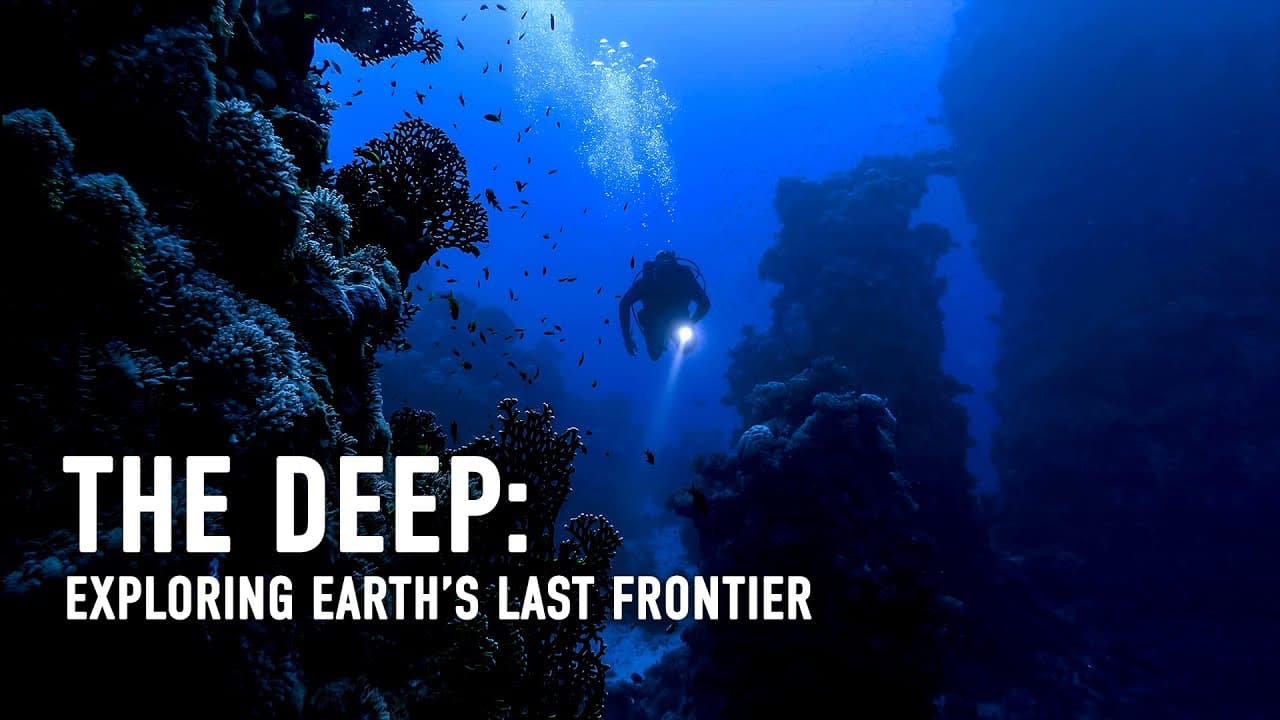
The Deep: Exploring Earth’s Last Frontier
TL;DR
Advancements in submersibles and robotics are allowing scientists to explore the deep ocean, revealing the vast biodiversity and hidden wonders of this previously unknown frontier.
Transcript
foreign s of years our Notions about the deepest parts of the Seas were built upon guesswork and myths we assumed that beyond the reach of sunlight the deep ocean was a cold dark planet of nothingness but stunning advances in submersibles and Robotics are now allowing scientists and explorers their first real access to Earth's final frontier and re... Read More
Key Insights
- 👾 The deep ocean, which covers over 70 percent of the planet, is the largest living space and contains the majority of Earth's biomass.
- 😋 Life in the deep ocean has adapted to survive in a harsh and scarce environment, where finding food and mates is a constant challenge.
- 🛟 The study of hydrothermal vents and chemosynthesis has expanded our understanding of how life can thrive without sunlight, potentially providing insight into the origin of life on Earth and other celestial bodies.
- 🌊 Technological advancements, such as the development of submersibles and mapping technologies, have revolutionized our ability to explore the deep ocean and uncover its mysteries.
Install to Summarize YouTube Videos and Get Transcripts
Explore YouTube Video Summarizer or Get YouTube Transcript Extractor
Questions & Answers
Q: What drives scientists and explorers to venture into the deep ocean?
Driven by curiosity and a desire to push boundaries, scientists and explorers are drawn to the deep ocean to unravel its secrets and explore Earth's most remote and mysterious places.
Q: What are the different zones that one would encounter when descending into the ocean depths?
The journey begins from the sunlit zone, where sunlight still penetrates, to the twilight zone, where sunlight diminishes and bioluminescent creatures thrive. Descending further leads to the midnight zone, devoid of sunlight, and finally to oceanic trenches, the deepest parts of the ocean.
Q: What role do hydrothermal vents play in sustaining life in the deep ocean?
Hydrothermal vents are areas where hot mineral-laden water gushes out from the seafloor, creating unique ecosystems that rely on chemosynthesis. Organisms in these environments use the mineral-rich water as a source of energy and can thrive in this extreme and toxic environment.
Q: Have any new species been discovered in the deep ocean?
Yes, as explorations into the deep ocean increase, new species are being discovered. Giant isopods, bone-eating worms, and colonies of bacterial mats are just a few examples of the diverse and fascinating life forms found in the deep ocean.
Summary & Key Takeaways
-
Advancements in submersibles and robotics have granted scientists and explorers access to the deep ocean, disproving the notion that it is a cold, dark, and lifeless realm.
-
Only around 20% of the ocean floor has been mapped, prompting scientists to undertake the ambitious task of mapping the entire ocean depths to uncover untold mysteries.
-
Three extraordinary individuals, Dr. Helen Scales, Dr. Vicki Ferrini, and Victor Vescovo, share their insights on the wonders of the deep ocean and their personal motivations for exploring these distant realms.
Read in Other Languages (beta)
Share This Summary 📚
Summarize YouTube Videos and Get Video Transcripts with 1-Click
Try YouTube Summary with ChatGPT & Claude or YouTube Transcript Generator
Explore More Summaries from World Science Festival 📚


Summarize YouTube Videos and Get Video Transcripts with 1-Click
Try YouTube Summary with ChatGPT & Claude or YouTube Transcript Generator