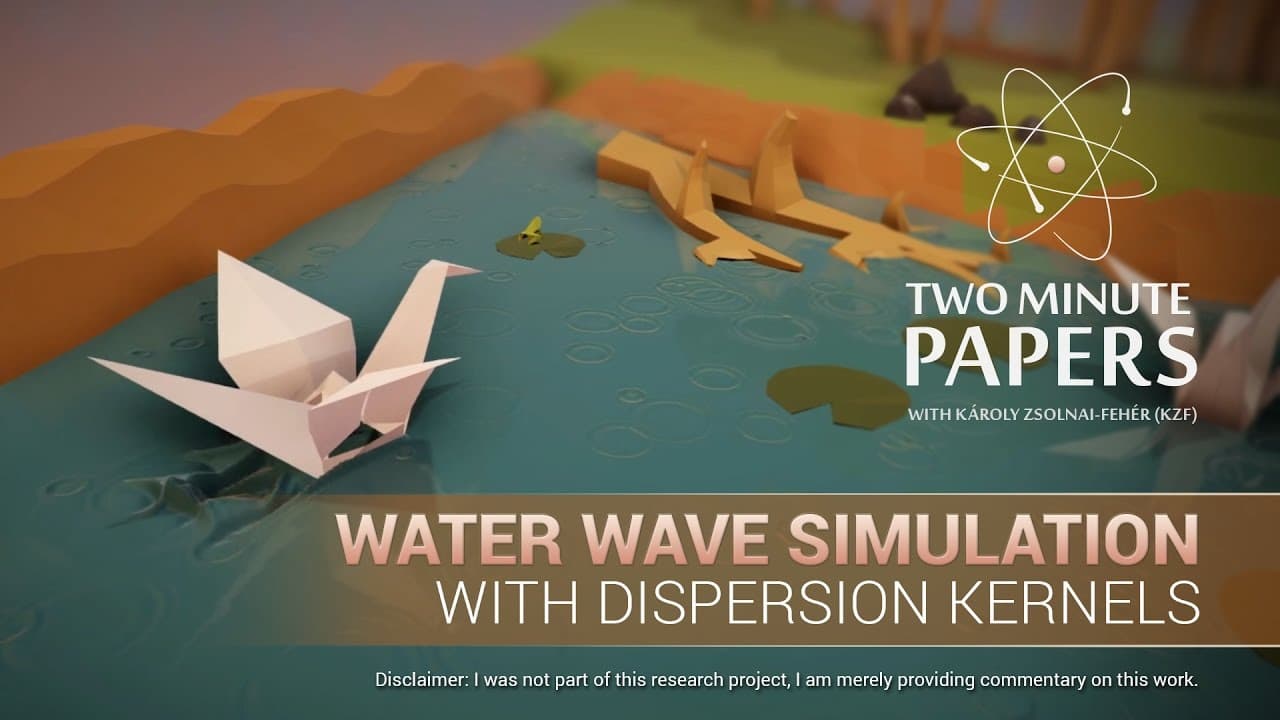
Water Wave Simulation with Dispersion Kernels | Two Minute Papers #110
TL;DR
The proposed water-wave simulation turns Sir George Biddell Airy’s dispersion model into a convolution formulation with optimizations that parallelize well on a computer’s graphical card. It captures complex wave behavior, reflections, capillary waves, and larger-scale scenes, although waves may pass through thin objects; one showcased example took roughly one and a half seconds per frame. Read on to understand how it works, where it may help, and what its limitations are.
Transcript
Dear Fellow Scholars, this is Two Minute Papers with Károly Zsolnai-Fehér. In this piece of work, we are interested in simulating the dynamics of water waves. There are quite a few forces acting on a bucket of water, such as surface tension, internal pressure, external force fields (such as wind, for instance), and gravity. Therefore, it is not a s... Read More
Key Insights
- 🌊 Simulating water waves accurately is a complex task due to various forces acting on the water.
- 👋 Airy's dispersion model describes wave phenomena accurately, but it is not directly applicable to computer simulations.
- 🌊 This paper introduces a new convolution formulation and optimizations for simulating water waves based on Airy's model.
- 🌊 The proposed technique has potential applications in ocean and coastal engineering and tidal wave simulation.
- 🌊 Limitations exist, such as the suitability of the original linear theory for shallow water simulations and waves in deeper waters.
- 🤔 The technique may struggle to accurately simulate the interaction of waves with thinner objects.
- 🌥️ The resulting algorithm is highly accurate and can simulate larger-scale scenes.
Install to Summarize YouTube Videos and Get Transcripts
Explore YouTube Video Summarizer or Get YouTube Transcript Extractor
Questions & Answers
Q: How does the dispersion-kernel technique simulate water waves?
It reformulates Sir George Biddell Airy’s dispersion model as a convolution that can be added directly to a computer simulation. Further optimizations allow the resulting algorithm to parallelize and map well to the computer’s graphical card.
Q: What is the main contribution of the water-wave simulation paper featured in Two Minute Papers #110?
The main contribution is a new convolution formulation of Airy’s dispersion model, along with simulation-ready optimizations. This makes a theory that was not directly applicable to computer simulation usable in an algorithm.
Q: What forces make water waves difficult to simulate?
Water is affected by surface tension, internal pressure, external force fields such as wind, and gravity. Together, these forces can produce complex waves with high-frequency details that are difficult to simulate.
Q: What does Airy’s dispersion model explain about waves?
Airy’s model accurately describes many common wave phenomena. In particular, longer waves are dominated by gravitational forces, while shorter waves are governed mostly by surface tension.
Q: Can the algorithm model water-wave reflections around solid objects?
Accurately modeling reflections after waves collide with solids is one of the important details addressed by the work. However, the approximation has an inherent limitation: waves may pass through thinner objects.
Q: What applications could benefit from this water-wave simulation technique?
Because the technique follows Airy’s classical dispersion model, it may be useful for ocean and coastal engineering. The presenter also identifies the simulation of huge tidal waves as a potential application.
Q: How accurate and scalable is the proposed water-wave algorithm?
The resulting algorithm is described as very accurate and capable of supporting larger-scale scenes. Demonstrations include capillary waves produced by raindrops and waves around swans in a pond.
Q: What are the technique’s limitations and computation time?
The original linear theory is mostly suitable for shallow-water simulations and larger waves in deeper waters, while the approximation may allow waves to pass through thin objects. One demonstrated example took roughly one and a half seconds per frame, so it was not yet running in real time.
Summary & Key Takeaways
-
The paper introduces a new convolution formulation and optimizations for simulating water waves based on Airy's dispersion model.
-
The proposed technique accurately models wave reflections and can be applied to ocean and coastal engineering and tidal wave simulation.
-
While the original linear theory is suitable for shallow water simulations, the proposed approximation has limitations like waves going through thinner objects.
Read in Other Languages (beta)
Share This Summary 📚
Summarize YouTube Videos and Get Video Transcripts with 1-Click
Try YouTube Summary with ChatGPT & Claude or YouTube Transcript Generator
Explore More Summaries from Two Minute Papers 📚




Summarize YouTube Videos and Get Video Transcripts with 1-Click
Try YouTube Summary with ChatGPT & Claude or YouTube Transcript Generator