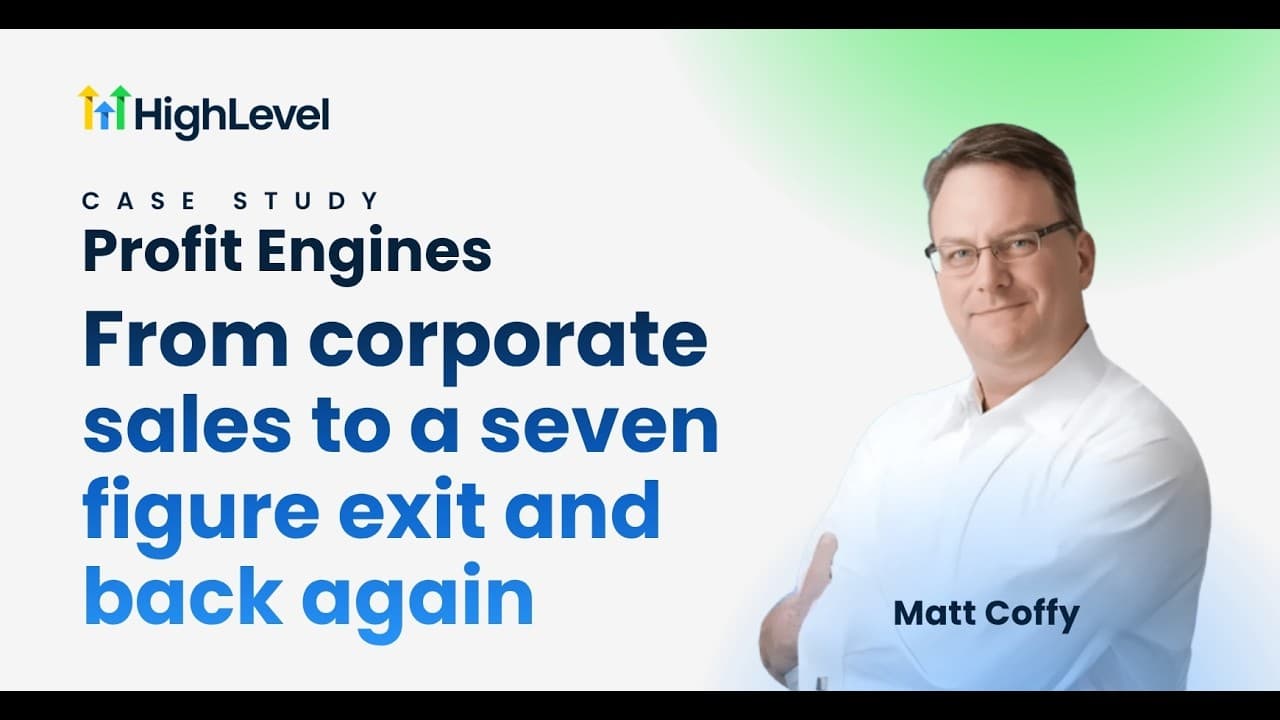
How to Rebuild an Agency After a Seven-Figure Exit
TL;DR
A service agency can grow without paid advertising by earning referrals, conducting cold outreach, and solving measurable client problems. After selling PracticeBloom for seven figures, Matt Coffy rebuilt from retained clients, reaching $40,000 in monthly recurring revenue with 30 active paying clients, 30 hosting clients, and a seven-person team.
Transcript
They don't necessarily want to do the things that we want to do in this business. They want us to do it for them. And [music] if you're honest, trustworthy, no matter what you do, the customer is going to say, "Just come in and do something to help us." Because very rarely do they get people to [music] actually be on their side. You know, there's u... Read More
Key Insights
- Trust is a central agency asset because businesses often want a capable partner to take responsibility for difficult work. Coffy says clients continue requesting help when they believe the provider is honest, understands their needs, and can save or make them money.
- Coffy's entrepreneurial path began with a telecommunications company in his early 20s, followed by positions at several technology companies. After six years as a top Sprint salesperson, he concluded that climbing the corporate ladder did not interest him and moved toward independent consulting.
- Coffy's agency started as a generalist consultancy that handled whatever clients needed, including bill reduction, websites, email marketing, SEO, paid Google advertising, logos, and building signs. This broad problem-solving approach produced at least one client relationship lasting 15 years.
- The original business grew slowly and steadily from roughly $100,000 in 2011 or 2012 through revenue levels of about $300,000, $500,000, $600,000, and $700,000. Coffy characterized its average growth rate as approximately 30% to 50%.
- A fragmented technology stack constrained scalability because the agency used separate systems for email, calls, texts, and other functions. After becoming an early HighLevel customer around 2018 or 2019, the company replaced tools such as ActiveCampaign and CallRail with one combined platform.
- Niching developed through experimentation rather than a single decision. The agency operated a white-label division for other agencies around 2016, but serving inexperienced agency owners often involved managing emotions, so Coffy and his team ultimately concentrated primarily on medical marketing services.
- ProfitEngines was built after Coffy's seven-figure exit from PracticeBloom, using a handful of retained clients as its starting base. One year later, the new AI-powered local-business agency had become a half-million-dollar operation without using paid advertising to acquire customers.
- ProfitEngines combines modular services through a Lego brick pricing model, allowing an initial $199-per-month chatbot offering to expand into broader agency work. Its seven-person team supports voice bots, chatbots, advertising, SEO, and a complete Content OS system.
Install to Summarize YouTube Videos and Get Transcripts
Explore YouTube Video Summarizer or Get YouTube Transcript Extractor
Questions & Answers
Q: How can an agency grow without spending money on ads?
An agency can grow without paid advertising by combining referrals, cold outreach, and demonstrable client results. ProfitEngines used no paid acquisition channel, yet reached $40,000 in monthly recurring revenue, 30 active paying clients, and another 30 web-hosting clients. Coffy's approach centers on becoming a trusted problem solver who can either reduce business costs or help clients make more money.
Q: Why did Matt Coffy leave corporate sales for entrepreneurship?
Matt Coffy left corporate work because the corporate ladder did not interest him, even though he had spent six years at Sprint and described himself as one of its top salespeople. He initially had no precisely defined independent offering. He began talking with clients, reducing their telephone bills, and accepting consulting engagements before developing a broader agency business around 2012.
Q: What services did Matt Coffy's first agency provide?
Coffy's agency provided a wide range of services based on whatever individual clients needed. Its work included reviewing and lowering physical bills, building websites, running email marketing, performing SEO, managing paid Google advertising, designing logos, producing building signs, and offering general business consulting. The agency later added content marketing, blog posting, social media, and white-label support for other agencies.
Q: How did HighLevel help Coffy's agency simplify operations?
HighLevel allowed the agency to consolidate functions that had previously been spread across numerous products. The earlier stack included separate tools and strategies for email, calling, and text communications, including ActiveCampaign and CallRail. After joining HighLevel as an early customer around 2018 or 2019, the agency moved these activities onto one combined platform, addressing a major obstacle to scaling its operations.
Q: Why did Coffy's agency specialize in medical marketing?
The agency specialized in medical services after testing different models and identifying a successful niche. Around 2016, it had also tried focusing on white-label services for other agencies. Coffy found that many incoming agency operators were inexperienced, making that model difficult to scale because his team was often managing their emotions. The business subsequently shifted toward providing services primarily within the medical market.
Q: How large did ProfitEngines become in its first year?
ProfitEngines became a half-million-dollar business within one year of being rebuilt from a handful of clients retained after Coffy's previous agency exit. It reached $40,000 in current monthly recurring revenue, with 30 active paying clients and 30 additional web-hosting clients. A team of seven delivered voice bots, chatbots, advertising, SEO, and a complete Content OS system.
Q: What is the Lego brick pricing model used by ProfitEngines?
The Lego brick pricing model treats individual services as modular components that can be combined into a broader agency engagement. The description identifies a $199-per-month chatbot as one possible starting point. From that entry service, ProfitEngines can add related capabilities such as voice bots, advertising, SEO, web hosting, and its Content OS system as the client's requirements expand.
Q: What business results did ProfitEngines produce for a client?
One ProfitEngines client moved from losing $10,000 each month to generating more than $100,000 in monthly profit within eight months. During the same period, that client's monthly revenue increased from $100,000 to $500,000. The case supports Coffy's broader view that an agency earns durable trust by solving significant financial problems and producing outcomes tied to saving or making money.
Summary & Key Takeaways
-
Matt Coffy moved from telecommunications entrepreneurship and a successful Sprint sales career into consulting around 2010. By 2012, he was independently serving businesses through a broad mix of cost reduction, websites, email marketing, SEO, Google ads, design, and general consulting, building relationships that sometimes lasted 15 years.
-
His original agency grew from roughly $100,000 in 2011 or 2012 to progressively higher revenue levels, generally expanding by 30% to 50%. Multiple disconnected tools and an expanding service catalog created scaling challenges, which led the company to consolidate communications and marketing operations on HighLevel around 2018 or 2019.
-
After building and selling PracticeBloom, a multimillion-dollar Inc. 5000 medical marketing agency, Coffy started ProfitEngines with several retained clients. Within one year, it became a half-million-dollar business with $40,000 in monthly recurring revenue, supported by referrals, cold outreach, modular services, and no paid customer-acquisition channel.
Read in Other Languages (beta)
Share This Summary 📚
Summarize YouTube Videos and Get Video Transcripts with 1-Click
Try YouTube Summary with ChatGPT & Claude or YouTube Transcript Generator
Explore More Summaries from HighLevel 📚





Summarize YouTube Videos and Get Video Transcripts with 1-Click
Try YouTube Summary with ChatGPT & Claude or YouTube Transcript Generator