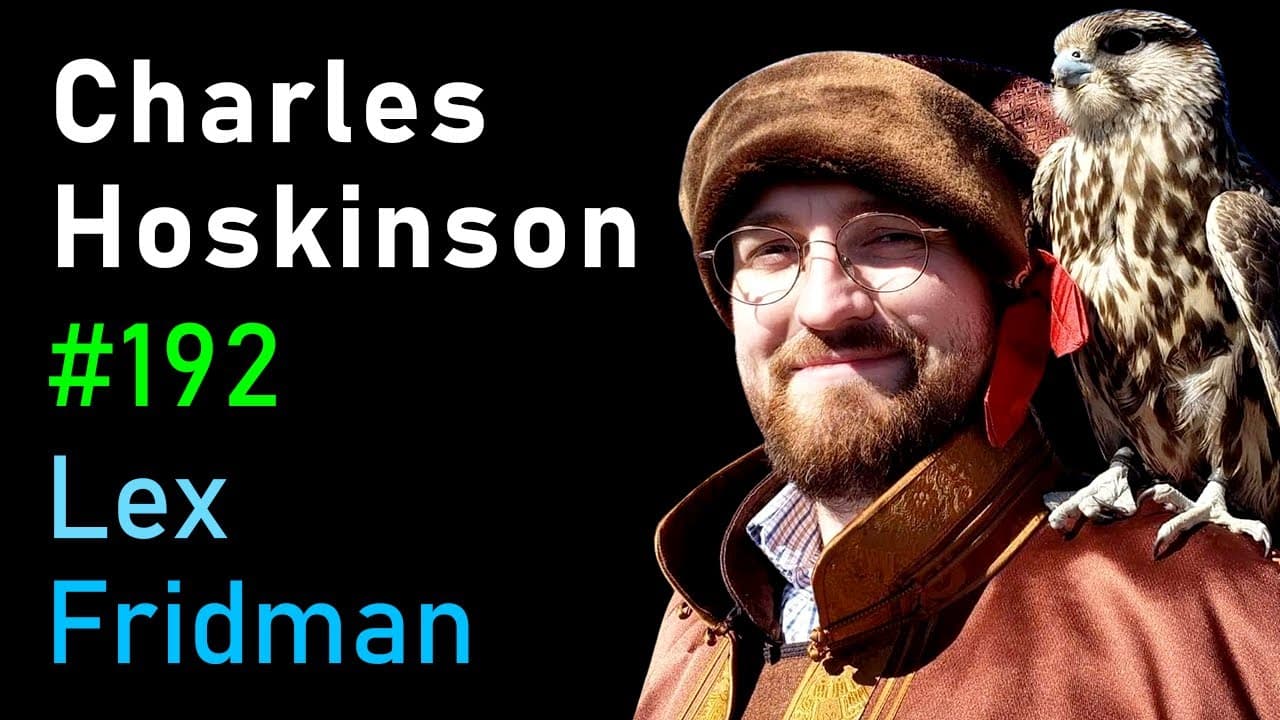
Charles Hoskinson on Cardano, Logic, and Crypto
TL;DR
Formal systems can precisely describe parts of reality while remaining unable to prove or predict everything from within their own boundaries. Charles Hoskinson connects this limitation to philosophy, computation, and cryptocurrency engineering, arguing that simple deterministic rules can generate surprising complexity and that dependable systems require pockets where properties can still be formally established.
Transcript
The following is a conversation with Charles Hoskinson, founder of Cardano, co-founder of Ethereum, and a mathematician who's one of the most well-read and knowledgeable people on the technical side of cryptocurrency that I've ever spoken to. Quick mention of our sponsors, Gala Games, Allform, Indeed, ExpressVPN, and Eight Sleep. Check them out in ... Read More
Key Insights
- A system may be unable to fully explain its own containing environment because its participants and reasoning tools are constrained by that system. Hoskinson compares this limitation to redstone computers built inside Minecraft, whose internal constructions cannot step outside the world that contains them.
- The computational feasibility of simulating a universe depends partly on unresolved questions about how efficiently computations can be performed. Hoskinson and Fridman connect the simulation question to whether P equals NP and to the difficulty of emulating every relevant process within an encompassing computational system.
- Simple deterministic rules can generate behavior that is complex and difficult to predict. The discussion of cellular automata highlights how knowing the rules and initial conditions does not necessarily provide a practical way to make conclusive statements about the system's distant future.
- Bottom-up models can sometimes be more predictive than complex top-down models. Hoskinson cites work associated with the Santa Fe Institute and draws an analogy to artificial intelligence systems that begin with comparatively simple elements and improve through interaction with their environments.
- Wolfram's computational universes were being considered as assets for an NFT marketplace on Cardano. Hoskinson says Wolfram approached his team about selling these universes, and they were exploring an auction system involving NFTs on Cardano around the time of the conversation.
- Rule 30 illustrates the gap between deterministic evolution and accessible prediction. Fridman describes competitions focused on predicting its development, including the middle column, and says participants had not produced conclusive predictions about its future behavior.
- Philosophy and computer science share a concern with precision in language and reasoning. Hoskinson presents Russell, Kripke, Wittgenstein, and Tarski as thinkers who sharpened analysis of formal languages, ordinary language, truth, necessity, possibility, and the limits of expression.
- Twentieth-century logic exposed limits in the project of completely formalizing mathematics. Hoskinson describes Russell and Whitehead's Principia Mathematica, Hilbert's ambitions, and later work by Gödel, Turing, Church, and others as revealing problems involving completeness and decidability.
Install to Summarize YouTube Videos and Get Transcripts
Explore YouTube Video Summarizer or Get YouTube Transcript Extractor
Questions & Answers
Q: How does Charles Hoskinson interpret the simulation hypothesis?
Charles Hoskinson interprets a simulated universe as a formal system whose inhabitants are constrained by its internal rules. Because they cannot access the external system that defines their environment, they may be unable to understand or prove its ultimate nature. He compares this predicament to redstone computers inside Minecraft, which can perform internal simulations but cannot leave their containing world.
Q: Why might a deterministic universe still be unpredictable?
A deterministic universe can remain unpredictable because simple rules may produce extremely complex behavior as they repeatedly operate over time. The discussion uses cellular automata as an example: their rules are explicit, yet observers may still lack a conclusive method for predicting distant states. Determinism therefore does not automatically provide practical foresight or complete understanding of future outcomes.
Q: What does Rule 30 demonstrate about complex systems?
Rule 30 demonstrates that a system governed by simple rules can produce patterns whose future behavior is difficult to characterize. Fridman notes efforts to predict features such as its middle column and says no conclusive solution had emerged in the discussion. The example shows why apparent simplicity at the rule level does not guarantee easy prediction at the system level.
Q: How are bottom-up models different from top-down models?
Bottom-up models begin with relatively simple rules and initial conditions, then allow complex behavior to emerge as the system runs. Hoskinson says this approach can sometimes be more predictive than constructing an elaborate model from the top down. He associates the idea with work at the Santa Fe Institute, economic modeling, and artificial intelligence systems that adapt within an environment.
Q: What connection does Hoskinson make between philosophy and computer science?
Hoskinson connects philosophy and computer science through their shared pursuit of precise language and reliable reasoning. He describes Russell, Kripke, Wittgenstein, and Tarski as examining formal language, ordinary language, truth, necessity, and possibility. These inquiries help clarify what formal systems can express, calculate, or prove, as well as where their internal methods encounter fundamental limitations.
Q: Why does Hoskinson discuss Russell and Whitehead's Principia Mathematica?
Hoskinson discusses Principia Mathematica as part of the historical effort to formalize mathematics. Russell and Alfred North Whitehead connected set theory, arithmetic, and logic across an extensive work whose development reaches the conclusion that one plus one equals two. Their project exemplifies the ambition to build mathematics from precise foundations before later discoveries exposed limits to completeness and decidability.
Q: What did Gödel, Turing, and Church contribute to the discussion of formal systems?
Within Hoskinson's account, Gödel, Turing, Church, and other logicians helped undermine the hope that all mathematics could be captured by one complete formal system. Their work revealed limitations involving completeness and decidability. The broader lesson is that rigorous formalization remains powerful, but formal languages and computational procedures cannot necessarily settle every statement or question arising within their scope.
Q: How did Wolfram's ideas connect with Cardano and NFTs?
Hoskinson says Stephen Wolfram approached the Cardano team with the idea of creating an NFT marketplace for computational universes. They discussed establishing an auction system and determining how to offer Wolfram Universes as NFTs on Cardano. Fridman expressed particular interest in Rule 30, one of the cellular automata associated with striking complexity emerging from simple rules.
Summary & Key Takeaways
-
Charles Hoskinson considers the simulation hypothesis through formal systems and computation. He argues that entities confined within a system may be unable to understand or prove the nature of what exists outside it, much as constructions inside Minecraft cannot leave or fully characterize the environment that contains them.
-
Simple rules can produce complex and difficult-to-predict behavior. Hoskinson and Lex Fridman discuss Stephen Wolfram's work, cellular automata, Rule 30, and the possibility that bottom-up systems may sometimes model phenomena better than elaborate top-down approaches, while still leaving major questions about prediction and computation unresolved.
-
Hoskinson connects philosophy with computer science through the pursuit of precision. He discusses Russell, Kripke, Wittgenstein, Tarski, Hilbert, Gödel, Turing, Church, and Whitehead, emphasizing their work on truth, logic, formal languages, mathematical foundations, completeness, consistency, decidability, necessity, possibility, and the boundaries of formal reasoning.
Read in Other Languages (beta)
Share This Summary 📚
Summarize YouTube Videos and Get Video Transcripts with 1-Click
Try YouTube Summary with ChatGPT & Claude or YouTube Transcript Generator
Explore More Summaries from Lex Fridman 📚
Summarize YouTube Videos and Get Video Transcripts with 1-Click
Try YouTube Summary with ChatGPT & Claude or YouTube Transcript Generator